Photo: No machine-readable author provided. Sten assumed (based on copyright claims)., CC BY-SA 3.0 · source

Broadleaf tree · Elm family (Ulmaceae)
Wych elm
Ulmus glabra · also: Scots elm
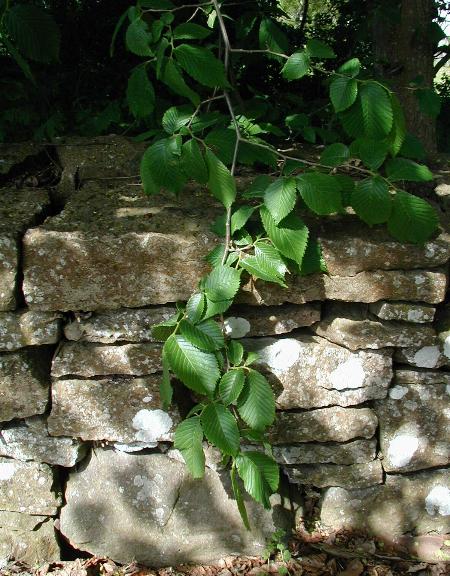
The wych elm is a native elm of cool, moist woods on slopes and in stream valleys. You can recognise it by its very large leaf, as rough as sandpaper, with a lopsided base that covers the short leaf stalk and often three points at the tip. Left to grow freely it reaches 20–30 m with a crown of about 15 m: too big for an ordinary garden. It is very susceptible to Dutch elm disease, so old trees have become rare. Unlike field elm it does not form root suckers: it regenerates only from seed.
Caution: Very susceptible to Dutch elm disease; old trees have become rare. Only prune in winter, and clear away diseased and dead elm wood quickly: burn it or strip the bark.
Light
Sun or partial shade
preferably some sun
Moisture
Normal
no wet feet
Legal basis
Any garden soil
any pH
Hardiness
Throughout Belgium
no protection needed
Size
20–30 m
tall
Flowering
March
| Pruning months | November–February |
|---|---|
| Height | 20–30 m |
| Native to Belgium | Yes |
| Poisonous to people and pets | Not known to be poisonous |
| Flowering | March |
Identify
Wych elm: how do you recognise it?
- Habit
- Tree of 20–30 m with a broad crown of about 15 m; the trunk stays smooth and grey for a long time.
- Leaves
- Alternate, 8–16 cm, broadly obovate with a long pointed tip, often with two extra side points; double-toothed. Upper side as rough as sandpaper. The larger half of the leaf covers the very short stalk (2–5 mm) with an ear lobe.
- Bark
- Smooth and grey for a long time, only later furrowed into broad, shallow ridges; young twigs thick and hairy, without corky ridges.
- Flowers
- Clusters of small reddish-purple flowers in February–March, before the leaves.
- Fruit
- Large (1.5–2.5 cm), round winged fruits with the seed in the middle; ripe in May–June.
- Difference from field elm
- Field elm has a smaller, smooth and glossy leaf on a longer stalk, often corky ridges, and the seed close to the notch of the fruit.
- Difference from Dutch elm
- Dutch elm, a cross with field elm, has a smaller, less rough leaf on a distinct stalk.
- Difference from hazel
- Hazel has a round, softly hairy leaf with a heart-shaped base and is a multi-stemmed shrub.
Flowering: March · Pruning: November–February
Identify by feature: Lopsided leaf base · Winged seeds
Looks like it, but isn’t
- Field elm Ulmus minor: smaller, smooth and glossy leaf on a longer stalk, often corky ridges, and the seed close to the notch of the fruit. Difference from field elm
- Dutch elm Ulmus × hollandica: a cross with field elm: smaller, less rough leaf on a distinct stalk. Difference from Dutch elm
- Hazel Corylus avellana: round, softly hairy leaf with a heart-shaped base; a multi-stemmed shrub. Difference from hazel
In your garden
Why grow it?
- Food plant of the rare white-letter hairstreak; its large seeds feed finches and mice.
- A native tree with the largest and roughest leaves of our elms and yellow autumn colour.
- Flowers as early as February–March, before the leaves: an early source of pollen.
- Does not form root suckers, unlike field elm.
Wych elm: where does it grow best?
- Sun to partial shade; when young it tolerates quite a lot of shade.
- Fertile, moisture-retentive soil such as loam or clay; chalk is no problem.
- A cool, sheltered spot such as a slope or a stream valley; hot, dry places do not suit it.
- Allow for 20–30 m in height and a crown of about 15 m: only for a park or a large garden. Because of Dutch elm disease, you are better off planting a resistant cultivar or a European white elm.
- Light
- Sun or partial shade
- Legal basis
- Any garden soil
- Moisture
- Normal
- Size
- 25 m tall, 15 m wide
- Hardiness
- Throughout Belgium, no protection needed
Goes well with
- Large-leaved lime: Grows naturally alongside wych elm in cool woods on slopes and in stream valleys.
- Sycamore: Another tree of the same cool woodland on slopes, with yellow autumn colour.
- Hazel: Forms the shrub layer in the same woods and, like the elm, flowers in late winter.
Good and bad companions
Goes well with
- Tolerate the shade under this tree: oregon grape, rhododendron, oleaster, japanese skimmia, garden privet, camellia, laurustinus, box-leaved honeysuckle
Maintenance
Wych elm: when and how to plant it?
- Plant from November to March, when the ground is not frozen.
- A wych elm grown from seed or taken from the wild is not resistant to Dutch elm disease. If you want an elm that lasts, choose a resistant cultivar or a European white elm.
- Tie a young tree to a stake and keep the base free of grass for the first few years.
- Water after planting and during dry spells in the first summers.
Care
- Watering
- In dry spells during the first few years; later too it likes moist soil.
- Feeding
- Not needed in ordinary garden soil.
- Checking
- In June–July, look out for branches that suddenly wilt and turn yellow or brown: the first sign of Dutch elm disease.
- Elm wood
- Don’t leave pruned branches or felled wood with bark lying around the garden: the elm bark beetle breeds in it.
Tip: Want to give wych elm a place without a big tree? The weeping form ‘Camperdownii’ stays small and forms an umbrella of hanging branches, but it is also susceptible to Dutch elm disease. For an elm that lasts, a European white elm or a resistant cultivar is a better choice.
Wych elm: when to prune it?
Pruning months: November–February.
When: Only in winter (November–February).
How:
- In spring and summer, fresh pruning wounds attract the elm bark beetle, which spreads Dutch elm disease: so never prune during the growing season.
- Give a young tree a single central leader and remove crossing branches; otherwise little pruning is needed.
- Remove diseased branches from the site and disinfect your tools after each tree.
Caution: Brown, wilted leaves suddenly hanging in the crown in summer? It is probably Dutch elm disease: have the tree inspected.
Propagation
- Sowing
- The large fruits ripen in May–June and only stay viable for a short time: sow them straight away, on the surface of moist soil. A seedling is not resistant to Dutch elm disease.
- Grafting
- The weeping form ‘Camperdownii’ is grafted onto a wych elm stem; that is a job for the nursery.
Wych elm: how does it get through the winter?
Hardy throughout Belgium: no protection needed.
- Fully hardy.
- Winter is the only good season for pruning; the first reddish-purple flowers already appear in late February.
Diseases and pests
- Dutch elm disease: Leaves on one branch or across the whole crown wilt in June–July, turn yellow to brown and often stay hanging; under the bark you see brown streaks in the wood. There is no cure: have the tree felled and clear away the wood with bark quickly.
- Elm bark beetle: A small bark beetle that breeds in diseased and dead elms. The young beetles fly out and carry the fungal spores to healthy trees. Clear away dead elm wood.
- Leaf galls: Rolled leaves or galls on the leaf, caused by aphids. Harmless.
- Drought: Brown leaf edges and early leaf fall in hot, dry summers. Water young trees and choose a cool, moist spot.
Through the year
- January: Prune, only now in winter; remove the prunings from the site.
- February: Last month for pruning; the first flowers appear.
- March: Flowers before the leaves; still planting season.
- May: Fruits ripe (May–June): sow straight away.
- June: Look out for wilting branches (Dutch elm disease); do not prune.
- July: Check again for Dutch elm disease; water young trees in dry spells.
- October: Yellow autumn colour.
- November: Planting season; pruning is possible again.
- December: Prune in winter; clear away dead elm wood.
Use
What can you use it for?
- Wood
- Tough, beautifully figured wood that does not rot when wet: once used for wheel hubs, water pipes and furniture.
- For wildlife
- Food plant of the white-letter hairstreak; its large seeds feed finches and mice.
Caution: Very susceptible to Dutch elm disease; old trees have become rare.
You and this species
Did you know?
- Unlike field elm, it does not form root suckers: it regenerates only from seed.
- Its tough, beautifully figured wood does not rot when kept wet: it was once used for wheel hubs, water pipes and furniture.
- The white-letter hairstreak, a small brown butterfly with a white W-shaped line on the underside of its hindwing, lives in the crowns of elms.