Side by side
Heather or winter heath? How to tell them apart
Calluna vulgaris · Erica carnea
How to tell them apart – heather: scale-like leaves in four rows, flowers in late summer; winter heath: low, evergreen heath that flowers pink, purple or white in the middle of winter, with dark anthers sticking out of the bells.
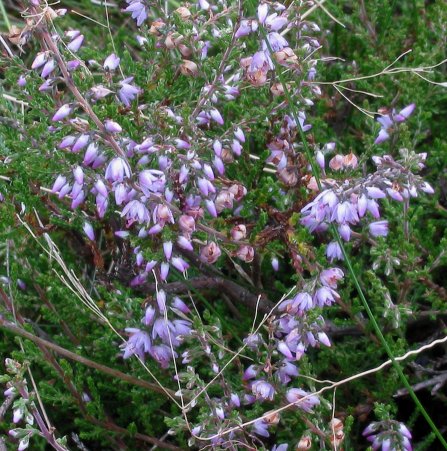


How do you recognise them?
- Heather
- Dwarf shrub with tiny scale-like leaves and small purple flowers in August.
- Compared with winter heath: scale-like leaves in four rows; flowers in late summer.
- Winter heath
- Low, evergreen heath that flowers pink, purple or white in the middle of winter, with dark anthers sticking out of the bells.
| Heather | Winter heath | |
|---|---|---|
| Leaves | Tiny, scale-like leaves (1–3 mm) in four rows, pressed close to the shoots. | Needle-like, 4–8 mm, hairless and dark green, in whorls of four. |
| Flowering | Small lilac (sometimes white) bells in long spikes, August–September (August–October). | Urn-shaped bells (5–6 mm) in one-sided spikes, December–April, with protruding brown anthers. The buds are already formed in summer (January–April). |
| Fruit | Small capsules. | Small capsules. |
| Bark | Thin, tough, woody stems. | Thin, trailing to ascending stems. |
| Shape and height | Dwarf shrub, 0.2–1 m | Dwarf shrub, 15–30 cm |
| Site | Full sun, acid soil, dry | Sun or partial shade, any garden soil, normal |
| Native to Belgium | Yes | No, planted |
| Good for bees, butterflies and birds | Yes, for bees and butterflies | – |
| Poisonous to people and pets | Not known to be poisonous | Not known to be poisonous |
| Pruning months | March–April | April–May |
What does it mean for your garden?
- Heather is native: it feeds more insects and birds than a non-native species. If in doubt, choose this one.
Read on
- Plant profile: Heather
- Plant profile: Winter heath
- Heather: when and how to prune
- Winter heath: when and how to prune
- Identification key
Also looks like
This comparison is compiled from the Bladwijzer species pages.