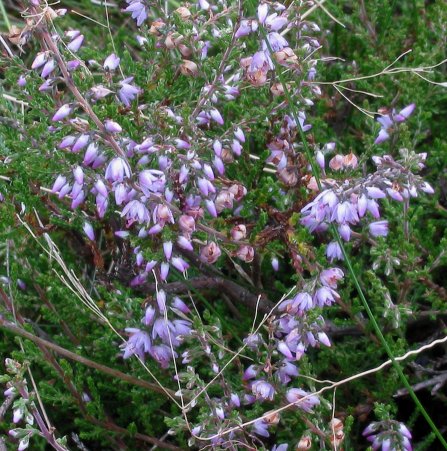
Photo: Rasbak at Dutch Wikipedia, CC BY-SA 3.0 · source

Pruning guide · Dwarf shrub
Heather (ling): when and how to prune
Calluna vulgaris
Prune heather after winter, in March–April: cut off the faded flower spikes just below the flowers, but never cut into the old, bare wood.
Heather, or ling, is the native dwarf shrub that turns the heathland purple in August–September. In the garden it forms a low, evergreen carpet on acid, poor soil. Without pruning it becomes woody and bare in the middle after a few years, and an old plant barely rejuvenates. A light trim every year keeps the plant dense, young and full of flowers. The secret: always stay in the green, never in the bare wood.
| Pruning months | March–April |
|---|---|
| Flowering | August–October |
| Good for bees, butterflies and birds | Yes, for bees and butterflies |
| Native to Belgium | Yes |
Heather (ling): when to prune it?
Prune after winter, in March–April, when the hard frosts are over and the plant starts growing again.
Leave the faded spikes all winter: they protect the plant from frost, look lovely with hoar frost and give insects shelter.
Don’t prune in autumn: any young shoots that still appear will be killed by frost in winter.
Heather (ling): how to prune it?
- Cut off the faded flower spikes just below the lowest dried flowers. That leaves green leaves from which the plant sprouts again.
- Trim a larger area with hedge shears, in a gently undulating line: that looks more natural than a flat slab.
- Never cut into the old, bare wood without leaves: heather sprouts poorly or not at all from there.
- Rather replace an old, woody plant that has gone bare with a young one: it barely rejuvenates.
- In a large heather garden, don’t trim everything in the same year: leave part of it for two years, so there is always some older, denser heather too.
How much to cut, and how often?
- Every year the faded spikes, just below the flowers.
- Nothing more: heather needs neither fertiliser nor hard pruning.
What does it mean for wildlife?
- March–April falls at the start of the nesting season (from 15 March). A nest in a low clump of heather is rare in a garden, but do take a look before running the shears over a large area.
- In August–September heather is a late, rich source of nectar for honeybees, bumblebees and wild bees. The heather colletes, a solitary bee, collects its pollen mainly from heather.
- Bud-flowering varieties, whose flowers stay closed, offer bees nothing. For wildlife, choose varieties that really open, or wild heather.
- The caterpillars of several moths live on heather, and the silver-studded blue lays its eggs on it. Leave the faded spikes until March: spiders and small insects spend the winter in them.
Common mistakes
- Not pruning for years, so the plant becomes woody and bare.
- Cutting into the old, bare wood, so the plant doesn’t sprout again.
- Pruning in autumn, so the young shoots get frosted.
- Feeding or liming after pruning: heather sickens from it.
Caution: Leave the faded spikes on over winter: they protect the plant from frost and look lovely with hoarfrost.
Nearby: related pruning guides
Similar to: Difference from cross-leaved heath · Difference from crowberry · Difference from tamarisk · Difference from winter heath
Plant profile: Heather (ling) · Pruning calendar and basic rules