Side by side
Heather or cross-leaved heath? How to tell them apart
Calluna vulgaris · Erica tetralix
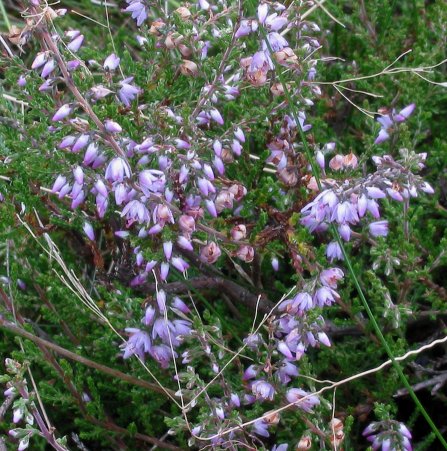
You can tell a heather by its tiny scale leaves in four rows against the twigs and its lilac flowers in long spikes in August–September; a cross-leaved heath has greyish-green, hairy needle leaves in whorls of four and pink bells in clusters at the tips.
Look at where they grow: heather on dry heath, cross-leaved heath on wet heath and around pools. Up close: small lilac flowers spread along long spikes on the heather, a cluster of large pink bells at the top on the cross-leaved heath.


| Heather | Cross-leaved heath | |
|---|---|---|
| Leaves | Tiny, scale-like leaves (1–3 mm) in four rows, pressed close to the shoots. | Needle-like leaves of 3–5 mm in whorls of four, grey-green with glandular hairs. |
| Flowering | Small lilac (sometimes white) bells in long spikes, August–September (August–October). | Pink, egg-shaped bells in small clusters at the shoot tips, June–September (June–September). |
| Fruit | Small capsules. | Small capsules. |
| Bark | Thin, tough, woody stems. | Thin, hairy stems. |
| Shape and height | Dwarf shrub, 0.2–1 m | Dwarf shrub, 20–50 cm |
| Site | Full sun, acid soil, dry | Full sun, acid soil, moist to wet |
| Native to Belgium | Yes | Yes |
| Good for bees, butterflies and birds | Yes, for bees and butterflies | Yes, for bees and butterflies |
| Poisonous to people and pets | Not known to be poisonous | Not known to be poisonous |
| Pruning months | March–April | March–April |
The best feature in each season
- Spring
- Both start growing again in April. The greyish-green, hairy leaves of the cross-leaved heath stand in whorls of four, the leaves of the heather lie like scales in four rows against the twig.
- Summer
- The cross-leaved heath flowers first, from June to September, with pink, egg-shaped bells; heather turns the heath lilac in August–September.
- Autumn
- Heather flowers into October and then stays brownish lilac with its faded flowers; the cross-leaved heath carries dry, brown bells at the tips.
- Winter
- Both are evergreen dwarf shrubs. Heather grows taller, up to 1 m, and is tough and woody; the cross-leaved heath stays low, 20–50 cm, with hairy little stems.
Where do they grow?
Both are native. Heather is the image of the dry heath in the Campine and on the Veluwe; the cross-leaved heath grows on wet, acid heath, around pools and in raised bogs. Where dry and wet heath merge, they grow side by side.
Which one for your garden?
- Both need sun and acid soil: heather on dry sand, cross-leaved heath on moist to wet soil. In a garden on chalky or ordinary soil they dwindle away; choose a winter-flowering heath instead.
- For bees and butterflies both are valuable, heather especially in late summer. Trim them lightly in March–April, so they stay dense and flower well.
Did you know? Heather honey is a speciality of the Campine: so thick that beekeepers have to stir it loose before they can extract it.
Read on
- Plant profile: Heather
- Plant profile: Cross-leaved heath
- Heather: when and how to prune
- Cross-leaved heath: when and how to prune
- Identification key: the question that separates them