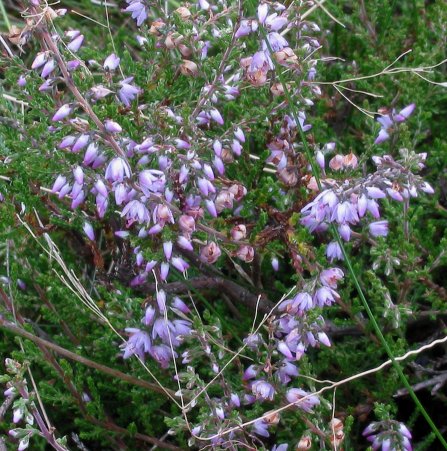
Photo: Rasbak at Dutch Wikipedia, CC BY-SA 3.0 · source

Dwarf shrub · Heather family (Ericaceae)
Heather
Calluna vulgaris · also: Ling, Common heather
Heather is the native dwarf shrub that turns the Campine heathland purple in August–September. It grows 0.2–1 m tall, with tiny scale-like leaves and long spikes of lilac, sometimes white, bells. It is a rich, late source of nectar for bees and bumblebees, and a food plant for many insects. In the garden, heather forms a low, evergreen carpet for sunny spots with acid, poor and dry soil, for instance near pines and birches. On chalk or in wet clay it struggles: choose a different plant there.
Light
Full sun
warm and bright
Moisture
Dry
tolerates drought
Legal basis
Acid soil
acid
Hardiness
Throughout Belgium
no protection needed
Size
0.2–1 m
tall
Flowering
August–October
| Pruning months | March–April |
|---|---|
| Height | 0.2–1 m |
| Native to Belgium | Yes |
| Good for bees, butterflies and birds | Yes, for bees and butterflies |
| Poisonous to people and pets | Not known to be poisonous |
| Flowering | August–October |
Identify
Heather: how do you recognise it?
- Habit
- Dwarf shrub of 0.2–1 m with tough, much-branched stems.
- Leaf
- Tiny, scale-like leaves (1–3 mm) in four rows, pressed close to the shoots; evergreen.
- Bark
- Thin, tough, woody stems.
- Flower
- Small lilac (sometimes white) bells in long spikes, August–September.
- Fruit
- Small capsules.
- Difference from cross-leaved heath
- Cross-leaved heath (Erica tetralix) has needle-like leaves in whorls of four and larger pink bells; it grows on wet heath.
Flowering: August–October · Harvest and fruit: August–September · Pruning: March–April
Identify by feature: Purple or blue flowers
Looks like it, but isn’t
- Cross-leaved heath (Erica tetralix): needle-like leaves in whorls of four and larger pink bells; on wet heath.
In your garden
Why grow it?
- Purple flowers in August–September, when there is little other nectar for bees and bumblebees.
- Native, and a food plant for many insects.
- A low, evergreen carpet for poor, dry, sandy soil, where little else will grow.
- Little work: one trim a year and no fertiliser.
Heather: where does it grow best?
- Full sun; in shade it becomes straggly and flowers poorly.
- Acid, poor, free-draining soil, such as sand; no lime and no wet feet.
- On clay or chalky soil: build a raised bed of acid, sandy soil, or grow it in a pot.
- Allow 0.5–0.6 m width per plant; in groups it forms a closed carpet.
- Light
- Full sun
- Legal basis
- Acid soil
- Moisture
- Dry
- Size
- 0.8 m tall, 0.6 m wide
- Hardiness
- Throughout Belgium, no protection needed
Goes well with
- Scots pine: A pine at the edge of the heather garden adds acid needle litter and the look of the Campine heath.
- Common juniper: A native, prickly conifer that rises like a dark column above the heather.
- Winter heath: Flowers in winter and early spring, while heather rests: together, colour almost all year round.
- Cowberry: A native, evergreen dwarf shrub for the same acid soil, with red berries.
Good and bad companions
Goes well with
- Likes the acid soil near: scots pine, black pine, weymouth pine, english oak, sessile oak, giant redwood
- Like acid soil, just like this plant: rhododendron, japanese skimmia, raspberry, highbush blueberry, witch hazel, broom, gorse, camellia
Best kept away from
- Walnut releases juglone, to which this plant is sensitive: walnut
- Do not plant under the dense crown of these trees: norway spruce, european silver fir, nordmann fir, douglas fir, yew, horse chestnut, norway maple, sycamore
Maintenance
Heather: when and how to plant it?
- Plant in spring (March–May) or early autumn (September–October).
- Space plants 30–40 cm apart, in groups of one variety for a calm effect.
- Plant slightly deeper than in the pot, up to just below the lowest shoots: they will root as well.
- Loosen the root ball a little and water well after planting; don’t add fertiliser or lime.
Care
- Watering
- Regularly in the first year, as the root ball dries out quickly; after that only in long dry spells. Rainwater is best.
- Feeding
- Not needed: heather likes poor soil. Fertiliser makes it floppy and prone to disease.
- Mulching
- A thin layer of pine bark or pine needles keeps the soil acid, moist and weed-free.
- Weeding
- Pull out grasses and birch and pine seedlings in good time, or they will overgrow the carpet.
Tip: Mix several varieties: some have golden, orange or grey foliage, and bud-bloomers stay colourful into winter. That way your carpet stays lively outside the flowering season too.
Heather: when to prune it?
Pruning months: March–April.
When: In March–April, after winter.
How:
- Clip off the faded flower spikes just below the flowers to keep the plant dense and young.
- A larger area can be trimmed with shears, following a gently undulating line.
- Don’t cut into old, bare wood: heather regrows poorly from it, if at all.
Caution: Leave the faded spikes on over winter: they protect the plant from frost and look lovely with hoarfrost.
Propagation
- Cuttings
- In July–August, take 3–5 cm cuttings from non-flowering shoots and insert them in a mix of ericaceous compost and sand; keep them moist under glass or plastic.
- Layering
- In spring, press a few low shoots into the soil and cover them with sandy soil; after a year you can cut them free with their roots.
Heather: how does it get through the winter?
Hardy throughout Belgium: no protection needed.
- Fully hardy and evergreen.
- In hard frost without snow and with bright sun, the foliage can dry out and turn brown; water plants in pots now and then on frost-free days.
- Bud-bloomers, varieties whose flowers stay in bud, keep their colour well into autumn and winter.
Diseases and pests
- Lime or fertiliser: Yellow, sickly plants. Heather can’t tolerate lime or fertiliser: plant it in acid soil and water with rainwater.
- Wet feet: Root rot: the plants turn grey and die. Make sure the soil is free-draining and sandy.
- Bare, woody plants: Happens when you don’t trim for years. An old plant barely rejuvenates: replace it with a young one.
- Heather beetle: Small beetles and their larvae eat the foliage, which turns greyish-brown. Mainly on large heathlands; in the garden, cut out affected parts.
Through the year
- March: Trim off the faded spikes. Planting possible.
- April: Last month for trimming; planting and layering.
- June: Water in dry spells, especially young plants.
- July: Take cuttings from non-flowering shoots.
- August: Flowering: plenty of bees and bumblebees.
- September: Flowering continues; planting possible again.
- October: Planting and mulching with pine bark.
- December: Leave the faded spikes on as protection.
Use
What can you use it for?
- Garden and landscape
- Low, flowering carpet for dry, acid soil; lovely with pines, birches and blueberries.
- For wildlife
- An important late source of nectar for bees (heather honey) and a food plant for many insects.
Edible and useful
- Flowers (August–September)
- In August and September, cut flowering tips of heather from your own garden. Dried, they make a mild, slightly floral herbal tea, on their own or in a blend. In Scotland, heather was once used to flavour beer.
- Storing
- Dry the tips in small bunches or on a rack in an airy, shady place. Then rub off the flowers and leaves and keep them in a closed jar away from the light for up to a year.
- Fermenting
- In Scotland, ale was once brewed with flowering heather tips instead of, or alongside, hops.
Caution: Do not pick heather in nature reserves: heathland is protected there and picking is forbidden. Make sure it is ling heather (Calluna vulgaris) and do not use other members of the heather family: relatives such as pieris and rhododendron are poisonous. Drink herbal teas in moderation.
Eating and using is at your own risk: see the terms of use.
Recipes
- Heather flower tea (Tea · 1 cup · 5 min + 5–10 min steeping)
- Heather flower syrup (Syrup · ± 500 ml · 20 min + 12 hrs steeping)
- Apple jelly with heather flowers (Jelly · ± 4 jars of 250 ml · 1 hr 15 min + 3 hrs draining)
Good for wildlife
- Bees
- Nectar and pollen for honeybees and wild bees.
- Caterpillars
- Host plant: caterpillars of butterflies or moths eat the leaves.
- Bumblebees
- Nectar and pollen for bumblebees, also from deep flowers and early in spring.
- Butterflies
- Nectar for butterflies.
You and this species
Did you know?
- The classic image of the Campine heathland; heather honey is a local speciality.
- Heathland is a cultural landscape: it stayed open because farmers grazed sheep on it and cut turf there as bedding for their livestock.
- Brooms used to be made from the tough stems; the name Calluna comes from a Greek word for sweeping or cleaning.
- Calluna comes from the Greek kallunein, ‘to sweep clean’: its twigs were used to make brooms.
- Heathland is largely man-made: for centuries sheep grazed it and farmers cut turfs from it for animal bedding. Without management it fills in with birch and pine.