Side by side
Silver lime or large-leaved lime? How to tell them apart
Tilia tomentosa · Tilia platyphyllos
How to tell them apart – silver lime: lime whose leaves are silvery-white felted underneath, in the wind the crown seems to shimmer; large-leaved lime: underside of the leaf green and softly hairy, not silvery white, flowers as early as late June.
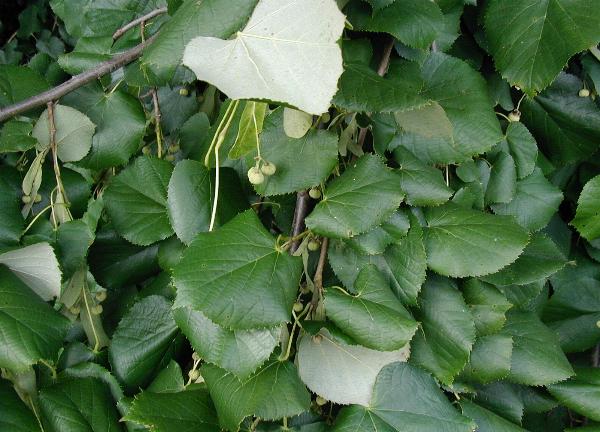


How do you recognise them?
- Silver lime
- Lime whose leaves are silvery-white felted underneath: in the wind the crown seems to shimmer.
- Large-leaved lime
- Large, lopsided heart-shaped leaf with a softly hairy underside and white tufts of hair in the vein axils.
- Compared with silver lime: underside of the leaf green and softly hairy, not silvery white; flowers as early as late June.
| Silver lime | Large-leaved lime | |
|---|---|---|
| Leaves | Alternate, 8–12 cm, rounded heart-shaped with a short pointed tip, sharply toothed; dark green above, silvery-white felted below with star-shaped hairs. Leaf stalk shorter than half the blade. | Alternate, lopsided heart-shaped, 6–15 cm, finely toothed. Underside light green and softly hairy all over, with white tufts of hair in the vein axils. |
| Flowering | Hanging clusters of 5–10 strongly scented, yellowish-white flowers, late July–August: the last lime to flower (July–August). | Clusters of 2–5 fragrant yellow flowers on a tongue-shaped bract, in late June (June). |
| Fruit | Egg-shaped, felted nutlets with five faint ribs. | Hard, globular nutlets with 5 distinct ribs. |
| Bark | Grey, smooth for a long time, later with a regular network of shallow ridges; young twigs white-felted. | Grey, finely fissured. Young twigs hairy. |
| Shape and height | Broadleaf tree, 20–30 m | Broadleaf tree, 25–35 m |
| Site | Full sun, any garden soil, dry | Sun or partial shade, any garden soil, normal |
| Native to Belgium | No, planted | Yes |
| Good for bees, butterflies and birds | – | Yes, for bees and butterflies |
| Poisonous to people and pets | Not known to be poisonous | Not known to be poisonous |
| Pruning months | November–March | November–March |
What does it mean for your garden?
- Large-leaved lime is native: it feeds more insects and birds than a non-native species. If in doubt, choose this one.
- Silver lime (20–30 m) and large-leaved lime (25–35 m) both grow into large trees: too big for an ordinary garden, but fine in a large garden, a park or a meadow.
Read on
- Plant profile: Silver lime
- Plant profile: Large-leaved lime
- Silver lime: when and how to prune
- Large-leaved lime: when and how to prune
- Identification key
Also looks like
- Large-leaved lime or small-leaved lime
- White poplar or silver lime
- Hazel or large-leaved lime
- Common lime or large-leaved lime
- Indian bean tree or large-leaved lime
- Handkerchief tree or large-leaved lime
- Large-leaved lime or black mulberry
Identify by feature
This comparison is compiled from the Bladwijzer species pages.