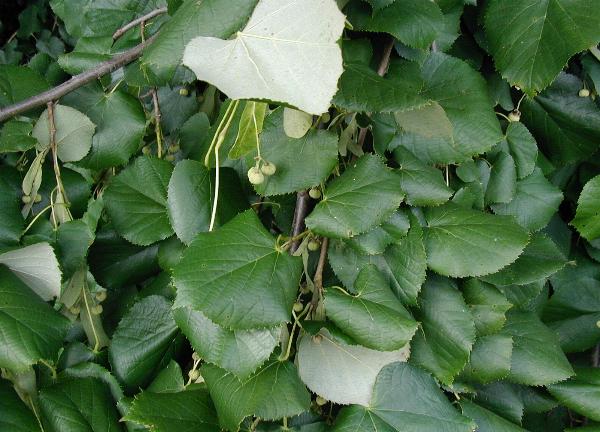
Photo: Wikimedia Commons, CC BY-SA 3.0 · source

Broadleaf tree · Mallow family (Malvaceae)
Silver lime
Tilia tomentosa · also: Silver linden
Silver lime is a stately lime of 20–30 m from south-eastern Europe and western Turkey, with a dense, regular crown. You recognise it by its leaves, which are silvery-white felted underneath: in the wind the whole crown seems to shimmer. It is the last lime to flower, in late July–August, and is then strongly scented. Because it copes well with heat, drought and urban air and is little troubled by aphids, it is a popular street and park tree. With a crown about 15 m across it is too big for an ordinary garden: plant it in a park, an avenue or a very large garden.
Caution: Many dead bumblebees are sometimes found under the flowering tree; plant other summer-flowering plants nearby.
Light
Full sun
warm and bright
Moisture
Dry
tolerates drought
Legal basis
Any garden soil
any pH
Hardiness
Throughout Belgium
no protection needed
Size
20–30 m
tall
Flowering
July–August
| Pruning months | November–March |
|---|---|
| Height | 20–30 m |
| Native to Belgium | No, planted |
| Poisonous to people and pets | Not known to be poisonous |
| Flowering | July–August |
Identify
Silver lime: how do you recognise it?
- Habit
- Tree of 20–30 m with a dense, broadly conical to oval crown about 15 m across.
- Leaf
- Alternate, 8–12 cm, rounded heart-shaped with a short pointed tip, sharply toothed; dark green above, silvery-white felted below with star-shaped hairs. Leaf stalk shorter than half the blade.
- Bark
- Grey, smooth for a long time, later with a regular network of shallow ridges; young twigs white-felted.
- Flower
- Hanging clusters of 5–10 strongly scented, yellowish-white flowers, late July–August: the last lime to flower.
- Fruit
- Egg-shaped, felted nutlets with five faint ribs.
- Difference from large-leaved lime
- Large-leaved lime has a green, softly hairy leaf underside, not silvery white, and flowers as early as late June.
- Difference from white poplar
- White poplar is also white underneath, but the leaf is lobed or wavy-toothed and the trunk whitish grey.
Flowering: July–August · Harvest and fruit: July–August · Pruning: November–March
Identify by feature: Heart-shaped leaves · White or silver underside
Looks like it, but isn’t
- Large-leaved lime Tilia platyphyllos: underside of the leaf green and softly hairy, not silvery white; flowers as early as late June. Difference from large-leaved lime
- White poplar Populus alba: also white underneath, but the leaf is lobed or wavy-toothed and the trunk whitish grey. Difference from white poplar
In your garden
Why grow it?
- A crown that shimmers silver when the wind runs through the leaves.
- The last lime to flower, in late July–August: late nectar for bees and bumblebees.
- Copes with heat, drought and urban air better than our native limes.
- Few aphids, and so little sticky honeydew.
Silver lime: where does it grow best?
- Full sun.
- Almost any free-draining soil, including dry and chalky soil; copes well with drought and heat.
- A good tree for towns: it tolerates urban air and the heat between buildings.
- Allow for 20–30 m in height and a crown about 15 m across: only for a park, an avenue, a square or a very large garden.
- Light
- Full sun
- Legal basis
- Any garden soil
- Moisture
- Dry
- Size
- 25 m tall, 15 m wide
- Hardiness
- Throughout Belgium, no protection needed
Goes well with
- Small-leaved lime: It flowers in July, silver lime in August: together they extend the lime flowering season for bees.
- Japanese pagoda tree: Flowers in August–September: even more late nectar for bees and bumblebees.
- Common ivy: Flowers in autumn as one of the last nectar sources, and covers the ground in the shade under the crown.
Good and bad companions
Goes well with
- Tolerate the shade under this tree: oregon grape, rhododendron, oleaster, japanese skimmia, garden privet, camellia, laurustinus, box-leaved honeysuckle
Best kept away from
- Sun-loving plants get too little light under the dense crown: english lavender, heather, butterfly bush, blackthorn, highbush blueberry, sea buckthorn, japanese rose, broom
Maintenance
Silver lime: when and how to plant it?
- Plant from November to March when the ground isn’t frozen.
- Choose a young root-balled or bare-root tree; avenues are often planted with cultivars that have a regular crown, such as ‘Brabant’.
- Stake the tree on the windward side and remove stake and tie after 2–3 years.
- Water generously after planting and during dry spells in the first two or three summers.
Care
- Watering
- In dry spells during the first few years; an established tree is very drought-tolerant.
- Feeding
- Not needed; a thin layer of compost around the base is enough.
- Shape
- Leave the natural conical shape; a street tree can be crown-lifted gradually.
- Bumblebees
- Plant other summer-flowering plants nearby so that bumblebees find enough food in August.
Tip: If you plant a silver lime for bees, make sure there are other flowers nearby in August too, such as a Japanese pagoda tree, lavender or summer-flowering perennials: that way the bumblebees find enough food.
Silver lime: when to prune it?
Pruning months: November–March.
When: During winter dormancy (November–March).
How:
- Little pruning needed; leave the natural conical shape.
- A street tree can be crown-lifted gradually: every few years, remove one or two of the lowest branches until you reach the height you want.
- Train a young tree on a single leader and remove crossing branches.
Caution: Don’t saw thick branches off an old tree: large wounds heal slowly. Leave heavy pruning to an arborist.
Propagation
- Sowing
- Limes germinate slowly and erratically: sow the fruits outdoors in a seed tray in autumn and be patient, as they often only come up in their second spring. Cultivars such as ‘Brabant’ are propagated vegetatively by the nursery.
Silver lime: how does it get through the winter?
Hardy throughout Belgium: no protection needed.
- Fully hardy.
- In winter you recognise it by its white-felted young twigs.
Diseases and pests
- Dead bumblebees: In August you sometimes find many dead bumblebees under the flowering tree. They have probably starved, because so late in summer there are few other flowers. Plant other summer-flowering plants nearby.
- Aphids: Little troubled, so little honeydew: that is why it is often planted along streets and over car parks.
- Drought in young trees: A newly planted tree needs water for the first few years; later it is very drought-tolerant.
- Lack of space: Silver lime grows tall and wide. Choose a spot that is big enough: hard pruning to keep it small spoils the tree.
Through the year
- January: Prune during winter dormancy, if needed.
- February: Pruning; planting season when it isn’t freezing.
- March: Last month for pruning and planting.
- May: The leaves unfold, with their silvery-white undersides.
- July: Water young trees in dry spells; flowering begins in late July.
- August: In full flower, buzzing with bees and bumblebees.
- October: Yellow autumn colour; the fruits fall: sow them.
- November: Planting season; pruning possible again.
- December: Crown-lift street trees during winter dormancy.
Use
What can you use it for?
- Garden and landscape
- Stately street and park tree that copes well with heat, drought and urban air; little troubled by aphids.
- For wildlife
- The last lime to flower, in August, when it attracts bees and bumblebees in huge numbers.
Caution: Many dead bumblebees are sometimes found under the flowering tree; plant other summer-flowering plants nearby.
Edible and useful
- Blossom (July–August)
- Pick the blossom in July and August: the silver lime is the last lime to flower. Choose a dry, sunny morning, when the flowers have just opened and smell strong, and pick the whole cluster together with its long, pale bract. Pick sparingly and only from branches you can reach safely, without climbing the tree: in August there are few other flowers and bees and bumblebees live off this tree. Lay the blossom loosely in a basket, never in a closed bag, as it quickly turns brown and musty. Use it the same day or dry it.
- Storing
- Process fresh blossom the same day; until then, lay it loosely on a cloth. Dry it in a thin layer on a cloth or rack, somewhere airy and shady or in a dehydrator at 35–40 °C, until crisp. Keep the dried blossom in a closed jar or paper bag, dry and dark. It keeps its scent for about a year, until the next flowering.
Caution: Use only fresh, fragrant blossom from true limes (Tilia); throw away blossom that is brown, musty, sticky or blackened with sooty mould. Recognise the silver lime by its heart-shaped leaves, white and felty underneath, and by its hanging flower clusters with a long, pale bract. Silver lime is a street and park tree: do not pick beside busy roads, where exhaust fumes and dog urine soil the blossom, or from sprayed trees, and ask the owner or the council for permission. Under the flowering tree you sometimes find dead bumblebees, probably starved, so pick very sparingly. If you are allergic to pollen, start with a small cup of tea. Never eat anything you have not identified with certainty.
Eating and using is at your own risk: see the terms of use.
Recipes
- Dried lime blossom (Dried · ± 1 jar of 500 ml · 15 min + 5–10 days drying)
- Lime blossom iced tea (Tea · ± 1 litre · 15 min + 2 hrs chilling)
- Lime blossom liqueur (Liqueur · ± 800 ml · 30 min + 2 weeks steeping)
- Lime blossom panna cotta (Dish · 4 servings · 20 min + 4 hrs chilling)
You and this species
Did you know?
- Under flowering silver limes you sometimes find many dead bumblebees. For a long time a poison in the nectar was suspected; now it is thought more likely that they starve, because so late in summer there are few other flowers.
- It comes from south-eastern Europe, including the Balkans and Hungary, and from western Turkey.
- The silvery-white underside of the leaf comes from a felt of star-shaped hairs, which you can see clearly with a hand lens.