Side by side
Large-leaved lime or small-leaved lime? How to tell them apart
Tilia platyphyllos · Tilia cordata
You can tell a large-leaved lime by its big leaf with a softly hairy underside and white tufts of hair in the vein axils; a small-leaved lime has a smaller leaf with a hairless, blue-green underside and rusty-brown tufts.
Turn a leaf over. Soft and lightly hairy all over, with white tufts: large-leaved lime. Hairless and blue-green, with rusty tufts: small-leaved lime. The leaf of the large-leaved lime is also bigger, 6–15 cm against 3–8 cm.

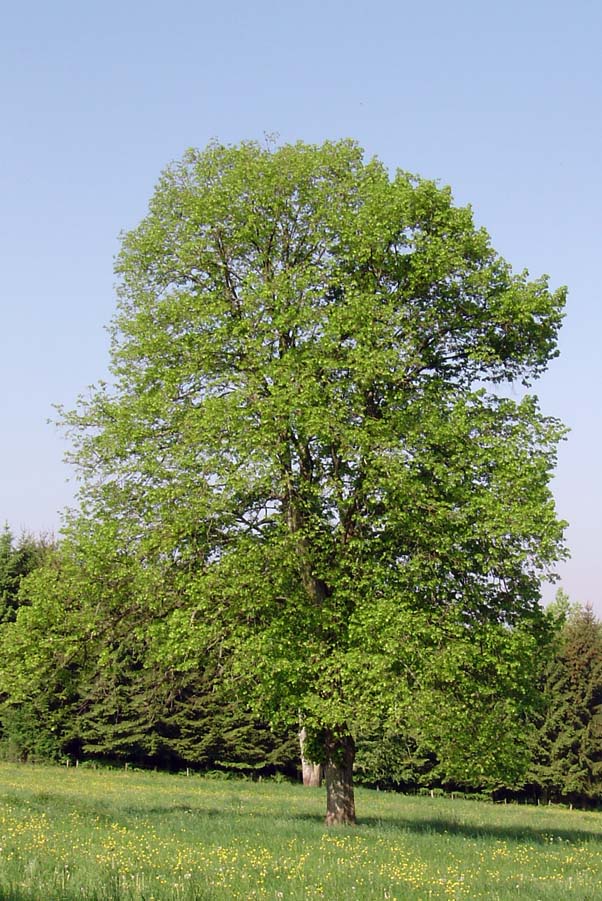


| Large-leaved lime | Small-leaved lime | |
|---|---|---|
| Leaves | Alternate, lopsided heart-shaped, 6–15 cm, finely toothed. Underside light green and softly hairy all over, with white tufts of hair in the vein axils. | Alternate, lopsided heart-shaped, 3–8 cm, finely toothed. Underside blue-green and hairless, with rusty-brown tufts of hair in the vein axils. |
| Flowering | Clusters of 2–5 fragrant yellow flowers on a tongue-shaped bract, in late June (June). | Clusters of 5–10 flowers on a tongue-shaped bract, in early July (July). |
| Fruit | Hard, globular nutlets with 5 distinct ribs. | Thin-walled nutlets without distinct ribs, easily crushed between your fingers. |
| Bark | Grey, finely fissured. Young twigs hairy. | Grey and finely fissured. |
| Shape and height | Broadleaf tree, 25–35 m | Broadleaf tree, 20–30 m |
| Site | Sun or partial shade, any garden soil, normal | Sun or partial shade, any garden soil, normal |
| Native to Belgium | Yes | Yes |
| Good for bees, butterflies and birds | Yes, for bees and butterflies | Yes, for bees and butterflies |
| Poisonous to people and pets | Not known to be poisonous | Not known to be poisonous |
| Pruning months | November–March | November–March |
The best feature in each season
- Spring
- The large-leaved lime comes into leaf slightly earlier, on hairy young shoots; the shoots of the small-leaved lime are hairless.
- Summer
- The large-leaved lime flowers in late June with clusters of 2–5 flowers, about two weeks before the small-leaved lime, which flowers in early July with 5–10 flowers per cluster.
- Autumn
- Squeeze a fruit: that of the large-leaved lime is hard, round and has 5 clear ribs; that of the small-leaved lime is thin-walled, without ribs, and breaks between your fingers.
- Winter
- Both have zigzag twigs with reddish buds. On the large-leaved lime the young twigs are hairy, on the small-leaved lime they are hairless. Fruits still lying under the tree give it away too.
Where do they grow?
Both are native. The large-leaved lime likes rich, chalky soil and grows on village squares, in churchyards, avenues and castle grounds. The small-leaved lime is less fussy: it grows on sand, loam and clay, in ancient woods and hedgerows. The common lime, a hybrid of the two, is the most widely planted street lime.
Which one for your garden?
- As free-standing trees they reach 20–35 m: too big for an ordinary garden. Trained as a pleached lime, a pollard or a hedge, they do fit, because both tolerate hard pruning.
- For bees, both are outstanding: planted together, they stretch the lime blossom over almost a month. Do not plant them over a terrace or drive: in summer, aphids drip sticky honeydew.
Did you know? The Latin name of the small-leaved lime, Tilia cordata, means heart-shaped lime; that of the large-leaved lime, Tilia platyphyllos, broad-leaved lime.
Read on
- Plant profile: Large-leaved lime
- Plant profile: Small-leaved lime
- Large-leaved lime: when and how to prune
- Small-leaved lime: when and how to prune
- Identification key: the question that separates them
Also looks like
- Hazel or large-leaved lime
- Common lime or large-leaved lime
- Indian bean tree or large-leaved lime
- Handkerchief tree or large-leaved lime
- Silver lime or large-leaved lime
- Large-leaved lime or black mulberry
- Common lime or small-leaved lime
- Katsura tree or small-leaved lime