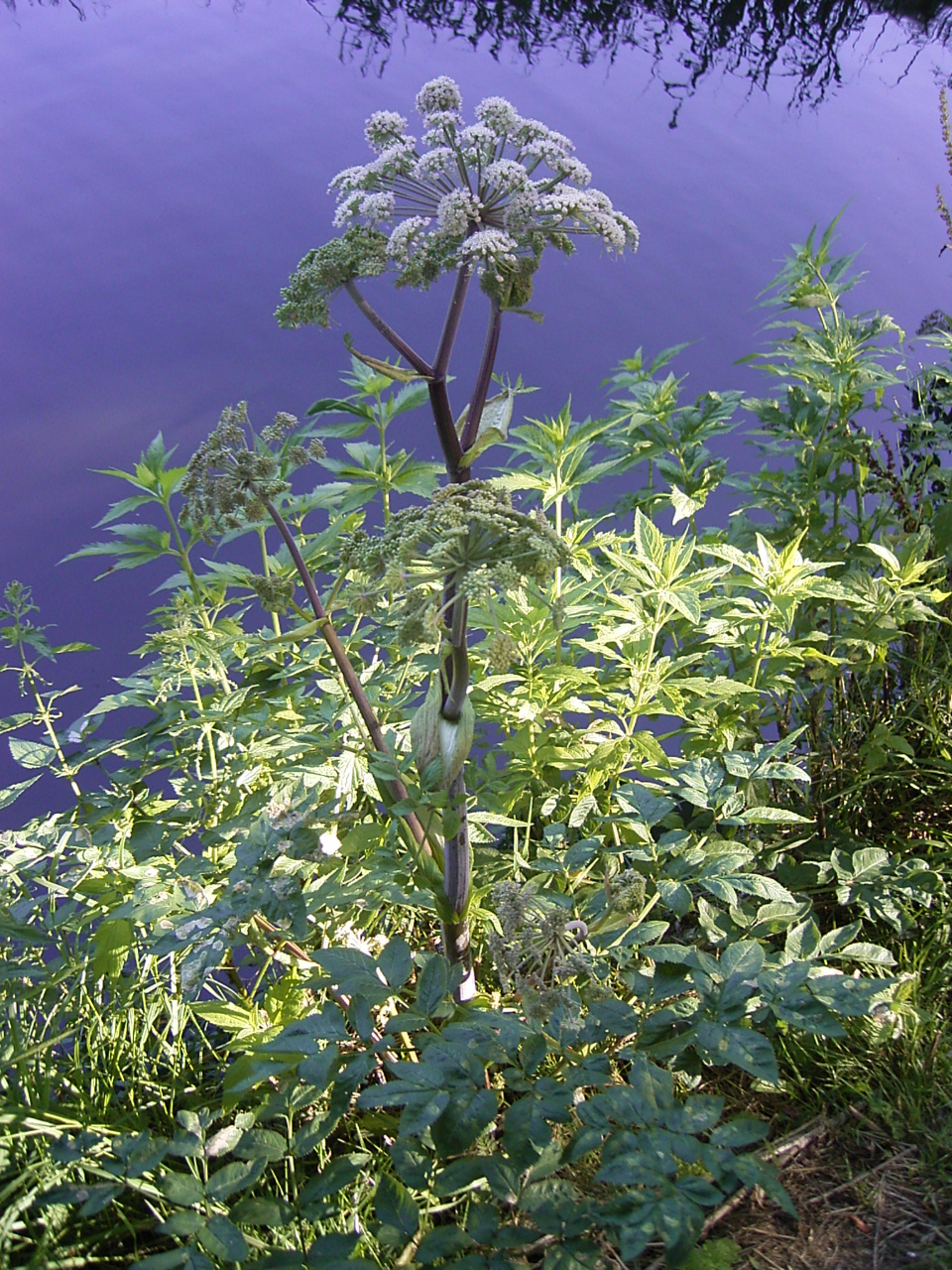
Photo: No machine-readable author provided. TeunSpaans assumed (based on copyright claims)., CC BY-SA 3.0 · source

Herbaceous plant · Carrot family (Apiaceae)
Wild angelica
Angelica sylvestris
In other languages: Gewone engelwortel (Nederlands) · Angélique sauvage (Français)
Grows wild in Belgium.
Wild angelica is a stately umbellifer of wet grassland, tall-herb vegetation, ditch banks, stream sides and damp woodland. In Belgium it is fairly common, especially in stream valleys and on moist, fertile soil. You recognise it by its thick, hollow, hairless stem, often flushed purple and covered with a white bloom, by its large leaves with inflated leaf sheaths and by its domed white to pinkish umbels, which flower from July to September. In late summer the umbels hum with insects: hoverflies, wasps, beetles and flies flock to them. For a wet wildlife garden or a pond edge it is a superb structural plant.
Caution: In combination with sunlight, angelica sap can irritate the skin or cause blisters, although far less severely than hogweed: wear gloves. Do not confuse the plant with giant hogweed, which is on the EU list of invasive species, or with the highly poisonous cowbane, which also grows in wet places.
Light
Sun or partial shade
preferably some sun
Moisture
Normal to wet
must not dry out
Hardiness
Fully hardy
down to -30 °C
Size
1.5 m
tall, 0.8 m wide
Flowering
July–September
| Pruning months | March and October |
|---|---|
| Height | 1.5 m |
| Native to Belgium | Yes |
| Flowering | July–September |
Identify
How to recognise it
- Growth habit
- Robust, often short-lived perennial; flowering stems of 1–2 m.
- Leaf
- Large, two to three times pinnate, with broad, oval, finely toothed leaflets. The leaf stalk is grooved on top; higher up, inflated, pouch-like sheaths surround the stem.
- Flower
- Domed umbels up to 15 cm across, white to pinkish, from July to September.
- Stem
- Thick, hollow, hairless and often flushed purple, with a white waxy bloom that rubs off.
- Fruit/seed
- Flat, oval fruits of 4–5 mm with broad wings; they float on water.
- Confusion with
- Hogweed has rough, hairy stems and broad, lobed leaves. Giant hogweed grows 3–4 m tall, with purple blotches and bristly hairs on the stem. Garden angelica has greenish-yellow flowers and a strong aromatic scent.
Flowering: July–September · Pruning: March and October
In your garden
Why grow it?
- One of the best nectar plants of late summer: from July to September the umbels attract a great variety of insects.
- Stately structure of 1.5–2 m for a pond edge, a wet meadow or a stream bank.
- The hollow stems give shelter to overwintering insects.
- The faded umbels with flat, winged seeds are decorative in autumn and winter.
- It flowers late, when many other wild flowers are over.
Wild angelica: where does it grow best?
- In the wild: wet and damp grassland, tall-herb vegetation, ditch banks, stream sides, alder woods and damp woodland edges.
- Sun to part shade.
- Moist to wet, fertile soil; wet feet are no problem.
- In the garden: at the edge of a pond, in a wet corner or a bog bed, with 80 cm of space around the plant.
Goes well with
- Meadowsweet: Creamy plumes in the same wet soil, flowering a little earlier.
- Purple-loosestrife: Purple spikes for contrast, a favourite of bees and butterflies.
- Hemp-agrimony: Pink flower clusters in late summer, much loved by butterflies.
- Yellow iris: For the pond edge, flowering in May–June.
- Common valerian: Pinkish-white flower clusters for a moist border.
Maintenance
Wild angelica: when and how to plant it?
- Buy a plant from a native plant nursery or sow seed of wild origin.
- Sow fresh seed in September–November where it is to grow or in a pot left outdoors: the seed needs a cold period and soon loses its viability.
- Press the seed in lightly, barely cover it and keep the soil moist.
- Plant young plants in spring or autumn, 60–80 cm apart, in moist soil.
- Water after planting and keep the soil moist during the first year.
- Never dig up plants from the wild.
Care
- Water
- Not needed in a wet spot. In an ordinary border, water generously in dry summers.
- Feeding
- Not needed; moist, humus-rich soil provides enough.
- Letting it seed
- Let a few umbels self-seed: the plant is often short-lived and seedlings take over.
- Mowing
- Only mow a wet hay meadow in October, after the seed has ripened, and remove the cuttings.
- Gloves
- Wear gloves when cutting: the sap can irritate the skin in sunlight.
Tip: Do not throw the old stems away in March: tie them into bundles and lay them in a sunny, dry spot, and you have a free insect hotel.
Pruning and mowing
Pruning months: March and October.
When: Remove the old stems in March; mow a wet hay meadow in October.
How:
- Leave the faded umbels and hollow stems standing all winter.
- In March, cut the old stems off at the base.
- Tie the cut hollow stems into bundles or stack them in a pile: insects overwintering inside can still crawl out.
- Mow a wet hay meadow in October, once the seeds are ripe, and remove the cuttings.
Caution: Wear gloves and long sleeves: in combination with sunlight, the sap can irritate the skin.
Propagation
- Seed
- Sow fresh seed outdoors in autumn. Dried seed that has been stored for a long time germinates poorly.
- Self-seeding
- In a moist, open spot it self-seeds; move seedlings while young, with a root ball.
Wild angelica: how does it get through the winter?
Hardy to −30 °C.
- The plant dies back above ground; the dry stems and umbels remain standing.
- Insects overwinter in the hollow stems.
- Fully hardy, to about −30 °C.
- After a generous flowering the plant sometimes dies completely; nearby seedlings then take over.
Diseases and pests
- Short-lived: After a few years of flowering the plant may disappear. Always let some seed fall.
- Aphids: On stems and umbels in summer; ladybirds and hoverfly larvae soon clear them.
- Skin irritation: In sunlight the sap can cause redness or blisters. Wear gloves and wash your skin if you get sap on it.
- Drought: In too dry a spot the leaves droop and the plant stays small. Choose a wet or moist spot.
Through the year
- March: Cut off old stems and stack them in a pile.
- April: New leaves emerge. Plant.
- May: The leaves grow into large clumps.
- June: The flowering stems shoot up.
- July: Flowering begins.
- August: Full flower: insects on the umbels.
- September: Last flowers; the seed ripens. Collect and sow fresh seed.
- October: Mow the wet hay meadow. Sow.
- December: Leave the dry stems and umbels standing.
You and this species
Did you know?
- The name Angelica refers to angels: according to a medieval legend, an angel revealed the plant to people as a remedy against the plague.
- The seeds have broad wings and float on water, so streams and rivers carry them downstream.
- The stems of its relative, garden angelica, are candied; you find them as small, green, sugared pieces in some cakes and pastries.