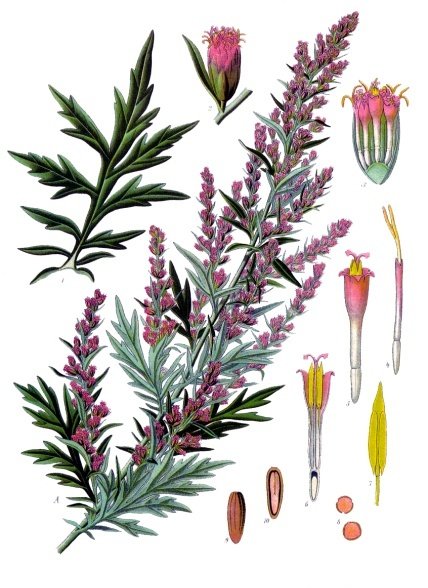
Photo: Franz Eugen Köhler, Köhler's Medizinal-Pflanzen, Public domain · source

Herbaceous plant · Daisy family (Asteraceae)
Mugwort
Artemisia vulgaris
In other languages: Bijvoet (Nederlands) · Armoise commune (Français)
Grows wild in Belgium.
Mugwort is a sturdy perennial of the daisy family, 60–150 cm tall, that you see everywhere on verges, waste ground, along railways, on riverbanks and at field edges. In Belgium it is very common, especially on fertile, somewhat disturbed soil. You recognise it by its deeply cut leaves, dark green above and silvery-white and felted beneath, its grooved stems flushed reddish-purple and its long panicles with hundreds of small, inconspicuous, yellowish to reddish-brown flower heads in July–September. Crushed, the leaves have a mild aromatic smell. Mugwort is a rich food plant for insects and has a long history in folk customs and cooking, but its pollen is also a well-known cause of hay fever in late summer.
Caution: Mugwort pollen is a major cause of hay fever in July–September, and people allergic to mugwort sometimes also react to celery or certain spices. So do not plant it near a patio or window if someone in the household is allergic. Mugwort was once used as a herb, but use it at most in moderation as a kitchen herb; pregnant women are better off avoiding it altogether.
Light
Sun or partial shade
preferably some sun
Moisture
Dry to normal
no wet feet
Hardiness
Fully hardy
down to -30 °C
Size
1.2 m
tall, 0.6 m wide
Flowering
July–September
| Pruning months | March and August |
|---|---|
| Height | 1.2 m |
| Native to Belgium | Yes |
| Flowering | July–September |
Identify
How to recognise it
- Growth form
- Sturdy perennial, 60–150 cm, sometimes up to 2 m, with a woody rhizome; forms large clumps after a few years.
- Leaf
- Deeply pinnately cut with pointed lobes, 5–10 cm long; dark green and almost hairless above, silvery-white and felted beneath. Mild aromatic smell when crushed.
- Flower
- Numerous small, egg-shaped heads of 3–4 mm, without ray florets, yellowish to reddish brown, in long, leafy panicles. Flowers in July–September and is wind-pollinated.
- Fruit/Seed
- Tiny brown achenes without a pappus, in huge numbers; they fall close to the plant or travel with soil and shoes.
- Stem
- Upright, grooved, often flushed reddish-purple and somewhat woody at the base.
- Confusion with
- Wormwood is silvery grey on both sides and smells strongly bitter. Tansy has yellow, button-like flower heads and leaves that are green on both sides. Common ragweed, a non-native plant with even more allergenic pollen, has finely cut leaves that are green on both sides and long spikes of green flower heads.
Flowering: July–September · Pruning: March and August
In your garden
Why grow it?
- An important food plant: many insect species live on it, including caterpillars of pug moths and other moths, aphids, small beetles and gall midges.
- The dead stems and panicles stand all winter: small insects overwinter among them and birds pick out seeds.
- A plant for a rough corner or a natural verge in a large nature garden, where little else grows so easily.
- The leaves were once used as a kitchen herb with fatty dishes such as goose and duck, and sometimes in herb mixtures for beer, before hops became widespread.
- A plant full of folklore: around Midsummer people used to wear girdles of mugwort, and travellers put the leaves in their shoes.
Mugwort: where does it grow best?
- In the wild on verges, waste ground, rubble, railway land, riverbanks and field edges; often close to people.
- Full sun to light half shade.
- Almost any soil, preferably fertile; it tolerates drought but also grows on moist riverbanks.
- In the garden only in a rough spot: at the edge of a large nature garden, by the compost heap or on a wild verge.
Goes well with
- Tansy: Yellow buttons beside the grey-green panicles on a rough, sunny verge.
- Wild carrot: White umbels on the same dry, fertile verge.
- Common nettle: Together a rough corner full of food plants for butterflies and other insects.
- Wild teasel: Tall, sturdy winter stems beside the mugwort, with seed for goldfinches.
Maintenance
Mugwort: when and how to plant it?
- Mugwort often arrives by itself. If you want to plant it deliberately, buy a plant or seed from a nursery specialising in native plants. Do not dig up plants in the wild.
- Sow outdoors in autumn or in March–April on bare soil, barely covering the fine seed.
- Plant in March–April or in October, at least 60 cm from other plants: a clump grows wide.
- Choose a spot where it cannot seed or spread into a border, for example between a path and a hedge.
- Water after planting; after that it needs no further care.
Care
- Water
- Not needed, except after planting. It copes well with dry summers.
- Feeding
- Never: on rich soil it grows even taller and spreads even faster.
- Mowing
- On a verge you can mow it once or twice a year. If you mow at the end of July or in August, before the seed is ripe, it self-sows much less.
- Spreading
- It spreads by rhizomes and above all by seed. Chop off runners at the edge of the clump with a spade and pull up seedlings while they are small.
- Letting it seed
- Only let the panicles ripen in a rough corner; elsewhere cut them off before the seed is ripe.
Tip: If you want to keep mugwort in the garden without seedlings everywhere, cut off the panicles of most plants in August and let only one or two ripen for the insects and birds.
Pruning and mowing
Pruning months: March and August.
When: In March, cut down the dead stems; in August, if you wish, cut off the flowering panicles to limit self-sowing.
How:
- Leave the dead stems over winter: they shelter overwintering insects.
- In March, cut them down to just above the ground, before the new shoots appear. Lay them on a brush pile so any insects inside can still emerge.
- If you do not want seedlings, cut off the flowering panicles in August, before the seed is ripe.
- In a rough corner, leave a few panicles for the birds and insects in winter.
Caution: If you are prone to hay fever or eczema, wear gloves and long sleeves and avoid working on the plant while it is in flower: it releases a lot of pollen then.
Propagation
- Seed
- Self-sows freely. Sow in autumn or spring on bare soil; it germinates easily.
- Division
- In March–April, lift a clump and split it with a spade into pieces each with part of the rhizome.
Mugwort: how does it get through the winter?
Hardy to −30 °C.
- The leaves die back, but the dry, reddish-brown stems with their panicles stand until spring.
- Small insects overwinter among the dead stems, and birds pick seeds from the panicles.
- Fully hardy; as early as February–March the first new leaves appear at the base.
Diseases and pests
- Spreading: On rich soil it spreads quickly by seed and rhizomes. Mow before the seed ripens, pull up seedlings and chop off the edge of the clump.
- Hay fever: Its pollen causes hay fever in many people in July–September. Do not plant it near a patio or a bedroom window.
- Aphids: Mugwort can be covered in aphids, but they are food for ladybirds, hoverflies and tits. Do not control them.
- Hard to dig out: An old clump has a tough, woody rhizome. Dig it out with a spade in spring and remove every piece.
Through the year
- March: Cut down dead stems and lay them on a brush pile. New leaves appear.
- April: Plant or divide clumps. Pull up unwanted seedlings.
- May: Rapid growth. Aphids attract ladybirds.
- June: The stems shoot up. Pick leaves as a kitchen herb, before flowering.
- July: Flowering begins. Pollen and hay fever.
- August: Full flower. Cut off panicles where you do not want seedlings.
- September: Last flowers; the seed ripens.
- October: Plant. Leave the stems standing for winter.
- December: Dead stems and panicles provide winter food and shelter.
You and this species
Did you know?
- According to folk explanation, the Dutch name bijvoet comes from an old custom: travellers put the leaves in their shoes against tired feet.
- Around Midsummer, on 24 June, people used to wear a girdle of mugwort and then throw it into the fire to ward off bad luck; in some regions the plant was therefore called St John’s girdle.
- Artemisia is named after the Greek goddess Artemis. In Germany mugwort is still the classic herb for roast goose.