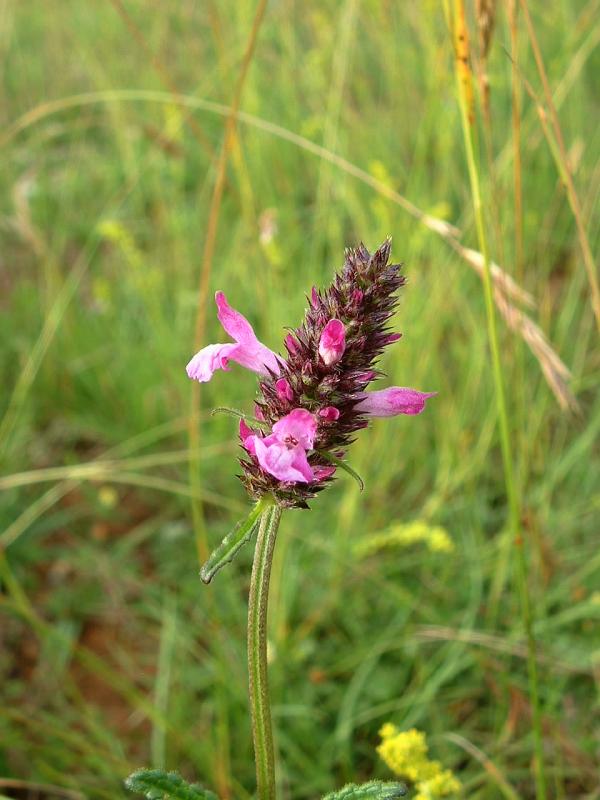
Photo: Wikimedia Commons, CC BY-SA 3.0 · source

Herbaceous plant · Mint family (Lamiaceae)
Betony
Betonica officinalis
In other languages: Betonie (Nederlands) · Bétoine officinale (Français)
Grows wild in Belgium.
Betony is a native perennial of the mint family, found in unimproved grassland, heath edges, verges and open woodland edges. In Flanders it has become rare because of fertilisers and the loss of hay meadows; in Wallonia it still grows in more places. You can recognise it by a rosette of long-stalked, evenly scalloped leaves and upright stems topped in summer by a dense spike of magenta-pink lipped flowers. Bumblebees, bees and butterflies love it. In the Middle Ages it was one of the most highly valued herbs, and in a flower-rich meadow or a natural border it is a gem.
Light
Sun or partial shade
preferably some sun
Moisture
Normal
no wet feet
Hardiness
Fully hardy
down to -25 °C
Size
0.5 m
tall, 0.3 m wide
Flowering
June–September
| Pruning months | March and September |
|---|---|
| Height | 0.5 m |
| Native to Belgium | Yes |
| Flowering | June–September |
Identify
How to recognise it
- Growth habit
- Perennial with a basal rosette and upright, little-branched stems of 30–60 cm.
- Leaves
- Rosette leaves oblong with a heart-shaped base, 5–10 cm, evenly scalloped and long-stalked. A few smaller, almost stalkless pairs on the stem.
- Flowers
- Magenta-pink to rose-red lipped flowers of about 1.5 cm in a dense, oval spike at the top, often with a separate whorl below; June to September.
- Stem
- Square, as in all members of the mint family, and roughly hairy.
- Fruit
- Four small brown nutlets per flower, held in the persistent calyx.
- Look-alikes
- Hedge woundwort has large, nettle-like stem leaves and darker purplish-red flowers in loose whorls. Marsh woundwort grows in wet places and has narrow leaves. Betony has most of its leaves in a basal rosette.
Flowering: June–September · Pruning: March and September
In your garden
Why grow it?
- A rich source of nectar in July–August for bumblebees, bees and butterflies.
- A typical plant of flower-rich, nutrient-poor hay meadows: where it grows, the grassland is well managed.
- Long flowering from June to September, with a warm magenta-pink in a wild border.
- A compact plant that does not spread: suitable for small gardens too.
- A historic herb that grew in monastery and herb gardens for centuries.
Betony: where does it grow best?
- In the wild: unimproved grassland, hay meadows, heath edges, verges and open woodland edges, on dry to moist, nutrient-poor soil.
- In the garden: sun or light half shade, in a wildflower meadow, at the front of a border or along a hedge.
- Preferably poor, free-draining soil: sand, loam or light clay, slightly acid to chalky.
- On rich, fertilised soil it grows floppy and is crowded out by grasses.
Goes well with
- Common knapweed: Purple heads in the same poor meadow; together a magnet for butterflies.
- Harebell: Delicate blue bells on the same poor, sunny soil.
- Oxeye daisy: White flowers in June, before betony is at its best.
- Tormentil: Low, yellow flowers at the front, also on poor soil.
- Devil’s-bit scabious: Flowers in late summer and takes over from betony.
Maintenance
Betony: when and how to plant it?
- Buy young plants from a native plant nursery, or seed of native origin. Never dig up plants from the wild.
- Sow in September–November outdoors in a pot or tray: the seed needs a cold period and germinates in spring.
- Plant in March–April or September–October, 25–30 cm apart, in groups of three to five.
- In an existing meadow: clear small patches of bare soil and plant sturdy plug plants, so they are not swamped straight away.
- Water during dry spells for the first few weeks; after that it is no longer needed.
Care
- Watering
- Only after planting. Established plants tolerate drought well.
- Feeding
- Do not feed: on poor soil it stays sturdy and flowers more.
- Mowing
- In a wildflower meadow, mow once in September and remove the cuttings.
- Self-seeding
- Leave some spikes standing until the seed is ripe; it will then self-seed gently.
- Rejuvenating
- After some years the centre of the clump may go bare; divide it in March.
Tip: Plant betony in small groups and give it space for the first two years: a 20 cm ring without grass around each plant makes all the difference.
Pruning and mowing
Pruning months: March and September.
When: Cut back old stems in March; mow meadows in September.
How:
- Leave the faded stems standing over winter: small insects overwinter in them.
- Cut them back in March to just above the new leaves.
- In a wildflower meadow: mow at 5–10 cm in September and remove the cuttings, so the soil stays poor.
Propagation
- Seed
- Sow outdoors in autumn; it germinates in spring after a cold period. Usually flowers from the second year.
- Division
- In March–April or September, lift an old clump and split it into pieces with roots and a leaf rosette.
Betony: how does it get through the winter?
Hardy to −25 °C.
- The flower stems die back; the rosette leaves often stay partly green in mild winters.
- Fully hardy to about −25 °C.
- The dry stems and calyces give shelter to small insects.
Diseases and pests
- Crowded out by grass: On rich soil grasses take over. Reduce fertility by removing cuttings and never feeding.
- Slugs: They eat the young rosettes in spring. Plant slightly larger plants in spring.
- Floppy stems: A sign of soil that is too rich or too much shade: choose a sunnier, poorer spot.
- Powdery mildew: White powder on the leaves in dry late summers; usually harmless. An open, airy spot helps.
Through the year
- March: Cut back old stems. Divide clumps.
- April: Plant plugs into grassland.
- May: Rosettes grow; flower stems appear.
- June: First flowers.
- July: Full flower; lots of bumblebees.
- August: Flowering. The first seed ripens.
- September: Last flowers. Mow the meadow and remove the cuttings. Planting time.
- October: Sow in a pot outdoors. Planting time.
- November: Dormant; leave the stems standing.
- December: Dormant.
You and this species
Did you know?
- According to the Roman writer Pliny, the name comes from the Vettones, a people of the western Iberian Peninsula.
- In Italy, a person with many good qualities is said to have ‘more virtues than betony’.
- Old folk belief held that betony kept evil spirits away; that is why it was sometimes planted around houses and in churchyards.