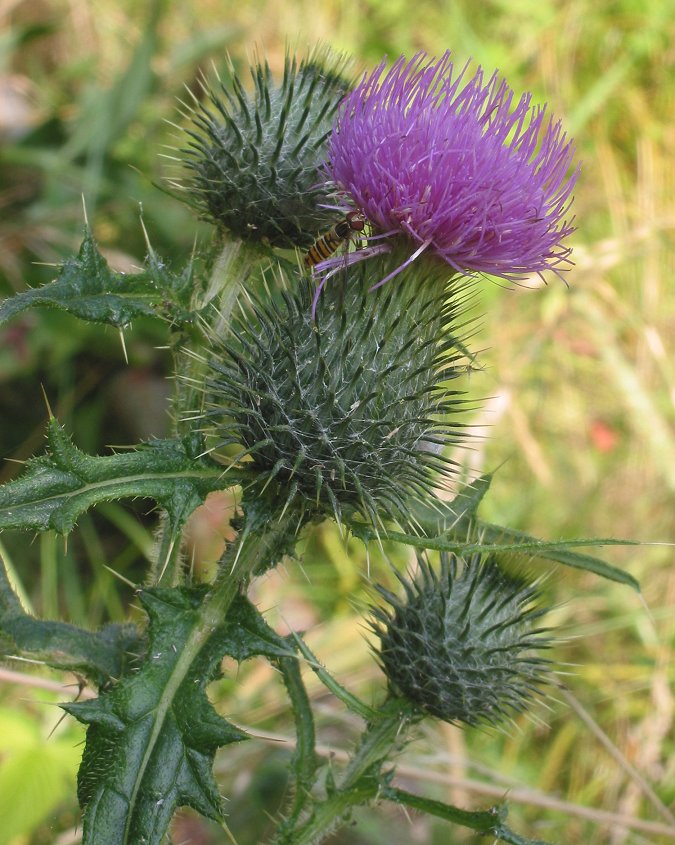
Photo: Rasbak at Dutch Wikipedia, CC BY-SA 3.0 · source

Herbaceous plant · Daisy family (Asteraceae)
Spear thistle
Cirsium vulgare
In other languages: Speerdistel (Nederlands) · Cirse commun (Français)
Grows wild in Belgium.
Spear thistle is a robust biennial thistle with large purple flower heads and sharp spines. It is very common throughout Belgium in pastures, verges, felled woodland, waste ground and gardens with open, fertile soil. In its first year it forms a flat rosette of spiny leaves; in the second year a branched stem with spiny wings and flower heads of 3–5 cm. For butterflies, bumblebees and seed-eating birds it is one of the most valuable wild plants. Give it a spot and you will bring goldfinches and butterflies into your garden.
Light
Full sun
warm and bright
Moisture
Normal
no wet feet
Hardiness
Fully hardy
down to -25 °C
Size
1.2 m
tall, 0.6 m wide
Flowering
July–September
| Pruning months | March and August |
|---|---|
| Height | 1.2 m |
| Native to Belgium | Yes |
| Flowering | July–September |
Identify
How to recognise it
- Growth habit
- Biennial: in the first year a flat rosette up to 50 cm across, in the second year a branched stem of 50–150 cm.
- Leaves
- Deeply cut, with long, sharp spiny tips; the upper side rough with stiff bristles, the underside grey and cobwebby.
- Flowers
- Heads 3–5 cm long, single or a few together, with purple tubular florets. The bracts form an egg-shaped cup, each ending in a yellow spine. Flowers from July to September.
- Stem
- With interrupted spiny wings along its whole length, and cobwebby hairs.
- Seed
- A nutlet with a feathery parachute that can travel far on the wind.
- Look-alikes
- Creeping thistle has smaller lilac heads, wingless stems and creeping roots that form large patches. Marsh thistle grows in wet places, has many small heads in clusters and a stem with continuous spiny wings. Spear thistle is recognised by its large heads and the rough upper surface of its leaves.
Flowering: July–September · Pruning: March and August
In your garden
Why grow it?
- A rich nectar source in summer for bumblebees, bees and butterflies such as the peacock and small tortoiseshell.
- Food plant of the painted lady: its caterpillars live in a silk web on the leaves.
- The downy seed is a favourite food of the goldfinch, whose scientific name Carduelis comes from the Latin word for thistle.
- Overwintering insects hide in the dry stems and seed heads.
- A striking, architectural plant that gives structure to a wild garden.
Spear thistle: where does it grow best?
- In the wild: pastures, verges, felled woodland, rough grassland, waste ground and other disturbed, fertile places.
- Full sun; in shade it stays small.
- Fertile, open soil, dry to moist; it germinates on bare patches.
- In the garden: a wild corner, the back of a wildlife border or a patch of rough grass, not beside paths people use.
Goes well with
- Wild teasel: Another spiny giant for goldfinches and bumblebees, in the same rough corner.
- Wild carrot: White umbels between the purple thistle heads.
- Tansy: Yellow button flowers in late summer, also good for insects.
- Common knapweed: Purple heads without spines, at the front of the same wild border.
Maintenance
Spear thistle: when and how to plant it?
- There is rarely any need to buy it: it turns up by itself on open soil. Do not dig up plants from the wild; leave a self-sown seedling in a good spot instead.
- If you want to sow, collect ripe seed in August–September and sow it straight away on bare soil, or in spring.
- Press the seed in lightly and keep the soil moist until it germinates.
- Allow 50–60 cm around each plant; the rosette grows wide.
- Only move young rosettes, in autumn or early spring, with a deep root ball for the taproot and wearing thick gloves.
Care
- Watering
- Not needed, except during germination.
- Feeding
- Not needed.
- Limiting self-seeding
- Cut off some of the heads before they turn fluffy, but leave a few for the birds.
- Neighbours
- If your garden borders a pasture or field, do not let it seed everywhere: farmers would rather not have it among their crops.
- Gloves
- Work with thick gloves and long sleeves.
Tip: Let one or two spear thistles flower each year in a wild corner and cut the rest: that way you get butterflies and goldfinches without a sea of seedlings.
Pruning and mowing
Pruning months: March and August.
When: In August cut off some of the faded heads; clear the dry stems in March.
How:
- In August cut off faded heads that should not seed, before the fluff appears.
- Leave a few heads for goldfinches and other finches.
- Leave the dry stems standing over winter as shelter for insects and cut them off at ground level in March.
Caution: The plant dies by itself after setting seed, so there is no need to dig it out.
Propagation
- Seed
- One plant produces thousands of seeds with parachutes that blow away on the wind. Sow fresh seed in late summer or spring on bare soil.
Spear thistle: how does it get through the winter?
Hardy to −25 °C.
- First-year rosettes stay green all winter, flat against the ground.
- Plants that have flowered die; the dry stems remain standing.
- In early winter birds still search the heads for seed; insects overwinter in and between the stems.
- Very hardy, to about −25 °C.
Diseases and pests
- Spines: Painful when weeding or along paths. Choose an out-of-the-way spot and wear gloves.
- Too many seedlings: Cut off heads before they go fluffy and dig out unwanted young rosettes with their taproot.
- Aphids: Often plenty of aphids on the stem tips; they attract ladybirds and hoverflies. Just let it be.
- Fluff next door: The seed can blow into neighbouring gardens. Limit the number of flowering plants and cut in time.
Through the year
- March: Cut dry stems off at ground level.
- April: Last year’s rosettes start to send up stems.
- May: Rapid growth; dig out unwanted rosettes.
- June: First buds. Look for painted lady caterpillars in their web on the leaves.
- July: Flowering; bumblebees and butterflies.
- August: Flowering and first fluff; cut off unwanted heads.
- September: Last flowers; goldfinches on the seed heads. Sow seed.
- October: New rosettes grow.
- November: Rosettes stay green.
- December: Leave the dry stems standing.
You and this species
Did you know?
- In Dutch the goldfinch is also called ‘distelvink’ (thistle finch), and in French ‘chardonneret’, from chardon (thistle): the bird loves thistle seed.
- The painted lady is called ‘thistle butterfly’ in Dutch and French because its caterpillars feed on thistles; every year it migrates from North Africa and southern Europe to our region.
- The thistle is the emblem of Scotland; spear thistle is often named as the ‘Scottish thistle’, although it is not certain which species was originally meant.