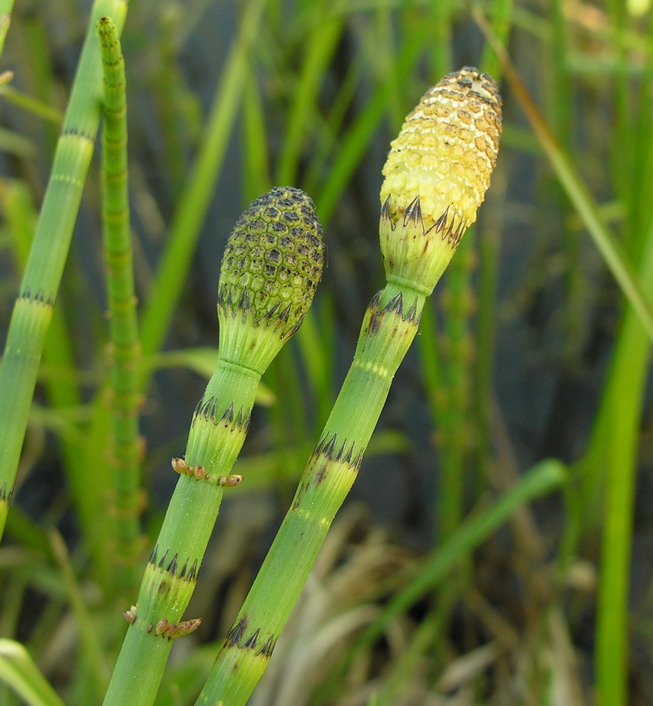
Photo: Algirdas at Lithuanian Wikipedia, CC BY-SA 3.0 · source

Fern · Horsetail family (Equisetaceae)
Water horsetail
Equisetum fluviatile
In other languages: Holpijp (Nederlands) · Prêle des eaux (Français)
Grows wild in Belgium.
Water horsetail is a horsetail that stands with its feet in the water: it forms dense stands of straight green stems in the shallow margins of ponds, ditches, pools, lakes and slow rivers. Its stem is almost entirely hollow: pinch it and it flattens easily. In Belgium it is scattered and locally common in marshes, silting-up pools and wet hollows, especially on peaty or sandy soils that are not too rich. You recognise it by its smooth, glossy stems of 0.5–1.5 m, unbranched or with short whorls of side branches, and by the blunt spore cone at the tip. Its dense stands shelter fish, frogs and water insects, and dragonfly larvae climb up the stems to emerge as adults.
Caution: Horsetails can be harmful to grazing animals, especially horses, if large amounts end up in hay or feed. Never take plants or rhizomes from the wild.
Light
Sun or partial shade
preferably some sun
Moisture
Moist to wet
must not dry out
Hardiness
Fully hardy
down to -30 °C
Size
1 m
tall, 1 m wide
| Pruning months | March |
|---|---|
| Height | 1 m |
| Native to Belgium | Yes |
Identify
How to recognise it
- Growth form
- Flowerless perennial marsh plant with straight green stems growing in groups from a creeping rhizome in the mud; usually stands in 10–100 cm of water.
- Stem
- 50–150 cm tall and up to 1 cm thick, smooth, glossy and soft; the central hollow takes up almost the whole stem. Unbranched or with short, irregular whorls of side branches around the middle.
- Leaf
- The leaves are fused into tight green sheaths around the nodes, ending in many small, narrow, black teeth.
- Spores
- In June–July a blunt, egg-shaped spore cone of 1–2 cm at the tip of the ordinary green stems; there are no separate fertile stems.
- Roots
- Creeping, glossy reddish-brown rhizomes in the mud, with which it can form large stands.
- Confusion with
- Marsh horsetail is shorter, with thinner, deeply grooved stems, a small central hollow, regular whorls of side branches and sheaths with fewer, white-edged teeth. Mare’s-tail also grows in water, but has true narrow leaves in whorls and tiny flowers.
Pruning: March
In your garden
Why grow it?
- A structural plant for the pond edge: its straight, dark green stems give a crisp, graphic look above the water.
- Larvae of dragonflies and damselflies climb the stems out of the water to emerge; in summer you often find their empty skins on them.
- The dense stands are a hiding and spawning place for fish, frogs, newts and water insects.
- A living fossil: horsetails have existed for hundreds of millions of years and are related to the tree-sized plants of the coal forests.
- Its rhizomes bind the mud of the bank, and it takes up nutrients from the water.
Water horsetail: where does it grow best?
- In the wild: shallow margins of ponds, ditches, pools, lakes and slow streams, silting-up pools, marshes and wet reedbeds.
- In shallow water or in waterlogged soil that always stays wet; it can grow down to about 1 m deep.
- Sun to light shade; in deep shade it stays sparse.
- Prefers a muddy, peaty or sandy bottom that is not too rich in nutrients.
- In the garden: the shallow zone of a wildlife pond or a bog area, in a planting basket, preferably in a pond of at least a few square metres.
Goes well with
- Marsh marigold: Golden-yellow flowers in April at the pond edge, before the horsetail grows tall.
- Bogbean: White, fringed flowers in May, in the same shallow zone.
- Yellow iris: Broad leaves and yellow flowers in May–June, contrasting with the thin stems.
- Frogbit: Floating little rosettes with white flowers on the open water nearby.
Maintenance
Water horsetail: when and how to plant it?
- Buy a plant from a nursery for aquatic and native plants; never take plants or rhizomes from the wild.
- Plant in April–June, when the water warms up and the plant is in full growth.
- Put the rhizome in a planting basket with heavy, low-nutrient pond soil or clay, without potting compost or fertiliser, and top it with a thin layer of gravel.
- Set the basket 10–30 cm under water at first; later it can go deeper, to about 50 cm.
- Allow 3–5 plants per square metre in a bog area, or one basket per metre of pond edge.
- In a small pond, keep it in its basket, or it will creep across the whole bottom.
Care
- Water
- It must never dry out. If the water level drops in summer, top up with rainwater.
- Feeding
- Not needed and even harmful: extra nutrients cause algae in your pond.
- Spreading
- On a bare pond bottom it spreads by rhizomes. In summer, pull or cut out runners beyond where you want it.
- Thinning
- Every 2–3 years, in September–October, remove part of the stems and rhizomes to keep some open water.
- Old stems
- Leave them standing in winter as shelter and cut them in March above the waterline.
Tip: Put water horsetail in a basket in the shallow zone on the sunny side of your pond: dragonfly larvae use the straight stems as a ladder out of the water, and it stays neatly in its place.
Pruning and mowing
Pruning months: March.
When: In March, before the new stems appear. Thinning is done in September–October.
How:
- Cut the old brown stems just above the water or the ground.
- Leave them standing in winter: the stems and dense clumps shelter small animals.
- Lift the cuttings out of the water, so they do not rot and make the pond richer in nutrients.
- To slow it down, pull out stems and rhizomes beyond where you want it in summer.
Caution: Leave removed stems and rhizomes on the bank for a day, so small water creatures can crawl back into the pond.
Propagation
- Dividing the rhizome
- In April–June, cut off a piece of rhizome with a few young stems and put it straight into a basket under water. This is the easiest method.
- Spores
- In June–July. The green spores stay viable for only a short time: scatter them at once on wet mud. Tricky; division is much easier.
Water horsetail: how does it get through the winter?
Hardy to −30 °C.
- In autumn the stems discolour and mostly die back; the rhizome overwinters in the mud under water.
- Fully hardy, to about −30 °C: even if the pond freezes over, the rhizome survives.
- The brown stems left standing shelter small animals along the bank.
- In April–May the new green stems come up again.
Diseases and pests
- Spreading: In a small pond it takes over the whole bottom. Plant it in a basket and thin it every few years.
- Drying out: If the pond edge stays dry for long, the stems turn brown. Top up with rainwater.
- Blanketweed: Blanketweed between the stems points to too many nutrients in the water. Do not feed, and twist the algae out with a stick.
- Harmful to livestock: Horsetails can be harmful to grazing animals, especially horses, if large amounts end up in hay or feed. Do not use the cuttings as fodder.
Through the year
- March: Cut old stems above the waterline.
- April: New stems come up. Plant or divide.
- May: Plant in a basket. Dragonfly larvae climb out of the water.
- June: Spore cones at the stem tips. Check for runners.
- July: Spores. Watch the water level and top up with rainwater.
- August: Look for empty dragonfly skins on the stems.
- September: Thin out if needed; leave the material on the bank for a day.
- October: The stems discolour.
- December: Rest. Leave the brown stems standing as shelter.
You and this species
Did you know?
- Equisetum comes from the Latin equus (horse) and seta (bristle or hair): the branched stems reminded people of a horse’s tail. Fluviatile means ‘of rivers’.
- The hollow in the stem takes up about four fifths of its width, more than in any other European horsetail. Hence its Dutch name holpijp, ‘hollow pipe’.
- Water horsetail crosses with field horsetail in the wild. This hybrid, Equisetum × litorale, does not form good spores, but holds its ground on riverbanks for years thanks to its rhizomes.