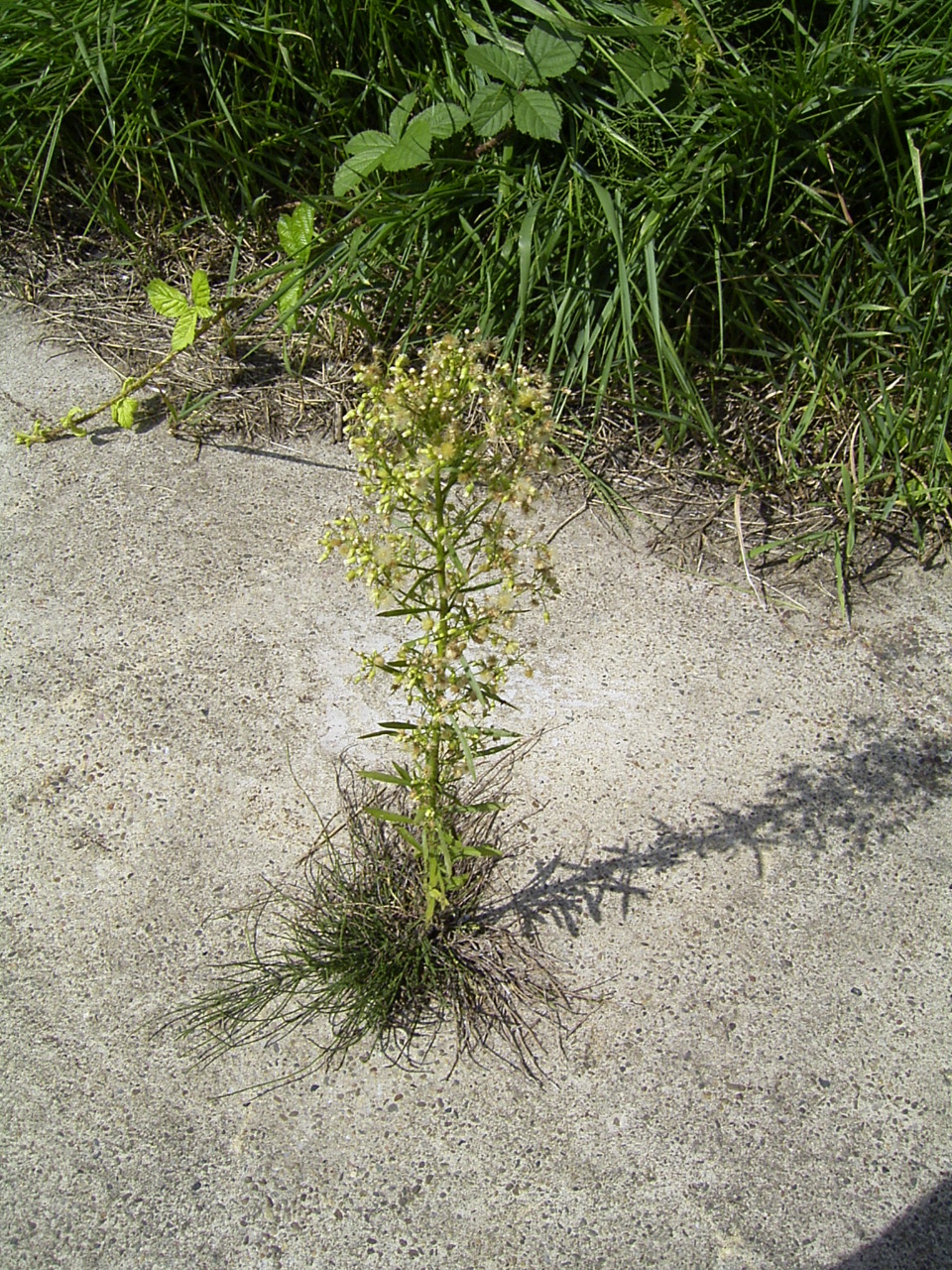
Photo: Wikimedia Commons, CC BY-SA 3.0 · source

Herbaceous plant · Daisy family (Asteraceae)
Canadian fleabane
Erigeron canadensis
In other languages: Canadese fijnstraal (Nederlands) · Vergerette du Canada (Français)
Grows wild in Belgium.
Canadian fleabane is an annual member of the daisy family from North America that has grown in Europe since the 17th century and is now one of the commonest plants of open, disturbed ground. It is found throughout Belgium: on waste ground, verges, along railways, between paving stones, on gravel paths, in fields and vegetable gardens, mainly on dry, sandy soil. Recognise it by its single, stiff, densely leafy stem with narrow, hairy leaves, ending in a long spray of hundreds of tiny, whitish flower heads of 3–5 mm. After flowering the spray turns into one big cloud of off-white fluff, and every seed flies off on the wind. It has little to offer insects, although small flies, hoverflies and tiny bees visit the flowers. In the garden, it is best pulled up before it sets seed.
Light
Full sun
warm and bright
Moisture
Dry to normal
no wet feet
Hardiness
Fully hardy
down to -25 °C
Size
0.8 m
tall, 0.3 m wide
Flowering
June–October
| Pruning months | July–August |
|---|---|
| Height | 0.8 m |
| Native to Belgium | No, naturalised |
| Flowering | June–October |
Identify
How to recognise it
- Growth habit
- Annual of 20–150 cm with a single upright, stiff, hairy stem that is densely leafy right to the top and only branches in its upper part into a long, narrow spray.
- Leaf
- Narrow, linear to lance-shaped, 2–10 cm, light green, with stiff hairs along the edge; the lower leaves sometimes have a few teeth. In autumn and winter young plants form a flat rosette.
- Flower
- Hundreds of tiny heads of 3–5 mm, with short, whitish ray florets that barely stick out beyond the bracts, and a yellowish centre. Flowers from June to October, mainly July–September.
- Fruit/Seed
- Very small, elongated seeds with an off-white tuft of hairs, which fly far on the wind. A single plant produces an enormous amount of seed.
- Roots
- A taproot with fine side roots; young plants are easy to pull up, old plants in dry soil slightly harder.
- Confusion with
- Guernsey fleabane, also from the Americas, is greyer and more roughly hairy, often taller, and has no visible white ray florets. Blue fleabane is a native species with fewer but larger heads and lilac ray florets.
Flowering: June–October · Pruning: July–August
In your garden
Why grow it?
- A pioneer that quickly covers bare, disturbed ground and so gives the soil a little protection against drying out and washing away.
- The tiny flowers from June to October provide some nectar and pollen for small flies, hoverflies and tiny bees.
- An instructive example of a plant that travelled with people: it came from North America to Europe as early as the 17th century.
- A signpost in your garden: lots of fleabane means lots of bare soil, which is better covered with native plants or mulch.
Canadian fleabane: where does it grow best?
- In the wild: waste ground, verges, railway land, paving, gravel paths, fields, urban wasteland and disturbed dunes.
- Full sun; in shade it germinates and grows poorly.
- Mainly dry, sandy, free-draining soil, but it grows almost anywhere the soil is bare.
- In the garden: it turns up by itself in the vegetable plot, the border, gravel and between paving, especially after digging or on newly landscaped ground.
Goes well with
- Wild carrot: A native biennial for dry, rough spots, of far greater value to insects.
- Common bird’s-foot trefoil: A low native ground cover that covers bare sand and feeds the caterpillars of the common blue.
- Biting stonecrop: Covers bare patches of gravel and sand, giving fleabane less chance.
- Viper’s-bugloss: A native pioneer of dry, open ground that attracts far more bees.
Maintenance
Canadian fleabane: when and how to plant it?
- Do not plant or sow it: it turns up everywhere by itself and spreads widely with the wind.
- If you still want a few plants for insects, leave them in a rough corner, far from the vegetable plot and border, and cut off the sprays after flowering.
- Prevent germination by covering bare soil: with a layer of mulch, with ground cover plants or by planting more densely.
- Do not dig unnecessarily: it brings seed from the soil to the top, where it germinates at the surface.
- Pull up young rosettes in autumn or spring when the soil is moist: the taproot then comes out easily.
- Never take plants from the wild or from waste ground to put elsewhere: you would only spread its seed.
Care
- Weeding
- Pull or hoe out young rosettes in October–November and March–April, before the stem shoots up.
- Before seeding
- Pull up flowering plants before the fluff appears, at the latest in July–August. One plant that sets seed gives a carpet of seedlings the following year.
- Disposal
- Plants with seed go in the organic waste bin or general waste, not on your own compost heap.
- Covering the soil
- A 5 cm layer of mulch or dense planting keeps out the light and prevents germination.
- Feeding
- Not applicable: it actually grows well on poor, bare soil.
Tip: Cover bare soil: fleabane mainly germinates at the surface of open ground. A layer of mulch or a dense planting of native ground cover is the best and easiest control.
Pruning and mowing
Pruning months: July–August.
When: In July–August, before the seed is ripe.
How:
- Pull up the whole plant, root and all; cutting it off works less well, as it often regrows with side shoots.
- If pulling is impossible, cut off the spray before it turns fluffy and put it straight into a bag.
- If you leave a few plants for insects, cut off the sprays as soon as flowering is over.
- Mow rough areas in summer, before the heads turn to fluff.
Caution: Do not wait until the spray is white and fluffy: the seed then flies off at the slightest touch.
Propagation
- Seed
- It spreads only by seed, but on a massive scale: the light tufts fly far on the wind and germinate on every bare patch, especially in autumn and spring.
- With soil and machinery
- Seed also travels with soil, imported sand, tyres and mowers. Clean your tools after working in a spot full of fleabane.
Canadian fleabane: how does it get through the winter?
Hardy to −25 °C.
- Plants that germinate in late summer or autumn overwinter as a flat, hairy rosette and shoot up in spring.
- Fully hardy; the old plants die after setting seed.
- Dead, dried stems often stay standing into winter and still drop seed: clear them away.
Diseases and pests
- Mass seedlings: On bare soil hundreds of seedlings sometimes appear at once. Hoe them off on a dry day while they are still small, then cover the soil.
- Between paving: In cracks it is hard to pull out. Use a block-paving knife, ideally when the cracks are damp; boiling water also works on young plants.
- In the vegetable garden: It competes with young vegetables for water and light. Weed early and keep the soil between rows covered with mulch.
- After groundwork: On newly landscaped or dug soil it comes up in masses. Sow or plant straight away, so the soil does not stay bare for long.
Through the year
- March: Pull up overwintered rosettes.
- April: Hoe off seedlings. Cover bare soil with mulch.
- May: The stems shoot up: they are still easy to pull now.
- June: First flowers. Pull up plants in the vegetable plot and border.
- July: Full bloom. Pull up before the seed is ripe.
- August: The first fluff. Last chance to remove plants before they spread seed.
- September: The seed is flying. Pulled plants into the organic waste bin or general waste.
- October: Hoe off new rosettes on a dry day.
- November: Pull up rosettes when the soil is moist.
You and this species
Did you know?
- According to an old story, the first seed reached Europe in the stuffing of a mounted bird from Canada; what is certain is that it was already growing in Europe in the 17th century.
- The Dutch name fijnstraal, ‘fine ray’, refers to the very fine, short ray florets of the flower heads.
- It was long placed in a separate genus, Conyza, and you will still find it as Conyza canadensis in many books.