Photo: Wikimedia Commons, CC BY-SA 3.0 · source

Herbaceous plant · Poppy family (Papaveraceae)
Common fumitory
Fumaria officinalis
In other languages: Gewone duivenkervel (Nederlands) · Fumeterre officinale (Français)
Grows wild in Belgium.
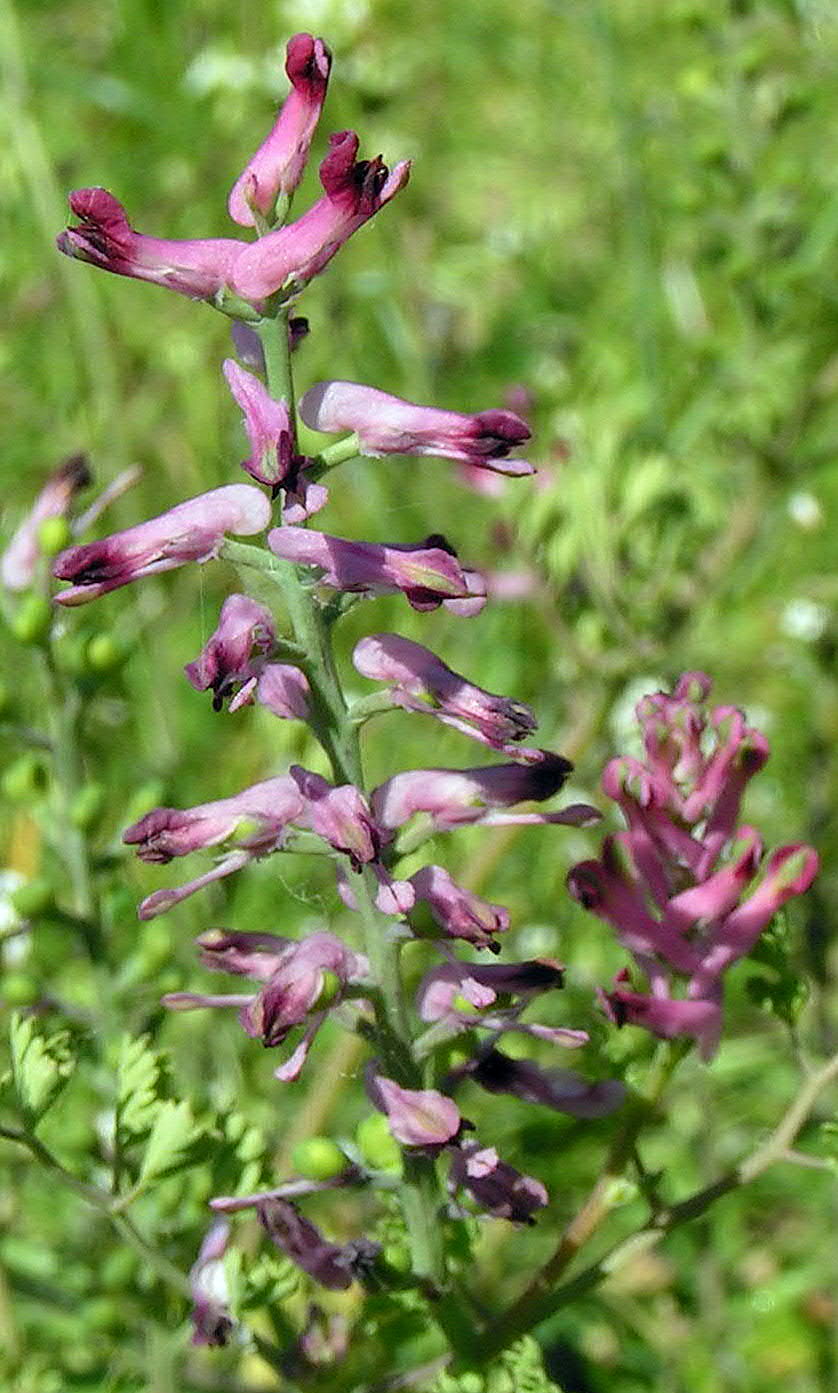
Common fumitory is a delicate annual of arable land, with finely divided, blue-grey leaves and small spikes of pink, tubular flowers with a dark purple tip. In Belgium it is common in fields, vegetable plots, fallow land and on roadsides, especially on light, well-worked and fairly rich soil. From a distance the plant looks like a grey haze above the ground, which explains its old name, ‘smoke of the earth’. It belongs to the poppy family and is therefore a distant relative of the common poppy. In the garden it is a pretty, modest guest between vegetables and in a cornfield-flower strip, although it largely flowers without help from insects.
Caution: Mildly poisonous: the plant contains alkaloids. Do not eat it or use it as a herb or tea. The risk is greatest for young children who pick plants and for grazing animals when hay or feed contains a lot of fumitory.
Light
Full sun
warm and bright
Moisture
Dry to normal
no wet feet
Hardiness
down to -10 °C
protect in harsh winters
Size
0.3 m
tall, 0.3 m wide
Flowering
April–October
| Height | 0.3 m |
|---|---|
| Native to Belgium | Yes |
| Flowering | April–October |
Identify
How to recognise it
- Habit
- Annual, 10–50 cm, upright to sprawling or scrambling up through other plants; hairless and blue-green with a waxy bloom.
- Leaf
- Two to three times pinnate, with narrow, flat segments; grey-green, reminiscent of a fern frond or chervil.
- Flower
- Elongated spikes of 10–40 tubular flowers of 6–9 mm, pink to purplish pink with a dark red to blackish-purple tip and a short spur.
- Fruit/Seed
- A round nutlet of 2–3 mm with one seed, slightly wider than long and a little flattened or notched at the top.
- Stem
- Thin, branched, hairless and rather brittle; the leaf stalks can twine around other stems.
- Look-alikes
- Other fumitories are rarer and differ in flower size, colour and fruit; white ramping-fumitory has larger, creamy white flowers. Climbing corydalis has true tendrils, cream flowers and grows on acid soil. Yellow corydalis grows on walls and has yellow flowers.
Flowering: April–October
In your garden
Why grow it?
- Flowers for a long time, from April into October, with graceful pink spikes above the grey foliage.
- Its seed lasts a long time in the soil and is food for seed-eating birds of fields and gardens.
- Part of the typical arable flora, which has declined sharply with intensive farming: a cornfield-flower strip gives it a home.
- The fine, blue-grey foliage is decorative and fills gaps between vegetables and annuals.
- Largely self-pollinating, but bees and bumblebees visit the flowers now and then.
- Easy to weed out where you do not want it: it has only a thin taproot.
Common fumitory: where does it grow best?
- In the wild in fields of cereals, beet or potatoes, in vegetable plots, on fallow land and open roadsides.
- Full sun to light shade; in deep shade it grows weak and flowers little.
- Light, free-draining soil: sand, sandy loam or loam, ideally slightly chalky and moderately rich.
- It needs bare soil that is cultivated regularly; in a closed lawn it soon disappears.
Goes well with
- Common poppy: A relative from the same arable flora, with large red flowers for bees and bumblebees.
- Cornflower: Blue flowers that attract many bees, bumblebees and butterflies.
- Scented mayweed: White flower heads for small bees and hoverflies, on the same bare soil.
- Field pansy: A small cornfield flower that blooms for just as long and needs the same cultivation.
Maintenance
Common fumitory: when and how to plant it?
- Buy seed of native cornfield flowers from a wildflower nursery, or collect it in your own garden; never dig up plants from the wild.
- Sow in September–October or in March on loosened, weed-free soil. Autumn sowing often gives the best germination.
- Scatter the seed thinly, rake it in lightly and firm the soil. You can mix it with other cornfield flowers.
- Thinning to 20–30 cm is rarely needed: it likes to grow up through other plants.
- Keep the soil moist until the seedlings are up; after that no watering is needed.
Care
- Watering
- Not needed, except for seedlings in a dry spring.
- Feeding
- Not needed. On soil that is too rich it is smothered by stronger plants.
- Cultivating
- Cornfield flowers need bare soil: rake or lightly dig over a cornfield-flower strip every autumn, after the seed has dropped.
- Spreading
- In the vegetable plot it can become numerous. Hoe off young plants before they flower and mulch the soil between the vegetables.
- Letting it seed
- In a cornfield-flower strip, leave the plants standing until late summer so that the seed ripens and falls to the ground.
Tip: Cornfield flowers such as fumitory disappear without cultivation: rake over your cornfield-flower strip every autumn and the seed in the soil will germinate again by itself.
Pruning and mowing
When: Not needed: it is an annual. Only clear dead plants in autumn, after the seed has dropped.
How:
- In a cornfield-flower strip, leave the plants until they die back; then pull them up or work them in when you cultivate the soil.
- In the vegetable plot, weed out unwanted plants before they set seed.
- Weeded plants without seed can go on the compost heap.
Propagation
- Seed
- It spreads only by seed. Ripe nutlets drop under the plant from June onwards. The seed stays viable in the soil for many years and germinates mainly after the soil is cultivated, in autumn and spring.
Common fumitory: how does it get through the winter?
Hardy to −10 °C: protect in harsh winters.
- The plants die after flowering or at the first frost; the species overwinters as seed in the soil.
- Plants that germinate in autumn sometimes overwinter as small grey rosettes and flower early in spring.
- Leave some stubble in a cornfield-flower strip: it shelters insects and birds search it for seed.
Diseases and pests
- Too many plants: In a vegetable plot on light soil it can come up in masses. Hoe in time and mulch the beds; this way the seed bank shrinks every year.
- Disappearing: In a cornfield-flower strip that is no longer cultivated, it disappears within a few years. Lightly work the soil every year.
- Being smothered: On very rich soil, nettles and grasses crowd it out. Choose a poor spot and do not feed.
- Aphids: Sometimes aphids on the shoot tips. Leave them: ladybirds and hoverflies will clear them up.
Through the year
- March: Sow on loose soil. Seedlings from autumn keep growing.
- April: First flowers. Weed in the vegetable plot where it is not wanted.
- May: Flowering.
- June: Full flower; the first nutlets ripen.
- July: Flowering and seed set. Let the seed drop in the cornfield-flower strip.
- August: Flowering. Collect seed for elsewhere.
- September: Last flowers. Sow for next year.
- October: Clear dead plants and lightly work the soil. Sowing is still possible.
- November: The species overwinters as seed; leave some stubble for birds.
You and this species
Did you know?
- The scientific name comes from the Latin fumus terrae, ‘smoke of the earth’: the fine grey foliage looks like smoke rising from the ground.
- Fumitories used to be placed in a family of their own; today they belong to the poppy family, together with the common poppy and greater celandine.
- The seed can survive in the soil for many years: after an old grassland is ploughed, fumitory sometimes suddenly reappears.