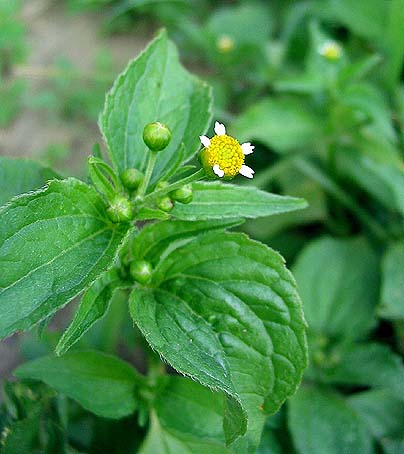
Photo: Wikimedia Commons, CC BY-SA 3.0 · source

Herbaceous plant · Daisy family (Asteraceae)
Gallant-soldier
Galinsoga parviflora
In other languages: Kaal knopkruid (Nederlands) · Galinsoga à petites fleurs (Français)
Grows wild in Belgium.
Gallant-soldier is a fast-growing annual of the daisy family that originally comes from the Andes in South America. It has long been naturalised here and is now one of the most common weeds of vegetable plots, arable fields and public plantings on loose, rich soil. You can recognise it by its opposite, oval, toothed leaves and its tiny flower heads of 3–6 mm, with a yellow centre and usually five short white ray florets, each with three teeth. It germinates and flowers remarkably quickly, so several generations grow in a single year. Small bees and hoverflies visit the flowers, and in Colombia it is a much-loved soup herb.
Light
Sun or partial shade
preferably some sun
Moisture
Normal
no wet feet
Hardiness
down to 0 °C
protect in harsh winters
Size
0.4 m
tall, 0.3 m wide
Flowering
June–November
| Height | 0.4 m |
|---|---|
| Native to Belgium | No, naturalised |
| Flowering | June–November |
Identify
How to recognise it
- Habit
- Annual, 10–60 cm, upright and much branched, often a loose bushy plant.
- Leaf
- Opposite, oval, 2–7 cm, shallowly toothed, with three clear veins and a short stalk; almost hairless.
- Flower
- Tiny heads of 3–6 mm on thin stalks, with a yellow centre of disc florets and usually five white ray florets of 1–2 mm, each with three teeth.
- Fruit/Seed
- Black achenes of 1–2 mm; those from the centre carry a little ring of fringed scales.
- Stem
- Round, green and branched, with at most a few flattened hairs.
- Look-alikes
- Shaggy soldier looks very similar but has stems and leaves covered in spreading, partly glandular hairs. Small mayweeds have finely divided leaves instead of oval ones.
Flowering: June–November
In your garden
Why grow it?
- Flowers from June until the first frost and provides nectar and pollen for small bees and hoverflies.
- Edible: the young tips and leaves can be briefly cooked like spinach or used in soup.
- A useful indicator: where it grows abundantly, the soil is loose, moist and rich in nutrients.
- It covers bare soil quickly but is easy to hoe off.
- A living piece of botanical history: it escaped from European botanic gardens around 1800 and spread across the whole continent.
Gallant-soldier: where does it grow best?
- In the wild in arable fields, vegetable plots, nurseries, public plantings and waste ground, especially on dug soil.
- Sun to partial shade.
- Loose, moisture-retentive and rich soil: sand, loam or humus-rich garden soil.
- It cannot stand frost or a closed lawn: it needs bare soil and a warm summer.
Goes well with
- Phacelia: A green manure that quickly covers bare soil, leaving gallant-soldier less room, and attracts bees and bumblebees.
- Pot marigold: Flowers for just as long and is a better pollen source for bees and hoverflies in the vegetable plot.
- Buckwheat: Grows fast on empty beds, smothers germinating weeds and attracts hoverflies.
- Scented mayweed: An annual with white flower heads, for anyone who wants to edge the vegetable plot more generously with wild flowers.
Maintenance
Gallant-soldier: when and how to plant it?
- There is no need to plant it: gallant-soldier arrives by itself, with soil, compost, shoes and tools.
- If you want to grow it as a vegetable, sow after the last frost, from May to July, thinly on loose soil and rake it in lightly.
- In warm weather it germinates within a week or two; thin to 15–20 cm between plants.
- Harvest the young tips 4–6 weeks after sowing, before the plant flowers. Only pick plants you are sure you recognise.
- Water in dry weather if you want to harvest; otherwise it is not needed.
- Never dig up plants from the wild: take seed from your own garden or from someone you know.
Care
- Watering
- Not needed; for a tender harvest, do water in dry spells.
- Feeding
- Not needed: it already grows vigorously on rich soil.
- Spreading
- One plant produces thousands of seeds and several generations grow each year. Hoe in dry weather so the plants wither, and always before they flower.
- Mulching
- A thick mulch of straw, grass clippings or leaf mould between the vegetables keeps most of it away.
- Harvesting
- Pick the young tips regularly: this keeps the plant compact and stops it setting seed.
Tip: Hoe gallant-soldier on a dry, sunny morning and never let a single plant flower: the seed bank in your soil will visibly shrink each year.
Pruning and mowing
When: Not needed: it is an annual. Weed from May to October, each time before the plants flower.
How:
- Hoe off young plants on a dry, sunny day; they wither straight away.
- Pull up larger plants and do not leave them lying: uprooted plants with flowers can still ripen seed and re-root in moist soil.
- Plants with flowers or seed belong in the green waste collection, not on a cold compost heap.
Caution: Do not wait until it flowers: within a few weeks of flowering, ripe seed is already dropping.
Propagation
- Seed
- It spreads only by seed, but exceptionally fast: seed germinates straight away in warm weather and new plants flower after just 6–8 weeks. The seeds travel with soil, compost, shoes and tools, and some remain viable for a few years.
Gallant-soldier: how does it get through the winter?
Hardy to 0 °C: protect in harsh winters.
- The first night frost blackens and kills all the plants.
- It overwinters only as seed in the soil and does not germinate again until the soil warms up in May.
- After harvesting, sow a hardy green manure: covered soil means less gallant-soldier the following year.
Diseases and pests
- Mass germination: Especially in vegetable plots on rich soil. Hoe every two to three weeks, mulch and never let a plant set seed; after a few years the seed bank drops noticeably.
- Seed carried in: It arrives with compost and soil. Use well-heated compost and clean tools and shoes after working in an infested bed.
- Re-rooting: Pulled plants left lying on wet soil take root again. Always remove them.
- Aphids: Sometimes aphids on the tips. Harmless; ladybirds and hoverflies will clear them up.
Through the year
- May: First seedlings as the soil warms up. Sow as a vegetable.
- June: Start of flowering. Hoe and mulch between the vegetables.
- July: Full flower; a new generation germinates. Harvest young tips.
- August: Flowering and seed set. Weed before flowering.
- September: Flowering. Hoe in dry weather.
- October: Last flowers. Sow a green manure on empty beds.
- November: The first frost kills the plants.
You and this species
Did you know?
- The genus is named after Mariano Martínez de Galinsoga, an eighteenth-century Spanish physician and botanist. The English name ‘gallant-soldier’ is a corruption of Galinsoga.
- In England it is also called ‘Kew weed’: it was grown at Kew’s botanic garden in the late eighteenth century and escaped from there.
- In Bogotá, under the name guascas, it is an essential herb in ajiaco, the traditional chicken soup.