Photo: The original uploader was Jeantosti at French Wikipedia., CC BY-SA 3.0 · source

Herbaceous plant · Nightshade family (Solanaceae)
Henbane
Hyoscyamus niger
In other languages: Bilzenkruid (Nederlands) · Jusquiame noire (Français)
Grows wild in Belgium.
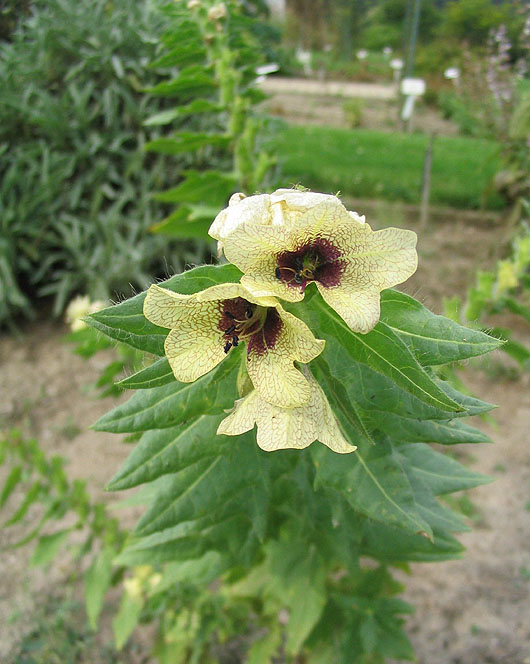
Henbane is a sticky-haired, foul-smelling annual or biennial of 30–80 cm in the nightshade family, and one of the most poisonous plants in our flora. It grows on open, fertile, disturbed ground: around farms, on muck heaps, waste ground, rough patches, field edges and in the dunes, often where rabbits churn up the soil. In Belgium it has become rare, and it often turns up unexpectedly where old ground is disturbed, because its seed stays viable in the soil for many years. You recognise it by its greyish-green, coarsely toothed leaves and its funnel-shaped, dull yellow flowers with a dense net of purple veins and a dark purple centre. Because of its poison it plays a large part in old folk tales about witches and magic potions.
Caution: Highly poisonous: all parts, especially the seed and the root, contain alkaloids that cause serious poisoning even in small amounts. A danger to children, dogs, cats, horses, cattle and other livestock. Never grow it where children play or animals graze, wear gloves, wash your hands and do not rub your eyes. Never eat any part of it. If swallowed, call a doctor or the Poison Centre straight away.
Light
Full sun
warm and bright
Moisture
Dry
tolerates drought
Hardiness
Fully hardy
down to -20 °C
Size
0.6 m
tall, 0.4 m wide
Flowering
June–September
| Pruning months | August–September |
|---|---|
| Height | 0.6 m |
| Native to Belgium | Yes |
| Flowering | June–September |
Identify
How to recognise it
- Habit
- Upright, sparsely branched plant of 30–80 cm, annual or biennial; biennial plants first form a large leaf rosette.
- Leaf
- Greyish-green, large and soft, coarsely toothed to deeply cut, sticky-hairy and foul-smelling; the stem leaves clasp the stem.
- Flower
- Funnel-shaped, 2–3 cm, dull creamy yellow with a dense net of purple veins and a dark purple centre, in one-sided spikes in the leaf axils, from June to September.
- Fruit/Seed
- Capsule with a lid, hidden in the enlarged, urn-shaped calyx with five stiff points; it holds hundreds of small, greyish-brown seeds.
- Stem
- Thick, sticky and densely hairy.
- Confused with
- Thorn-apple has large white trumpet flowers and a spiny capsule, and is also highly poisonous. Other nightshades, such as bittersweet and black nightshade, have small star-shaped flowers. A young rosette can look like an edible leaf: never eat plants you are not sure of.
Flowering: June–September · Pruning: August–September
In your garden
Why grow it?
- Strikingly patterned flowers: dull yellow with a network of purple veins, a real eye-catcher.
- Bumblebees and other bees visit the flowers for nectar and pollen.
- A rare plant of old farmyards, dunes and rough ground: coming across it is a special experience.
- Historically interesting: it is one of the best-known poisonous plants in history and folklore.
- The urn-shaped fruiting calyces make a striking dry structure in autumn.
Henbane: where does it grow best?
- In the wild: open, fertile, disturbed ground such as farmyards, muck heaps, rough ground, waste land, field edges, dykes and rabbit-grazed dunes.
- Full sun and warm, open sites.
- Dry to moderately moist, nitrogen-rich, sandy or limy soil.
- In the garden: only in a fenced-off corner of a historical or educational herb garden, never where children play or pets roam.
Goes well with
- Great mullein: Tall yellow spikes on the same warm, dry soil.
- Viper’s bugloss: Blue flowers for bumblebees on sunny rough ground.
- Wild mignonette: Pale yellow spikes, another plant of disturbed, limy ground.
- Feverfew: Another old herb-garden plant, with small white daisy-like flowers.
Maintenance
Henbane: when and how to plant it?
- First ask yourself whether you really want it: never grow it in a garden with young children or pets, or next to a field with grazing animals.
- Buy seed from a supplier of wild or heritage plants; never dig up plants from the wild.
- Sow in September–October or March–April on an open, sunny spot and cover the seed only very lightly.
- Thin the seedlings to 40–50 cm, wearing gloves.
- Put a clear label or a low fence around the spot so that nobody eats it or collects the seed.
- Water only until germination; after that no watering is needed.
Care
- Water
- Not needed; it likes dry, warm spots.
- Feeding
- Not needed.
- Gloves
- Always wear gloves when you touch the plant, wash your hands afterwards and do not rub your eyes.
- Letting it seed
- The seed stays viable in the soil for many years. Cut off the fruits before they ripen if you do not want it to self-sow.
- Disposal
- Put dead plants with fruits in the green waste bin or the general waste, not on your own compost heap.
Tip: If you want to show henbane in an educational herb garden, grow it behind a low fence with a clear ‘poisonous’ sign.
Pruning and mowing
Pruning months: August–September.
When: In August–September, before the fruits ripen.
How:
- Wear gloves and long sleeves.
- Cut off the stems with fruiting calyces before they turn brown, if you do not want seedlings.
- If you let one plant ripen for seed, cut it in good time and store the seed out of children’s reach.
- Dispose of the cuttings in the green waste bin or the general waste, not on your own compost heap.
Caution: Wash your hands thoroughly after the job and do not rub your eyes: all parts of the plant are poisonous.
Propagation
- Seed
- Ripens from August in the urn-shaped calyces. Sow in autumn or spring; germination is erratic, sometimes only after a year or more.
Henbane: how does it get through the winter?
Hardy to −20 °C.
- Annual plants die in autumn; the dry stems with urn-shaped fruiting calyces remain standing.
- Biennial plants overwinter as a leaf rosette and flower the following year.
- The rosettes are hardy to about −20 °C.
- The seed survives in the soil for many years and often only germinates when the ground is disturbed.
Diseases and pests
- Poisoning: The biggest risk. Keep it out of reach of children and animals, label the plant and wear gloves.
- Unexpected reappearance: It can come up again years later. Pull out unknown seedlings, wearing gloves, before they flower.
- Flea beetles: Tiny jumping beetles chew small holes in the leaves. Usually not serious; just let it be.
- Disappearing: Where the ground is no longer disturbed, it vanishes after a few years. Lightly loosen the soil now and then.
Through the year
- March: Sow on an open, sunny spot, wearing gloves.
- April: Thin seedlings to 40–50 cm.
- May: Biennial rosettes start to flower.
- June: First purple-veined flowers.
- July: Full flower; bumblebees visit the flowers.
- August: Fruiting calyces swell; cut them off if you do not want seed.
- September: Last flowers. Sow for biennial plants.
- October: Clear dead plants, wearing gloves.
You and this species
Did you know?
- Hyoscyamus comes from the Greek hys, pig, and kyamos, bean: ‘hog’s bean’. The English name henbane means ‘death of hens’ and points to its poison.
- In old folk tales henbane is one of the ingredients of so-called witches’ ointments and magic potions.
- The seed can survive in the soil for a very long time: henbane sometimes appears suddenly where old ground is disturbed, for example during building work or archaeological digs.