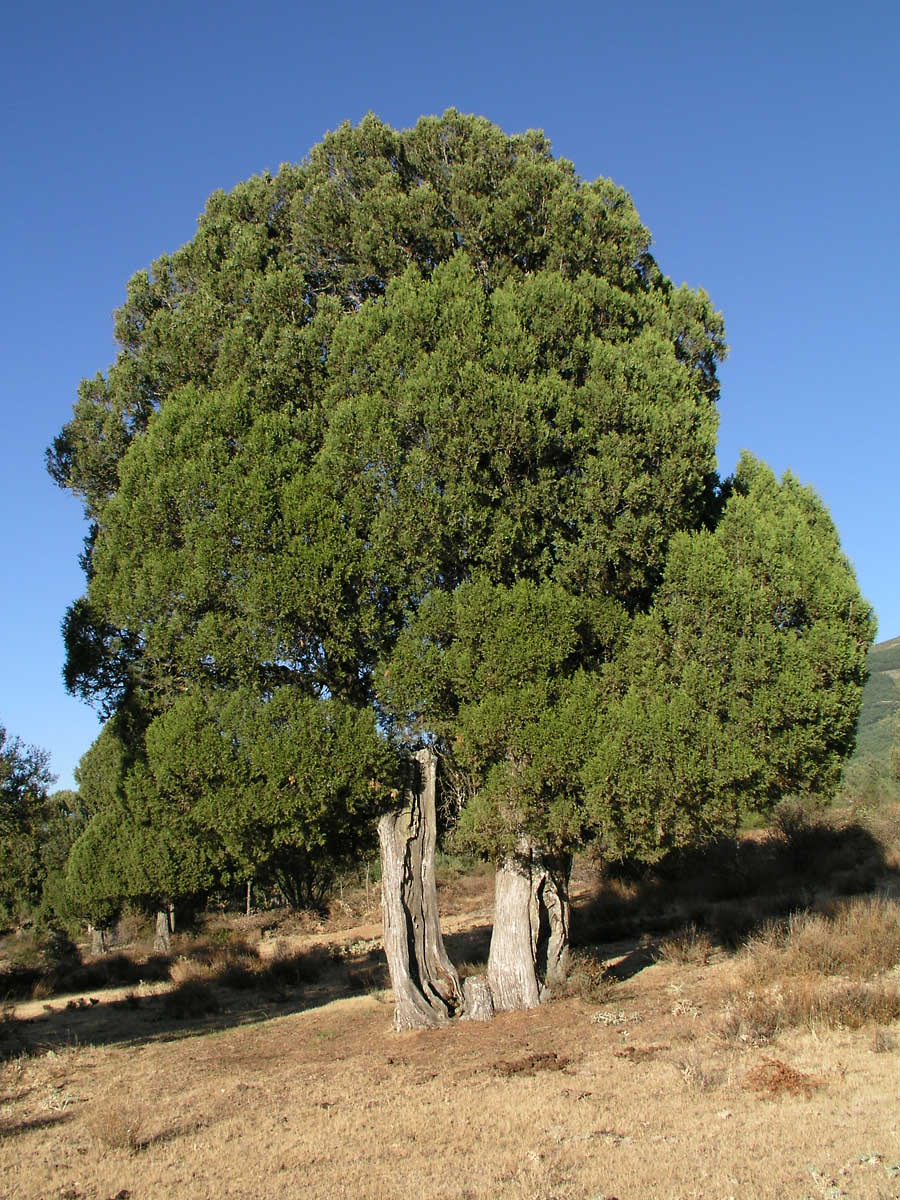
Photo: Wikimedia Commons, CC BY-SA 2.1 es · source

Tree · Cypress family (Cupressaceae)
Spanish juniper
Juniperus thurifera
In other languages: Spaanse jeneverbes (Nederlands) · Genévrier thurifère (Français)
Grows wild in Europe, but not in Belgium.
The Spanish juniper is a slow-growing evergreen conifer from the dry, cold uplands of Spain, with smaller populations in the French Alps, on Corsica and in the Atlas Mountains of North Africa. In Spain it forms open, centuries-old woodlands on limestone plateaus, where summers are hot and winters bitterly cold. It does not grow wild in Belgium: you only see it in a few arboreta and collections. You can recognise it by its fine, grey-green foliage of tiny scale leaves, its thick trunk with red-brown bark that peels in fibrous strips, and its blue-black berries with a waxy bloom. Made for drought and lime, it is an unusual tree for a dry, sunny garden or gravel garden.
Caution: Treat this juniper as poisonous: do not eat the berries and keep children and pets away from the berries and prunings. Only the berries of common juniper are used as a spice. The aromatic sap can irritate the skin of sensitive people.
Light
Full sun
warm and bright
Moisture
Dry
tolerates drought
Hardiness
Fully hardy
down to -20 °C
Size
10 m
tall, 5 m wide
Flowering
February–March
| Pruning months | April |
|---|---|
| Height | 10 m |
| Native to Belgium | No, planted |
| Flowering | February–March |
Identify
How to recognise it
- Habit
- Conifer of 6–15 m with a thick trunk; narrowly conical when young, broad, rounded and irregular when old. It grows slowly and lives very long.
- Leaf
- Tiny scale leaves of 1–2 mm, in four rows pressed close to the thin shoots, with a small gland on the back. Young plants also have needle-like, prickly leaves. The foliage is aromatic when crushed.
- Flowering
- Usually male and female on separate trees: in February–March the small yellow male cones at the shoot tips shed a lot of pollen; the female cones are small and greenish.
- Fruit
- Round ‘berries’, really fleshy cones, of 7–12 mm, blue-black to dark purple with a white waxy bloom. They only ripen in their second year and contain 1–4 seeds.
- Bark
- Red-brown to grey-brown, peeling in long, fibrous strips.
- Look-alikes
- Savin (Juniperus sabina) is usually a low shrub with an unpleasant smell and smaller berries of 5–7 mm. Phoenician juniper (Juniperus phoenicea) has red-brown berries. Common juniper has only prickly needles in whorls of three, never scale leaves.
Flowering: February–March · Pruning: April
In your garden
Why grow it?
- Exceptionally tolerant of drought and lime: a tree for the driest, poorest spot in the garden.
- Evergreen, with fine, grey-green, aromatic foliage and a trunk with attractively peeling bark.
- The blue-black berries are winter food for thrushes and other birds.
- The dense crown gives small birds shelter all year round.
- Grows slowly and can live to a great age: a tree for generations.
- A rarity: in Belgium you only see it in collections.
Spanish juniper: where does it grow best?
- In the wild on high, dry plateaus and slopes in Spain, the French Alps, Corsica and the Atlas Mountains, mostly on limestone, in a continental climate with hot summers and cold winters.
- In the garden: full sun, in an open, airy spot.
- Poor, dry, very free-draining soil; chalky soil is ideal. It dislikes wet winters and heavy clay: plant it on a slope, in a raised bed or in a gravel garden.
- Allow 4–5 m of space; it grows slowly but eventually becomes broad.
Goes well with
- Holm oak: Grows on the same dry plateaus in Spain and also copes with drought and lime in Belgium.
- Lavender: Flowers in summer on the same dry, chalky soil and attracts bees.
- Common thyme: A low, fragrant ground cover for poor, dry soil, with flowers for bees.
- Bloody cranesbill: A tough flowering plant for the sunny, dry edge of a gravel garden.
Maintenance
Spanish juniper: when and how to plant it?
- Buy a young plant in a pot from a nursery that sells unusual conifers or Mediterranean trees.
- Plant in April or September, when the soil is warm but not dried out.
- Dig a generous planting hole and mix the soil with plenty of grit or coarse sand; on heavy soil, plant on a raised mound.
- Set the plant at the same depth as in the pot, firm it in and water. Do not put compost or fertiliser in the planting hole.
- Water now and then in long dry spells during the first year, then no more.
- Never dig up plants in the wild or bring seedlings home from holiday: buy them from a nursery.
Care
- Watering
- Only in the first year, in long dry spells. After that, never: it is made for drought.
- Feeding
- Do not feed. Poor soil keeps it compact and healthy.
- Mulch
- A layer of gravel around the base keeps the foot of the trunk dry; do not use a thick layer of compost or wood chips.
- Light
- Do not plant anything tall right in front of it: in shade the inner branches turn brown and bare.
- Snow
- Shake wet snow off young plants so that the branches do not break.
Tip: Plant it in gravel or on a slope and give it no water or feed after the first year: the poorer and drier, the better. Wet feet in winter are its worst enemy.
Pruning and mowing
Pruning months: April.
When: Rarely needed. Do small corrections in April, when the frosts are over.
How:
- Remove dead and brown branches, back to healthy green wood.
- Only cut into green, scaly shoots: junipers do not regrow from bare old wood.
- If a young tree has two leaders, keep the stronger one and cut out the other.
Caution: Never cut back into bare wood: no new green will grow there. Wear gloves, as the aromatic sap can irritate the skin.
Propagation
- Seed
- Pick ripe, blue-black berries in autumn, take out the seeds and sow them straight away outdoors in a tray. They need a warm period followed by a cold one and often only germinate after one to two years. Many seeds are empty.
- Cuttings
- Semi-ripe heel cuttings in August–September, in sandy cutting compost in a cold frame. They root slowly and not always.
Spanish juniper: how does it get through the winter?
Hardy to −20 °C.
- Evergreen: the grey-green foliage and blue berries stay all winter.
- It copes well with cold, down to about −20 °C; wet soil in winter is more dangerous than frost.
- Heavy, wet snow can break branches: gently shake it off young plants.
- In winter, thrushes and other birds eat the ripe berries.
Diseases and pests
- Root rot: In wet, heavy soil the foliage discolours and the plant dies back. Only plant in very free-draining soil or on a raised spot.
- Brown inner shoots: Old twigs inside the crown die off; this is normal. Too much shade makes it worse: give it light all round.
- Shoot dieback: Brown shoot tips after a wet spring, caused by a fungus. Cut them back to healthy wood and choose an airy spot.
- Spider mites: Dull, greyish shoots with fine webbing in dry, warm summers. Hose the plant down with a strong jet of water.
Through the year
- February: Male trees flower: touch them and a little cloud of yellow pollen comes off.
- March: Flowering. Shake wet snow off young plants.
- April: Plant. Cut out dead or brown shoots.
- June: Water young plants in long dry spells.
- August: Take semi-ripe cuttings.
- September: Plant. Cuttings can still be taken.
- October: Harvest ripe, blue-black berries and sow the seed outdoors.
- December: Thrushes eat the berries. Shake off wet snow.
You and this species
Did you know?
- Thurifera means ‘incense-bearing’: its fragrant wood and foliage are said to have been burnt as incense in the past.
- Most of the world’s Spanish junipers grow in Spain, in open, centuries-old woodlands called sabinares, for example around Soria.
- In winter, thrushes, including fieldfares and redwings from the north, eat the berries and so spread the seeds across the plateaus.