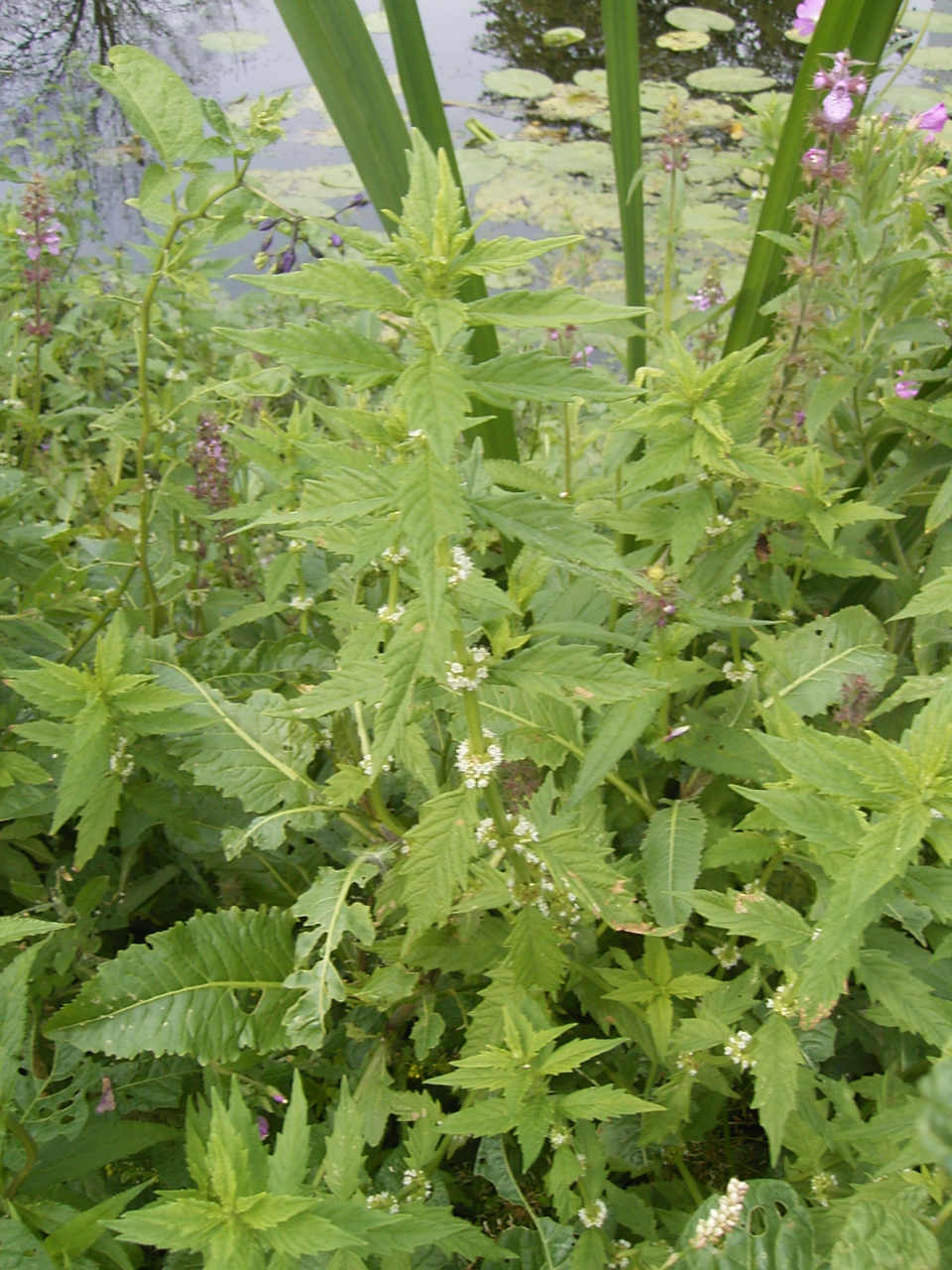
Photo: No machine-readable author provided. TeunSpaans assumed (based on copyright claims)., CC BY-SA 3.0 · source

Herbaceous plant · Mint family (Lamiaceae)
Gypsywort
Lycopus europaeus
In other languages: Wolfspoot (Nederlands) · Lycope d’Europe (Français)
Grows wild in Belgium.
Gypsywort is a perennial waterside plant of the mint family, with square stems, deeply toothed leaves and whorls of tiny white flowers in the leaf axils. It grows all over Belgium along ditches, streams, rivers and ponds and in marshes, reedbeds and wet woodland; it is very common. It looks like a mint, but does not smell of mint when you crush a leaf. From July to September its white flowers appear, finely dotted with purple. In a wildlife pond it is an easy, modest marginal plant for small insects that clothes the water’s edge quickly and naturally.
Light
Sun or partial shade
preferably some sun
Moisture
Normal to wet
must not dry out
Hardiness
Fully hardy
down to -25 °C
Size
0.8 m
tall, 0.4 m wide
Flowering
July–September
| Pruning months | March |
|---|---|
| Height | 0.8 m |
| Native to Belgium | Yes |
| Flowering | July–September |
Identify
How to recognise it
- Growth habit
- Upright perennial 30–100 cm tall, with square, slightly hairy to hairless stems and underground runners.
- Leaf
- Opposite, lance-shaped to oblong-oval, 3–10 cm, coarsely and deeply toothed; the lower leaves are almost pinnately cut at the base. No mint scent.
- Flower
- Tiny white two-lipped flowers 3–5 mm long, with four almost equal lobes and fine purple dots, in dense whorls in the leaf axils; from July to September.
- Fruit/Seed
- Four small, flat nutlets with a corky, thickened edge that lets them float.
- Roots
- Creeping rootstock with runners; forms a dense patch after a few years.
- Confusion with
- Water mint has lilac flowers in rounded heads at the top and smells strongly of mint. Corn mint also has whorls of flowers in the leaf axils, but they are lilac and the plant smells of mint. Gypsywort: small white flowers, deeply toothed leaves and no mint smell.
Flowering: July–September · Pruning: March
In your garden
Why grow it?
- Flowers from July to September and is visited by hoverflies, small bees and flies.
- A tough, native marginal plant that quickly covers the edge of a pond or ditch and gives shelter to frogs and toads at the water’s edge.
- Dragonfly larvae climb out of the water up its sturdy stems to moult.
- Also grows in partial shade and on wet, heavy soil, where few other flowering plants survive.
- It once provided a black dye for fabrics.
Gypsywort: where does it grow best?
- In the wild along ditches, streams, rivers, ponds and canals, in marshes, reedbeds, alder carr and wet tall-herb vegetation.
- Full sun to partial shade.
- Wet to very moist, fertile soil; it also tolerates shallow water.
- In the garden: in the marginal or bog zone of a pond, in 0–10 cm of water, or in a wet corner.
Goes well with
- Water mint: A fragrant neighbour with lilac flowers in the same marginal zone.
- Purple loosestrife: Purple spikes above the white whorls, a star plant for bees.
- Meadowsweet: Creamy plumes on the same wet soil.
- Yellow iris: Tall yellow flowers in spring, well before gypsywort flowers.
- Hemp-agrimony: Pink flower heads in late summer for butterflies, on the same moist soil.
Maintenance
Gypsywort: when and how to plant it?
- Buy a plant from a nursery for native water and marginal plants.
- Plant from April to June, when the water warms up, in the marginal zone, with the root ball in wet soil or up to 10 cm under water.
- Put it in a planting basket with poor aquatic compost or sand if you want to keep the runners in check.
- Plant 30–40 cm apart; a few plants form a nice patch within a year or two.
- You can also sow: sow in autumn in a tray that you keep wet outdoors; the seed germinates after the winter.
- Never take plants from ditches or nature reserves, and never release surplus pond plants into the wild.
Care
- Watering
- Keep the soil wet at all times; in a pond the water level takes care of that.
- Feeding
- Don’t: in a pond, fertiliser leads to algae and duckweed.
- Spreading
- The runners spread along the bank. Every two or three years in spring, cut back the edge of the patch with a spade.
- Self-seeding
- The nutlets float and self-seed along the water’s edge; weed out surplus seedlings.
- Winter stems
- Leave the stems standing until spring: insects overwinter in them.
Tip: Gypsywort does not smell of mint: crush a leaf if in doubt. Plant it in a basket in the marginal zone and you get the flowers without the runners taking over your whole pond edge.
Pruning and mowing
Pruning months: March.
When: In March, before the new shoots appear.
How:
- Cut the old stems in March to just above the ground or the water surface.
- Remove dead plant material from the water so that it does not rot there.
- If you want fewer seedlings, cut back some of the faded stems in September.
Propagation
- Division
- In April–May, cut off a piece of the patch with runners and roots and plant it elsewhere.
- Cuttings
- In May–June, put cuttings of young shoots in a glass of water or in wet soil; they root quickly.
- Seed
- Sow in autumn in a wet tray outdoors; the seed germinates in spring.
Gypsywort: how does it get through the winter?
Hardy to −25 °C.
- The parts above ground die back; the plant overwinters with its rootstock in the wet soil.
- Fully hardy, even on frozen banks.
- The dry, brown stems with their whorls of calyces stay standing and give shelter to insects.
Diseases and pests
- Spreading: In a small pond it can take up too much space. Plant it in a basket and divide it every few years.
- Aphids: Sometimes on the shoot tips. Leave the work to ladybirds and hoverfly larvae.
- Drying out: In a spot that dries out in summer, it wilts. Choose a place that stays wet.
- Shaded out: It disappears under tall clumps of reed and reedmace. Keep the most vigorous marginal plants in check.
Through the year
- March: Cut down old stems and remove dead material from the water.
- April: New shoots. Plant and divide.
- May: Plant. Take cuttings.
- June: Fast growth. Keep the runners in check.
- July: Flowering begins.
- August: Full flower. Hoverflies on the flower whorls.
- September: Last flowers. Collect seed and sow outdoors.
- October: The plant dies back. Leave the stems standing.
- December: Rest. Dry stems give shelter to insects.
You and this species
Did you know?
- Lycopus means ‘wolf’s foot’ in Greek, after the deeply toothed leaves that were thought to resemble a paw print.
- The English name gypsywort goes back to an old story that travelling fortune-tellers darkened their skin with the juice of the plant. What is certain is that it once provided a black dye for fabrics.
- The nutlets have a corky edge and float: that is how the plant spreads along streams and rivers.