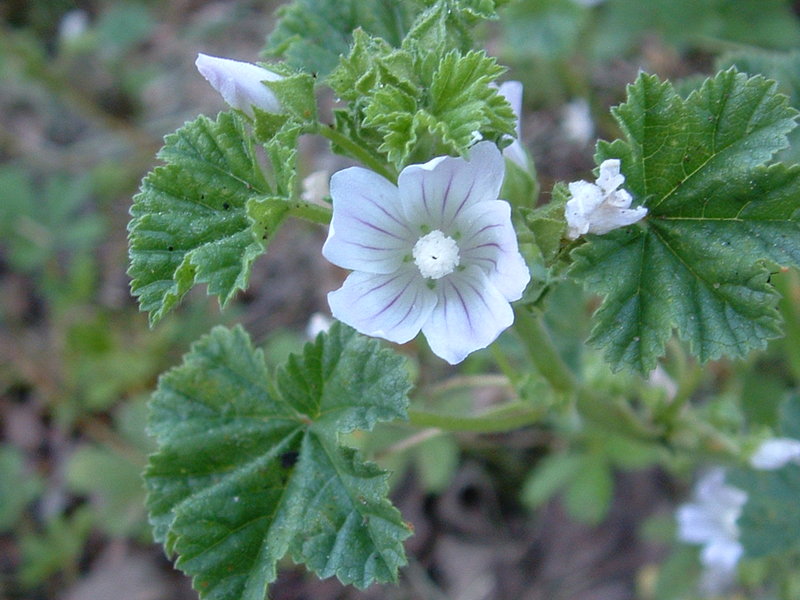
Photo: Wikimedia Commons, CC BY-SA 3.0 · source

Herbaceous plant · Mallow family (Malvaceae)
Dwarf mallow
Malva neglecta
In other languages: Klein kaasjeskruid (Nederlands) · Mauve à feuilles rondes (Français)
Grows wild in Belgium.
Dwarf mallow is a low, sprawling plant with round, softly hairy leaves and pale, white to light lilac flowers with fine purple veins. It is an annual or short-lived perennial of rich, disturbed ground: farmyards, village streets, the foot of walls, verges, field edges and waste ground. In Belgium it is fairly common, especially near houses and farms. You can recognise it by the flat, round fruits that look like a tiny wheel of cheese, and by the flowers, which are only about twice as long as the calyx. It is a food plant for the caterpillars of the painted lady and the mallow skipper, and children used to nibble the ‘cheeses’.
Light
Full sun
warm and bright
Moisture
Dry to normal
no wet feet
Hardiness
Fully hardy
down to -20 °C
Size
0.3 m
tall, 0.5 m wide
Flowering
June–October
| Pruning months | March and August |
|---|---|
| Height | 0.3 m |
| Native to Belgium | Yes |
| Flowering | June–October |
Identify
How to recognise it
- Growth habit
- Annual or short-lived perennial with sprawling to ascending stems of 10–50 cm from a central taproot; forms loose mats up to 30 cm tall.
- Leaf
- Long-stalked, round to kidney-shaped, 2–6 cm across, with 5–7 shallow, scalloped lobes; softly hairy.
- Flower
- White to pale lilac with fine purple veins, 1.5–2.5 cm, with five notched petals about twice as long as the calyx. In small clusters in the leaf axils, from June to October.
- Fruit/Seed
- A flat, round fruit of 12–15 segments in a ring, like a tiny wheel of cheese; each segment holds one seed.
- Roots
- A strong, deep taproot: the plant is hard to pull up.
- Confusion with
- Common mallow is upright, grows up to 1 m tall and has larger, pinkish-purple flowers with dark stripes. Round-leaved crane’s-bill has similar leaves but small pink flowers and beak-shaped fruits.
Flowering: June–October · Pruning: March and August
In your garden
Why grow it?
- A food plant for the caterpillars of the painted lady and the mallow skipper.
- Bees, bumblebees and hoverflies visit the flowers from June into October, including late in the season when little else is in flower.
- Grows where hardly anything else will: between paving slabs, along walls, in a yard or on rubble.
- The young leaves and the unripe ‘cheeses’ are edible, and children used to nibble them.
- An old companion of people: it has grown around farms and villages for centuries and belongs to the rural village scene.
Dwarf mallow: where does it grow best?
- In the wild: farmyards, village streets, verges, the foot of walls, field edges, around manure heaps and on waste or disturbed ground.
- Full sun to light part shade.
- Rich, dry to moist soil: sand, loam or rubble, preferably loose and free-draining.
- In the garden: along a path, between paving or in gravel, at the foot of a sunny wall, in a corner of the vegetable plot or near the compost heap.
Goes well with
- Common mallow: A larger, showier relative for a sunny wild patch or border.
- Common stork’s-bill: Another low plant of dry, open places, with small pink flowers.
- Wild mignonette: Yellow flower spikes on the same sunny, stony ground.
- Biting stonecrop: A yellow mat between paving and on low walls, beside the mallow.
Maintenance
Dwarf mallow: when and how to plant it?
- Buy seed of native origin from a nursery or wild-flower seed supplier; potted plants are rarely sold.
- Sow in March–May or in September, shallowly (half a centimetre) and thinly, in a sunny spot with loose soil.
- The seed has a hard coat: soak it overnight or rub it lightly with sandpaper and it will germinate faster.
- Keep the soil moist until the seedlings appear after 1–3 weeks, then thin to 30–40 cm.
- Move young plants early, because the taproot makes transplanting difficult later on.
- Never dig up plants from the wild; seed or a nursery plant establishes better.
Care
- Watering
- Only after sowing and for young plants. Once established, the taproot finds water deep in the soil.
- Feeding
- Not needed: it grows naturally on rich soil.
- Spreading
- It self-seeds readily on bare soil. Pull up unwanted seedlings while young, before the taproot goes deep.
- Self-seeding
- Let some of the fruits ripen: that way this short-lived plant comes back in the garden every year.
- Open ground
- Keep the ground around the plant fairly open; among tall grass or dense perennials it disappears.
Tip: If a plant turns up by itself between the paving of your patio or drive, just leave it: it is in nobody’s way there, and bees and butterflies find food in a spot where nothing else flowers.
Pruning and mowing
Pruning months: March and August.
When: In August you can shorten long, bare stems; clear the dead stems in March.
How:
- In August, cut the oldest, bare stems back to 10 cm: the plant regrows and keeps flowering until October.
- Let some of the fruits ripen for new plants.
- Only clear the dead stems in March; in winter they give a little shelter to small creatures.
- For fewer seedlings, cut off faded stems before the fruits turn brown.
Propagation
- Seed
- Collect ripe fruits in August–October, store them dry and sow in spring or September. The seed stays viable in the soil for years.
- Self-sown seedlings
- Simply let the plant self-seed; young plants appear around the parent plant in spring.
Dwarf mallow: how does it get through the winter?
Hardy to −20 °C.
- Many plants die after flowering or after their second year; others overwinter as a low rosette and flower again.
- The seeds survive the winter in the soil and germinate in spring.
- Moderately hardy, to about −20 °C; after a hard winter it mainly returns from seed.
Diseases and pests
- Mallow rust: Orange-brown pustules on the undersides of the leaves, especially in late summer. Cut off affected leaves and put them in the household waste, not on the compost heap.
- Slugs and snails: They eat holes in young leaves, especially in seedlings. Protect them at first, for example with a cut-off plastic bottle.
- Too many seedlings: On bare soil in the vegetable plot it can become a nuisance. Weed out young plants and cut off faded stems.
- Bare, untidy plant: After a long flowering season the stems go bare. Cutting back in August brings fresh growth.
Through the year
- March: Clear dead stems. Sow in a sunny spot.
- April: Sow. Thin seedlings.
- May: Protect young plants from slugs.
- June: First flowers.
- July: Full flower. Bees and bumblebees on the flowers.
- August: Cut back bare stems. First fruits ripe.
- September: Flowering. Collect seed. Sow.
- October: Last flowers.
- November: Leave faded stems standing.
You and this species
Did you know?
- The Dutch name means ‘little cheese herb’, after the flat, round fruits that look like tiny cheeses; in French they are popularly called ‘petits fromages’, and in English ‘cheeses’ is an old country name for them.
- The species name neglecta means ‘overlooked’: a fitting name for such an inconspicuous plant.
- The Romans already ate mallow as a vegetable; the poet Horace mentions it as simple fare alongside olives and chicory.