Photo: Kristian Peters -- Fabelfroh 14:46, 10 July 2005 (UTC), CC BY-SA 3.0 · source

Perennial · Malvaceae
Common mallow
Malva sylvestris
In other languages: Groot kaasjeskruid (Nederlands) · Grande mauve (Français)
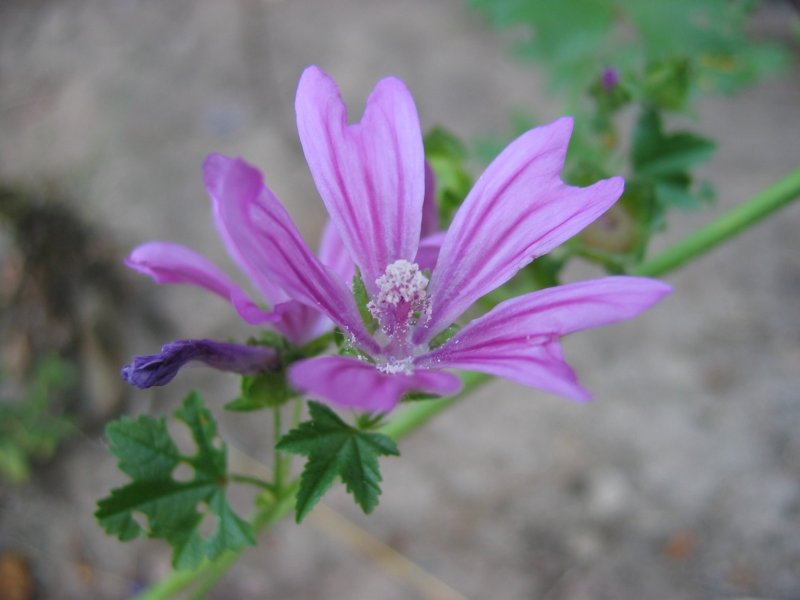
Common mallow is a native, short-lived perennial of roadsides, dykes, field margins and rough ground in Europe, North Africa and western Asia. It forms an upright to somewhat spreading plant 0.6–1 m tall with round, shallowly lobed leaves. From June into October, new purplish-pink flowers 3–4 cm across with dark veins keep appearing in the leaf axils, busily visited by bees and bumblebees. It usually lives for only two or three years, but self-seeds easily and so stays in the garden. Well-known varieties are ‘Zebrina’, white to pale pink with purple stripes, and the lower, pale blue ‘Primley Blue’. Young leaves and flowers are edible.
Light
Full sun
warm and bright
Moisture
Dry to normal
no wet feet
Legal basis
Sand, loam or clay
any pH
Hardiness
Fully hardy
down to -25 °C
Size
1 m
tall, 0.6 m wide
Flowering
June–October
| Pruning months | March and July |
|---|---|
| Height | 1 m |
| Native to Belgium | Yes |
| Good for bees, butterflies and birds | Yes, for bees and butterflies |
| Poisonous to people and pets | Not known to be poisonous |
| Flowering | June–October |
Identify
Common mallow: how do you recognise it?
- Habit
- Upright to spreading plant 0.6–1 m tall and about 60 cm wide, with hairy stems.
- Leaves
- Round to kidney-shaped, 5–10 cm, with 5–7 shallow, scalloped lobes on long stalks; softly hairy.
- Flower
- Purplish pink, 3–4 cm, with five notched petals with dark purple veins, in small clusters in the leaf axils, from June to October. White with purple stripes in ‘Zebrina’.
- Fruit
- A flat, round disc of small segments arranged in a ring, which looks like a tiny cheese.
- Roots
- A deep taproot, so it copes well with drought but dislikes being moved.
Flowering: June–October · Harvest and fruit: April–October · Sowing: March–May · Plants: April–May and September · Pruning: March and July
In your garden
Why grow it?
- One of the longest-flowering native plants: from June into October.
- A busy bee plant: bumblebees and other bees flock to the large, open flowers.
- Grows easily on dry to normal soil in full sun, even on poor, chalky spots.
- Young leaves, flowers and the green, cheese-shaped fruits are edible and pretty in a salad.
- Self-seeds, so after a few years you always have young plants.
Common mallow: where does it grow best?
- Full sun; in shade it becomes floppy and flowers little.
- Sand, loam or clay, acid to chalky, as long as it drains freely.
- Dry to normal soil; wet soil in winter shortens its life.
- Plant 50–60 cm apart, or sow it in an open spot in the border or on a flowering verge.
- Light
- Sun
- Soil type
- Sand, loam or clay
- Acidity
- Not fussy
- Moisture
- Dry or normal
- Size
- 1 m tall, 0.6 m wide
- Hardiness
- Hardy (to -25 °C)
Goes well with
- Wild marjoram: A low, pink bee plant for the same sunny, dry spot.
- Catmint: Blue clouds at the base that flower just as long.
- Viper’s bugloss: Blue spikes on dry soil, another top plant for bees.
- Greater knapweed: Purple flower heads in the same summer, on the same chalky soil.
- Ox-eye daisy: White flowers in June as a fresh contrast with the purplish pink.
Maintenance
Common mallow: when and how to plant it?
Plant in April–May and September.
- Sow indoors in March–April in small pots, one or two seeds per pot, and plant out in April–May.
- Or sow outdoors where it is to flower in April–May and thin later to 50–60 cm.
- Plant bought plants in April–May or in September.
- Dig a hole slightly larger than the pot, set the plant at the same depth as in the pot and do not damage the taproot.
- Firm in and water well. After that, water only in long dry spells.
- No fertiliser or compost is needed; on poor soil it stays sturdier.
Care
- Water
- Keep moist for a few weeks after planting. After that it copes well with drought.
- Feeding
- Not needed. On rich soil it grows large and floppy and falls over.
- Spent flowers
- Cut off spent stems regularly for a longer display, but let a few set seed in late summer.
- Support
- In a windy spot, push a few twigs or canes in around the plant, or plant it among sturdy neighbours.
- Harvesting
- Pick young leaves and flowers from plants that have not been sprayed and do not grow beside a busy road.
Tip: Let it self-seed: the plant is short-lived, but this way you always have young plants flowering into October. Young leaves and flowers are edible; pick them from unsprayed plants.
Common mallow: when to prune it?
Pruning months: March and July.
When: In July, when the plant falls open, cut it back by a third. In late February–March clear the old stems.
How:
- In July, cut long, sagging stems back by a third, just above a leaf: new flowering shoots will follow.
- Remove stems with rust spots completely and put them in the household waste.
- In March, cut the old stems back to just above the rosette of leaves at the base.
Caution: Do not cut right down to the ground late in autumn: the plant overwinters as a rosette of leaves at the base, which is best left in place.
Propagation
- Sowing
- Indoors in March–April in small pots at room temperature; the seed germinates in one to three weeks. Outdoors where it is to flower in April–May. ‘Zebrina’ usually comes true from seed.
- Self-seeding
- Let a few stems set seed in late summer. Move seedlings while young, with a good root ball, because of the taproot.
- Cuttings
- In April–May: take cuttings of young shoots from the base and root them in a sandy cutting mix. This keeps varieties such as ‘Primley Blue’ true.
Common mallow: how does it get through the winter?
Hardy to −25 °C.
- Hardy to about −25 °C: in Belgium protection is usually not needed.
- Wet, heavy soil in winter is a greater danger than frost. After a wet winter an old plant sometimes dies.
- It is short-lived: keep a few seedlings every year as successors.
Diseases and pests
- Mallow rust: Orange-brown pustules under the leaves and yellow spots on top, mainly in late summer. Remove affected leaves, give the plant room and let young seedlings replace the old plants.
- Slugs: Eat seedlings and young plants in spring. Pick them off in the evening or protect young plants with a rough layer.
- Flopping: On rich soil or in shade the stems fall apart. Do not feed, plant it in sun and cut back in July.
- Short life: After two or three years the plant dies. That is normal; let seed ripen or sow some more.
Through the year
- March: Clear old stems. Sow indoors in small pots.
- April: Sow outdoors. Plant out young plants.
- May: Sow and plant outdoors. Keep slugs away.
- June: Flowering starts. Pick young leaves and flowers.
- July: Cut sagging stems back by a third.
- August: Flowering. Watch for rust.
- September: Plant. Let a few stems set seed.
- October: Last flowers. Keep seedlings as successors.
Use
Edible and useful
- Flowers (June–October)
- Pick the pinkish-purple flowers with dark stripes from June to October. They taste mild and look pretty in salads; dried, they make a tea that turns blue, and then pink with a squeeze of lemon.
- Leaves (April–September)
- Pick the young, soft leaves from April to September. They are mild and a little mucilaginous (like okra) and thicken soups and stews; eat them raw in salads or cooked like spinach. The green seed pods, the little ‘cheeses’, are edible too.
- Storing
- Dry flowers and leaves in a thin layer on a rack somewhere airy and dark and keep them in a closed jar for up to a year. Fresh leaves keep for a few days in the fridge.
Caution: Mallow is safe in normal amounts. Do not pick it along roads or on heavily fertilised ground, where it builds up nitrate. The leaves often get rust (orange pustules): only pick healthy leaves.
Eating and using is at your own risk: see the terms of use.
Recipes
- Blue mallow tea (Tea · 1 teapot (± 500 ml) · 10 min)
- Mallow leaf soup (Dish · 4 people · 30 min)
Good for wildlife
- Bees
- Nectar and pollen for honeybees and wild bees.
- Butterflies
- Nectar for butterflies.
You and this species
Did you know?
- The Dutch name kaasjeskruid, cheese herb, comes from the flat, round little fruits, which look like tiny cheeses.
- The colour mauve takes its name from the French word for mallow, mauve.
- It is related to hollyhock, hibiscus and the cotton plant, which you can see in the shape of the flowers.