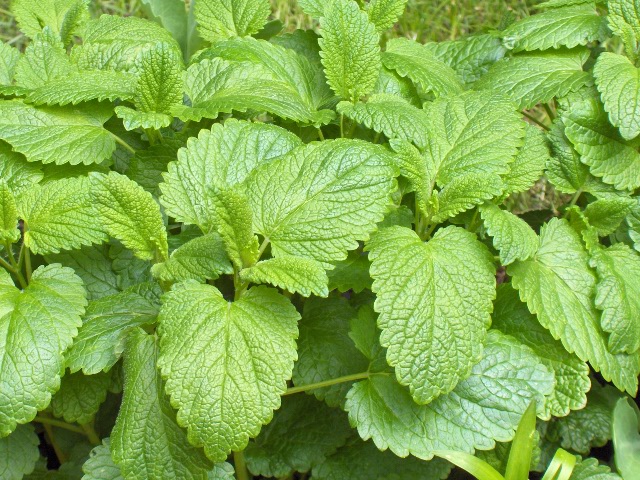
Photo: Wikimedia Commons, CC BY-SA 3.0 · source

Herbaceous plant · Mint family (Lamiaceae)
Lemon balm
Melissa officinalis
In other languages: Citroenmelisse (Nederlands) · Mélisse officinale (Français)
Grows wild in Belgium.
Lemon balm is a perennial of the mint family with fresh green, scalloped leaves that smell of lemon when you rub them. It comes from southern Europe and western Asia, has been grown since ancient times and is naturalised in Belgium: you find it escaped along walls, on verges, on rough ground and at woodland edges, usually near villages and gardens. Recognise it by its square stems, opposite oval leaves and small white two-lipped flowers in whorls where the leaves join the stem. Honeybees love it: the name Melissa comes from the Greek word for honeybee. In the herb garden it is a classic for tea and cooking.
Light
Sun or partial shade
preferably some sun
Moisture
Normal
no wet feet
Hardiness
Fully hardy
down to -20 °C
Size
0.7 m
tall, 0.5 m wide
Flowering
June–September
| Pruning months | March and July |
|---|---|
| Height | 0.7 m |
| Native to Belgium | No, naturalised |
| Flowering | June–September |
Identify
How to recognise it
- Habit
- Bushy perennial 50–80 cm tall and 40–60 cm wide, with many upright, branched stems.
- Leaves
- Oval to almost heart-shaped, 3–7 cm, scalloped, slightly wrinkled and softly hairy; opposite. Smells strongly of lemon when rubbed.
- Flowers
- Small two-lipped flowers of about 1 cm, white to pale yellow, sometimes tinged pink, in loose whorls in the leaf axils; June to September.
- Stem
- Square, as in most of the mint family, slightly hairy and a little woody at the base.
- Fruit
- Four small, dark brown nutlets in the calyx; they drop and germinate readily.
- Confusion with
- Mints smell of mint and flower in spikes or balls at the top. Catnip is greyish and hairy with a sharp smell. White dead-nettle has larger white flowers and no lemon scent.
Flowering: June–September · Pruning: March and July
In your garden
Why grow it?
- A top plant for honeybees, bumblebees and hoverflies, from June into September.
- The leaves have a fresh lemon scent and are lovely in tea, lemonade, salads and desserts.
- Tough and easy: grows in sun and light shade and comes back faithfully every year.
- After cutting back in July it quickly produces fresh new leaves.
- A fixture of monastery and herb gardens for centuries, with a rich history.
Lemon balm: where does it grow best?
- In the wild: old walls, verges, rough ground and woodland edges, mainly near villages, where it has escaped from gardens.
- In the garden: sun or light shade. In fierce midday sun the leaves can scorch and turn yellow.
- Any ordinary, free-draining garden soil; it dislikes wet feet in winter.
- Ideal in the herb garden, near the patio or in a bee border, and also in a large pot of at least 30 cm.
Goes well with
- Lavender: Another bee magnet for sun, for a fragrant herb corner.
- Chives: Purple pompoms at the front of the herb garden.
- Sage: Grey leaves next to the fresh green of lemon balm.
- Wild marjoram: Carries on flowering in late summer for bees and butterflies.
- Pot marigold: A splash of orange among the green, with edible petals.
Maintenance
Lemon balm: when and how to plant it?
- Buy a plant from a nursery and plant it in April–May or September.
- Or sow indoors in March–April: scatter the fine seed on moist compost and press it in without covering, as it needs light to germinate.
- Plant out the young plants after mid-May, 40–50 cm apart.
- Water after planting and again in dry spells during the first few weeks.
- Choose a spot where a few seedlings do no harm, or cut back after flowering.
- Never dig up plants from the wild: nurseries and gardens have plenty.
Care
- Water
- Once established only in long dry spells; regularly in a pot.
- Feeding
- Not needed. On rich soil it grows large, but the leaves are less fragrant.
- Harvesting
- Pick leaves from May, ideally just before flowering, when the scent is strongest.
- Spreading
- It self-seeds freely. Cut back after flowering if you do not want seedlings.
- Rejuvenating
- Divide the clump every 3–4 years, as the centre becomes woody and bare.
Tip: Pinch out the tips regularly and cut part of the plant back in July: you will have fresh, fragrant leaves all summer and far fewer seedlings.
Pruning and mowing
Pruning months: March and July.
When: In July, after the first flowering, cut back part of the plant; in March, the old stems.
How:
- After the first flowering cut half the stems back to 10–15 cm; leave the rest to flower for the bees.
- This gives fresh leaves for the kitchen and limits self-seeding.
- Leave the last stems standing in autumn: insects overwinter in and among them.
- In March cut the old stems back to just above the new shoots at the base.
Caution: Do not cut everything at once in full flower: the bees depend on it. Prune in stages.
Propagation
- Division
- In March–April or September split the clump with a spade and replant the pieces straight away.
- Cuttings
- In May–June take 8–10 cm cuttings from non-flowering shoots and put them in moist cutting compost; they root quickly.
- Seed
- Sow indoors in March–April or outdoors in May, without covering: the seed needs light to germinate.
Lemon balm: how does it get through the winter?
Hardy to −20 °C.
- It dies back largely above ground; small green leaves often remain at the base.
- Fully hardy to about −20 °C, as long as the soil is not too wet.
- The dry stems shelter insects; only cut them in March.
- In a pot: stand it against a wall and keep it on the dry side.
Diseases and pests
- Self-seeding: Seedlings pop up everywhere. Cut back the flower stems before the seed ripens and weed out seedlings while small.
- Powdery mildew: White powder on the leaves in late summer. Cut back; the new leaves are usually healthy.
- Yellow leaves: Caused by fierce sun, drought or wet feet. Choose a spot with some midday shade and free-draining soil.
- Bare centre: Older clumps go woody in the middle. Divide them every few years.
- Slugs: They eat young shoots in spring, especially on newly planted plants.
Through the year
- March: Cut back old stems. Sow indoors.
- April: Plant or divide. New leaves appear.
- May: Harvest leaves. Take cuttings.
- June: Flowering begins. Honeybees on the flowers.
- July: Full flower. Cut back half the stems for fresh leaves.
- August: Flowering. Water in long dry spells.
- September: Last flowers. Division or planting possible.
- November: Leave the stems for overwintering insects.
You and this species
Did you know?
- Melissa is the Greek word for honeybee. Beekeepers used to rub their hives with the leaves, as swarms were thought to settle in them more readily.
- The lemon scent comes from aromatic compounds such as citral and citronellal; citral is also found in lemongrass.
- In the 17th century Carmelite friars in Paris made a famous herbal water with it, known as eau de mélisse des Carmes.