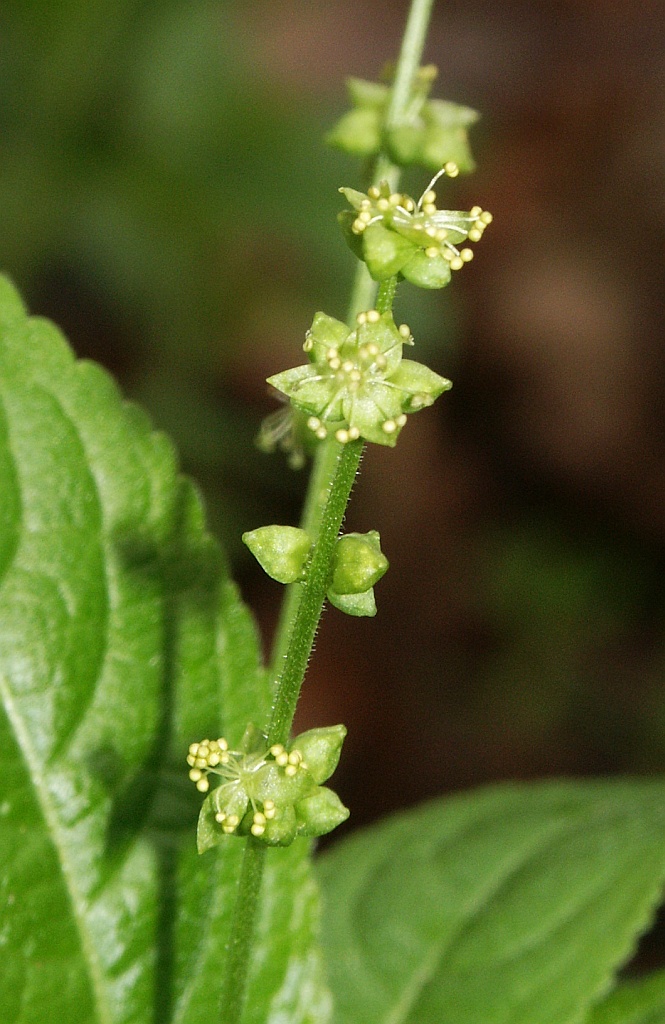
Photo: Wikimedia Commons, CC BY-SA 3.0 · source

Herbaceous plant · Spurge family (Euphorbiaceae)
Dog’s mercury
Mercurialis perennis
In other languages: Bosbingelkruid (Nederlands) · Mercuriale vivace (Français)
Grows wild in Belgium.
Dog’s mercury is a perennial plant of broadleaved woodland that forms large, dark green carpets from creeping rhizomes. It grows in moist but not wet, fertile woods on loam or chalk, such as the slope woods of Brabant, Hesbaye, the Condroz and the Ardennes, and in Flanders it counts as a typical plant of ancient woodland. You recognise it by its upright, unbranched stems with opposite, round-toothed, roughly hairy leaves crowded towards the top, and by its inconspicuous green flowers, from as early as February. Male and female plants are separate, and when crushed the plant smells somewhat unpleasant. Dog’s mercury is poisonous, but it is a strong ground cover and a sign of an old, rich wood.
Caution: Dog’s mercury is poisonous to people and animals. Eating it can cause serious poisoning with stomach and gut upsets. Children, dogs, horses, sheep and cattle are at risk: don’t plant it where children play or animals graze, and never give garden waste containing dog’s mercury to animals. Don’t confuse it with edible wild greens. If swallowed, call a doctor or the Poison Centre straight away.
Light
Partial shade or shade
tolerates little sun
Moisture
Normal
no wet feet
Hardiness
Fully hardy
down to -30 °C
Size
0.3 m
tall, 0.4 m wide
Flowering
February–May
| Height | 0.3 m |
|---|---|
| Native to Belgium | Yes |
| Flowering | February–May |
Identify
How to recognise it
- Growth habit
- Perennial of 15–40 cm with upright, unbranched stems, in dense groups from creeping rhizomes.
- Leaf
- Opposite, elliptic to lance-shaped, 3–8 cm, round-toothed and roughly hairy, dark green; the leaves are crowded towards the top of the stem.
- Flower
- Male and female on separate plants. Male flowers in clusters on long-stalked, upright spikes; female flowers 1–3 on a long stalk. Green, without petals. From February to May.
- Fruit/Seed
- A hairy, two-lobed capsule of 6–8 mm with two seeds, which bursts open.
- Roots
- Long, white, creeping rhizomes, with which the plant forms dense carpets.
- Confused with
- Annual mercury is annual, hairless and branched and grows as a weed in gardens. Also don’t confuse dog’s mercury with edible wild greens that grow along woodland edges in spring: only pick what you recognise for sure.
Flowering: February–May
In your garden
Why grow it?
- A characteristic plant of ancient woodland: where it forms large carpets, the land has often been wooded for centuries.
- One of the first green plants on the woodland floor: the shoots appear in late winter and flower from February.
- A dense native ground cover for deep shade, which holds the soil on slopes and leaves little room for weeds.
- The dense leafy cover shelters beetles, spiders and other small soil creatures.
- It has little value for pollinators: it is mostly wind-pollinated. Ants carry off the seeds.
Dog’s mercury: where does it grow best?
- In the wild in broadleaved woods, slope and ravine woods, old wooded banks and sunken lanes, on loam or chalk.
- Shade to partial shade; in full sun it dries out.
- Fertile, humus-rich soil that holds moisture but drains well, chalky to neutral. It does poorly on acid sand and wet soil.
- In the garden under trees and shrubs in a shady woodland garden, as ground cover. Not in a small border: it spreads widely.
Goes well with
- Wild garlic: Grows in the same fertile broadleaved woods and flowers white in April–May.
- Yellow archangel: Yellow flowers and a good plant for bumblebees, in the same shade.
- Male fern: A sturdy fern that rises above the carpet.
- Sweet woodruff: Little white stars in May on the same humus-rich soil.
- Hazel: A native shrub that casts the shade in which dog’s mercury thrives.
Maintenance
Dog’s mercury: when and how to plant it?
- Buy pot-grown plants from a nursery for native plants.
- Plant in September–November or in February–March, in shade under broadleaved trees or shrubs.
- Set the plants in small groups 30–40 cm apart: the rhizomes then fill the space by themselves.
- Mix some leaf mould into the planting soil and spread a layer of leaves around the plants.
- Water in dry spells during the first summer. Choose a spot away from a play area or a field with animals.
- Never dig up plants from the wild: dog’s mercury belongs to ancient woodland and deserves protection there.
Care
- Water
- In dry spells the first year; after that not needed in a shady, humus-rich woodland garden.
- Feeding
- Not needed. Leave the fallen leaves: they are all the feeding it needs.
- Fallen leaves
- In autumn let the leaves fall on the plants and stay there; they form a protective, nourishing layer.
- Spreading
- It spreads by rhizomes. Cut the edges with a spade in autumn, or put in a root barrier.
- Gloves
- Wear gloves when dividing or moving plants, and wash your hands.
Tip: Give dog’s mercury a place under trees where you want a dense, green ground cover, and keep it away from delicate spring flowers with a spade.
Pruning and mowing
When: No pruning or mowing is needed: the foliage dies back by itself in late autumn.
How:
- Simply leave the dying foliage in place; it breaks down into humus.
- To keep the carpet smaller, cut the edges with a spade in autumn and remove the rhizomes.
- Around delicate spring flowers, keep some space free by pulling out the new runners.
Caution: Don’t throw dug-up plants into a field or near animals: they are poisonous.
Propagation
- Division
- In autumn or late winter, cut a piece of the carpet with its rhizomes with a spade and plant it elsewhere.
- Seed
- Sow fresh seed straight away in summer, outdoors in a pot or tray; it germinates slowly and erratically, division is much quicker.
Dog’s mercury: how does it get through the winter?
Hardy to −30 °C.
- Most stems die back in late autumn; in mild winters some stay green.
- The rhizomes overwinter in the soil; new shoots appear in January–February.
- Fully hardy, to about −30 °C.
Diseases and pests
- Spreading: It can smother delicate spring flowers such as wood anemone and primrose. Cut back the edges every year.
- Poisonous to animals: Horses, sheep, cattle and dogs can become ill from it. Don’t plant it along a field and don’t give garden waste to animals.
- Drying out: In sun or on dry sandy soil it wilts and withers. Choose a cool, shady spot with humus-rich soil.
- Rust: Sometimes small orange spots on the leaves. Harmless; just leave the leaves be.
Through the year
- January: First shoots break through the leaf layer.
- February: First small green flowers. You can plant or divide.
- March: Flowering. The carpet thickens.
- April: Flowering; the female plants form fruits.
- May: The fruits burst open; ants carry away the seeds.
- June: A dense, dark green carpet in the woodland shade.
- September: Plant and divide.
- October: Cut back the edges if the carpet gets too big.
- November: The foliage dies back. Leave the fallen leaves in place.
You and this species
Did you know?
- When dried, dog’s mercury turns distinctly bluish: the plant contains a substance that turns blue as it dries. That is how you can recognise it in a herbarium too.
- The name dog’s mercury means something like ‘worthless mercury’: ‘dog’ was once used for a plant that was inedible or inferior.
- A large carpet is often a single clone that has spread over many square metres by its rhizomes. That is why all the stems in such a patch are often either all male or all female.