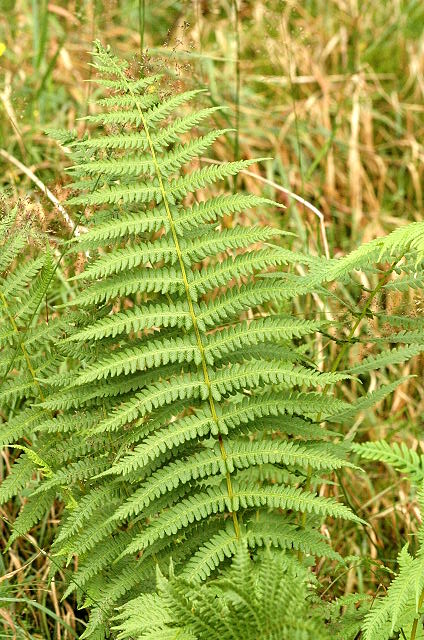
Photo: James K. Lindsey, CC BY-SA 3.0 · source

Fern · Marsh fern family (Thelypteridaceae)
Lemon-scented fern
Oreopteris limbosperma
In other languages: Bergvaren (Nederlands) · Fougère des montagnes (Français)
Grows wild in Belgium.
Lemon-scented fern is a fresh green, deciduous fern with long, narrow fronds that grow in a loose shuttlecock from a short rhizome. Rub the underside of a frond and you smell a fresh scent of lemon: that is where its English name comes from. In the wild it grows on acid, moist soil in open woodland, along woodland streams, on the banks of forest tracks and on heathy slopes, mainly in hill and mountain areas. In Belgium it is found mostly in the Ardennes; in Flanders it is rare. You recognise it by its yellowish green colour, the pinnae that get smaller and smaller towards the base of the frond, and the small spore clusters right along the edge of the lobes.
Light
Partial shade or shade
tolerates little sun
Moisture
Normal to wet
must not dry out
Hardiness
Fully hardy
down to -30 °C
Size
0.8 m
tall, 0.6 m wide
| Pruning months | March |
|---|---|
| Height | 0.8 m |
| Native to Belgium | Yes |
Identify
How to recognise it
- Growth form
- Deciduous fern of 50–100 cm, with fronds in a loose shuttlecock on a short, upright rhizome.
- Leaf
- Lance-shaped, once divided with deeply cut pinnae, yellowish green; the lowest pinnae gradually become very small, down to tiny stubs at the bottom of the short stalk.
- Scent
- The underside of the frond carries many tiny yellow glands that smell of lemon when crushed.
- Spores
- Small, round spore clusters right along the edge of the lobes, with no cover or a tiny one that soon disappears; ripe in July–August.
- Stalk and roots
- Short stalk with pale brown scales; short, thick rhizome that slowly forms new crowns.
- Confusion with
- Male fern is a darker green, does not smell of lemon and has larger spore clusters with a kidney-shaped cover in the middle of the lobes. Lady fern is finer, two to three times divided, with elongated spore clusters.
Pruning: March
In your garden
Why grow it?
- A scented fern: crush a leaflet and you smell lemon, a lovely discovery for children and adults alike.
- A graceful, fresh green structural plant for a moist, acid shade garden or woodland garden.
- Its shuttlecocks of fronds keep the soil cool and moist and shelter frogs, toads and other small animals.
- A native fern that is rare in Flanders: in a garden on acid soil you give it one more place to grow.
- Attractive in autumn, when the fronds turn yellow to russet brown.
Lemon-scented fern: where does it grow best?
- In the wild: open broadleaved and conifer woodland, woodland edges, banks of woodland streams, ravines, banks of forest tracks and moist heathy slopes, mainly in hills and mountains.
- Acid, humus-rich, moist to wet soil, ideally with some moving groundwater; no lime.
- Light shade to partial shade; in sun only if the soil always stays moist.
- In the garden: a moist, sheltered spot under trees, along a stream or on the shady side of a pond, in acid, humus-rich soil.
Goes well with
- Bilberry: Likes the same acid, humus-rich soil and forms a low shrub layer.
- May lily: A low native ground cover with small white flowers in May, on acid soil.
- Wood sorrel: Delicate clover-like leaves and small white flowers at its feet, in cool shade.
- Narrow buckler-fern: Another native fern of acid, moist woodland, with finer, darker fronds.
- Holly: An evergreen shrub that gives shade and shelter when the fern has gone in winter.
Maintenance
Lemon-scented fern: when and how to plant it?
- Buy a plant from a nursery for ferns or native plants; never dig up ferns from the wild.
- Plant in April–May or in September–October, when the soil is moist.
- Mix heavy or limy soil with leaf mould or rotted pine needles: it wants acid, humus-rich soil.
- Set the rhizome at the same depth as in the pot: the crown must stay at the surface and must not be buried.
- Allow 60–80 cm between plants.
- Water well straight away and spread a layer of leaf mould or fine wood chips around the plant.
Care
- Water
- Keep the soil moist at all times in the first year. After that, water only in long dry spells, preferably with rainwater.
- Feeding
- Not needed. Leave the fallen leaves of the trees where they lie: that is food enough.
- Mulching
- A layer of leaf mould or needle litter in spring keeps the soil acid, cool and moist.
- Lime
- Do not use lime or limy rubble nearby; it does not tolerate lime well.
- Old fronds
- Leave them in winter to protect the crown and remove them in March.
Tip: Plant it along a path or beside a stream, where you easily brush past it: you will smell its fresh lemon scent every time.
Pruning and mowing
Pruning months: March.
When: In March, before the new fronds unfurl.
How:
- Cut the old brown fronds just above the rhizome.
- Watch out for the young, coiled fronds in the centre: do not cut into them.
- Leave the old fronds standing or lying in winter: they protect the crown and shelter small animals.
- Spread the cut fronds as mulch under the shrubs.
Propagation
- Division
- In April, carefully cut a plant with several crowns into pieces, each with roots, and replant at once.
- Spores
- In July–August, lay a ripe frond on paper to collect the spores. Sow them on moist, acid seed compost under glass; after a few months the first little ferns appear.
Lemon-scented fern: how does it get through the winter?
Hardy to −30 °C.
- Deciduous: the fronds die back in autumn and turn yellow to brown.
- Fully hardy, to about −30 °C.
- The crown overwinters at the surface; leave the old fronds over it as protection.
- In May the new fronds unfurl, fairly late in the season.
Diseases and pests
- Drought: Brown frond edges and limp fronds in dry summers. Water with rainwater and mulch the soil.
- Limy soil: In limy soil, or heavy, wet soil without air, it dwindles. Choose an acid, humus-rich spot.
- Too much sun: The fronds fade and scorch. Move it to a shadier spot.
- Slugs: They may nibble the young, coiled fronds in May. Usually the damage is limited; let hedgehogs, frogs and ground beetles do the work.
Through the year
- March: Cut away old fronds. Apply mulch.
- April: Plant or divide.
- May: The new fronds unfurl.
- June: Full growth. Water in dry spells.
- July: The spores ripen. Crush a leaflet and smell the lemon scent.
- August: Collect spores. Water in dry spells.
- October: Autumn colour. Plant.
- November: Leave dead fronds in place as protection.
You and this species
Did you know?
- Oreopteris comes from the Greek oros (mountain) and pteris (fern); limbosperma means ‘with seed at the edge’, after the spore clusters along the edge of the lobes.
- The lemon scent comes from tiny yellow glands on the underside of the frond.
- It used to be placed in the same genus as marsh fern, Thelypteris; that is why it belongs to the marsh fern family.