Photo: Wikimedia Commons, Public domain · source

Herbaceous plant · Knotweed family (Polygonaceae)
Water-pepper
Persicaria hydropiper
In other languages: Waterpeper (Nederlands) · Renouée poivre-d’eau (Français)
Grows wild in Belgium.
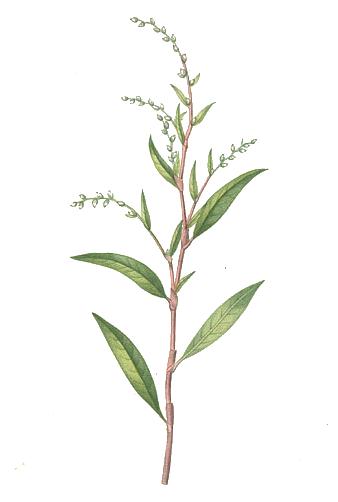
Water-pepper is an annual of the knotweed family that grows in wet, muddy places: the banks of ditches and ponds, waterlogged woodland paths, wheel ruts, dried-out pools and damp fields. In Belgium it is common, especially on somewhat acid, nutrient-rich soil. You can recognise it by its reddish stems with swollen nodes, each wrapped in a thin papery sheath, its narrow, lance-shaped leaves and its slender, drooping, interrupted spikes of small greenish-white to pink flowers. The surest feature is the taste: bite a leaf and after a few seconds you feel a burning, peppery heat. In wet places it is mostly valuable as a pioneer of bare mud and as a source of seed for birds.
Caution: The sap is acrid and can irritate skin, eyes and mouth. Do not let children chew the plant, do not rub your eyes after weeding and wear gloves for larger jobs. Grazing livestock usually leave it alone; in large amounts it can be harmful to animals.
Light
Sun or partial shade
preferably some sun
Moisture
Moist to wet
must not dry out
Hardiness
Fully hardy
down to -20 °C
Size
0.5 m
tall, 0.3 m wide
Flowering
July–October
| Height | 0.5 m |
|---|---|
| Native to Belgium | Yes |
| Flowering | July–October |
Identify
How to recognise it
- Growth form
- Annual, upright to partly sprawling, 20–80 cm, branched, with reddish, hairless stems and swollen nodes.
- Leaf
- Narrowly lance-shaped, 3–10 cm, with a smooth edge. Each node is wrapped in a papery sheath (ochrea) fringed with short bristles. The leaf tastes hot.
- Flower
- Slender, drooping, interrupted spikes of 3–10 cm with small greenish-white to pink flowers. The perianth is dotted with tiny yellow glands. Flowers from July to October.
- Fruit/Seed
- Dull dark brown to black nutlet of 2–3.5 mm, lens-shaped to three-sided.
- Roots
- Fibrous roots; sprawling stems can root at the nodes in wet mud.
- Confusion with
- Tasteless water-pepper and small water-pepper look very similar but do not taste hot and lack the yellow glands on the perianth. Redshank and pale persicaria have dense, upright spikes and often a dark blotch on the leaf.
Flowering: July–October
In your garden
Why grow it?
- In autumn and winter its seeds feed seed-eating birds such as finches, sparrows and ducks in wet places.
- A pioneer of bare mud: it quickly covers exposed banks and ruts and binds the soil.
- Small flies, hoverflies and occasionally bees visit the flowers, but it is largely self-pollinating: its value for pollinators is modest.
- The leaves taste hot like pepper and were once used as a pepper substitute; in Japan young shoots are still used as a herb.
- Fits into a natural pond edge or a wet corner, where few other plants colonise bare mud.
Water-pepper: where does it grow best?
- In the wild in wet, muddy places: ditch banks, edges of ponds and rivers, dried-out pools, waterlogged woodland paths, wheel ruts and damp fields.
- Sun to partial shade.
- Wet to very moist, nutrient-rich soil, often somewhat acid; it tolerates temporary flooding.
- In the garden: on the muddy edge of a pond, in a wet corner or in a rain garden.
Goes well with
- Water mint: Fragrant lilac flowers for bees and butterflies on the same wet bank.
- Purple loosestrife: Purple spikes in summer, a favourite with bees.
- Water forget-me-not: Sky-blue flowers at the water’s edge.
- Trifid bur-marigold: Another annual of exposed mud, with yellow flower heads in late summer.
Maintenance
Water-pepper: when and how to plant it?
- It often appears by itself on bare, wet mud: the seed is already in the soil or arrives with water and birds.
- If you want to sow it, use seed of wild origin from a nursery or seed supplier specialising in native plants.
- Sow in autumn, from September to November, on wet, bare ground at the pond edge: the seed needs a cold spell to germinate.
- Press the seed in and barely cover it. No spacing is needed; thin to 20–30 cm if you like.
- Keep the ground wet; it does best on an edge that dries out in summer.
- Never dig up plants from the wild.
Care
- Water
- Not needed if it grows in a wet spot; at a pond edge it has enough moisture even in dry summers.
- Feeding
- Not needed; the soil at pond edges is usually rich enough already.
- Self-seeding
- Seeds itself freely on bare mud. Pull out unwanted plants before they flower; this is easy.
- Letting it seed
- Let some of the plants ripen in autumn: the seeds feed birds and give new plants the following year.
- Weed in the vegetable patch
- On wet, acid soil it can turn up in the vegetable garden. Hoe off young plants and improve the drainage.
Tip: Create a gently sloping, muddy edge in your pond that dries out in summer: water-pepper, bur-marigold and other annuals will germinate there by themselves, and birds will find seed there in autumn.
Pruning and mowing
When: No pruning is needed: it is an annual. Tidying up can wait until spring, or not happen at all.
How:
- Leave the dead plants standing over winter: birds eat the seeds.
- In March, pull up the old stems or simply let them rot down at the pond edge.
- If you want fewer seedlings, pull up some of the plants in August, before the seed ripens.
Caution: Wear gloves if you pull up a lot of plants, and do not rub your eyes afterwards: the sap is acrid.
Propagation
- Seed
- The only way, as it is an annual. Sow in autumn on wet mud. The seed stays viable in the soil for several years and germinates as soon as there is bare, wet ground again.
Water-pepper: how does it get through the winter?
Hardy to −20 °C.
- Annual: the plant dies with the first frost; the red-brown stems stay standing for a while.
- The seeds drop into the mud or float away and overwinter in the soil.
- Finches, sparrows and ducks search for the seeds in autumn and winter.
Diseases and pests
- Acrid sap: The sap can irritate skin, eyes and mouth. Wear gloves when weeding and do not rub your eyes.
- Too many plants: On a pond edge it can take up a lot of room. Pull some out before the seed ripens.
- Drying out: If a spot dries out for good, it disappears. It needs bare, wet ground.
- Hard to identify: Without tasting it, it is difficult to tell from related persicarias. Use a hand lens to look for the yellow glands on the perianth.
Through the year
- March: Clear old stems or let them rot down.
- April: Seedlings appear on bare, wet mud.
- May: Grows fast. Pull out unwanted seedlings.
- July: Flowering begins.
- August: Full flower. Pull up plants where you do not want seed.
- September: Flowering and seed ripening. The stems turn red.
- October: Last flowers. Sow on wet mud.
- November: Seeds for the birds: leave the plants standing.
You and this species
Did you know?
- Hydropiper literally means ‘water pepper’, from the Greek hydor (water) and the Latin piper (pepper).
- In Japan the plant is called tade; young reddish seedlings are used as a hot garnish with sashimi. A Japanese proverb says that even water-pepper has insects that like it: there is no accounting for taste.
- The hot taste comes from a substance that protects the plant from being eaten: few insects and grazing animals feed on it.