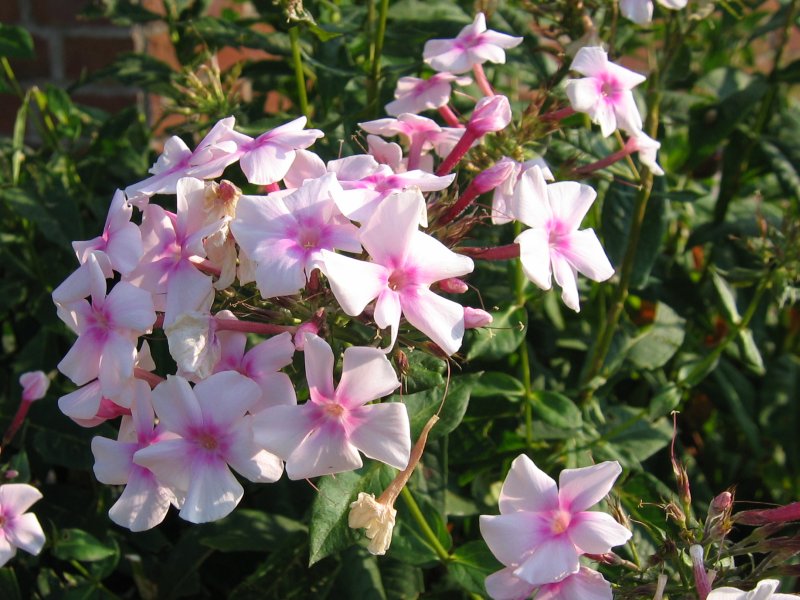
Photo: Kristian Peters -- Fabelfroh 08:34, 24 September 2005 (UTC), CC BY-SA 3.0 · source

Herbaceous plant · Phlox family (Polemoniaceae)
Garden phlox
Phlox paniculata
In other languages: Vlambloem (Nederlands) · Phlox paniculé (Français)
Comes from outside Europe, but is often planted here in gardens and parks.
Garden phlox is a perennial from the eastern and central United States, where it grows wild along moist woodland edges, beside streams and in open, fertile grassland. In Belgium it does not grow in the wild, but since the 19th century it has been a stalwart of cottage gardens and summer borders. You recognise it by its stiff, straight stems with opposite leaves and its large, domed panicles of flat, fragrant little flowers in pink, purple, white or red. From July to September these attract mainly butterflies and the hummingbird hawk-moth, because the nectar sits deep in a narrow flower tube. In a moist, fertile spot in sun or partial shade it flowers lavishly for years.
Light
Sun or partial shade
preferably some sun
Moisture
Normal
no wet feet
Hardiness
Fully hardy
down to -30 °C
Size
1 m
tall, 0.6 m wide
Flowering
July–September
| Pruning months | March and May |
|---|---|
| Height | 1 m |
| Native to Belgium | No, planted |
| Flowering | July–September |
Identify
How to recognise it
- Habit
- Upright clump 80–120 cm tall and 50–60 cm across, with many stiff, unbranched stems.
- Leaf
- Lance-shaped, 8–15 cm, untoothed and opposite, with a clear central vein.
- Flower
- Flat little flowers 2–3 cm across with five lobes on a narrow tube, together forming large, conical to domed panicles at the top of the stems. Pink, lilac, purple, white or red, often with a dark eye; sweetly scented.
- Fruit/Seed
- Small, egg-shaped capsules with a few seeds; seedlings often flower magenta, whatever the variety.
- Roots
- Fibrous roots on a woody rootstock; the clump widens slowly without running.
- Look-alikes
- Moss phlox (Phlox subulata) is low, forms mats and flowers in spring. Dame’s violet has flowers with four petals, alternate leaves and flowers as early as May–June.
Flowering: July–September · Pruning: March and May
In your garden
Why grow it?
- A top plant for butterflies: the peacock, red admiral, whites and the hummingbird hawk-moth can reach the nectar deep in the flower tube with their long tongues.
- The sweet scent hangs over the border on summer evenings and also lures moths.
- Long flowering in high summer, when many spring and early summer flowers are over.
- A fragrant cut flower for large summer arrangements.
- Long-lived and easy: a classic for a cottage garden or a flowery border.
Garden phlox: where does it grow best?
- In the wild: moist woodland edges, stream banks and open, fertile grassland in the eastern and central United States.
- Sun or light shade; in hot midday sun on dry soil it quickly gets powdery mildew and wilts.
- Fertile, humus-rich soil that stays moist in summer: loam or clay with compost.
- An airy spot, not right against a wall: good air circulation prevents powdery mildew.
- Allow 50–60 cm per plant, in groups of three or more.
Goes well with
- Purple coneflower: Flowers at the same time and attracts the same butterflies.
- Bee balm: Whorls of red or pink flowers and scented leaves, on the same moist soil.
- Black-eyed Susan: Yellow next to the pink and purple, well into September.
- Japanese anemone: Takes over flowering in September, in the same partial shade.
- Switchgrass: An airy grass that contrasts nicely with the solid panicles.
Maintenance
Garden phlox: when and how to plant it?
- Buy plants from a nursery or garden centre; never dig plants up from the wild.
- Plant in March–April or in September–October.
- Mix a few spadefuls of compost into the planting soil: it likes rich, moist ground.
- Plant at the same depth as in the pot and firm the soil well.
- Water thoroughly straight away and keep the soil moist for the first few weeks.
- Spread a layer of compost or leaf mould as a mulch around the base to hold in moisture.
Care
- Water
- In dry spells, water generously at the base, not over the leaves. Drought is the main cause of powdery mildew.
- Feeding
- In spring, a layer of compost or organic fertiliser. Unlike many wild flowers, it is a hungry plant.
- Thinning
- In May, cut out the weakest stems so that 5–8 remain per clump: this gives larger panicles and less mildew.
- Spent panicles
- Cut off the first panicles after flowering: a second flush often follows on the side shoots, and you prevent seedlings.
- Division
- Dividing every 3–4 years keeps the clump vigorous; throw away the old, woody centre.
Tip: Thin to 5–8 stems every spring and water generously at the base in dry summers: these are the two best defences against powdery mildew.
Pruning and mowing
Pruning months: March and May.
When: Old stems in March; thinning in May; spent panicles in summer.
How:
- Leave the stems standing in winter as shelter for insects and cut them back to just above the ground in March.
- In May, thin the clump to 5–8 strong stems, for more air and bigger panicles.
- At the end of May, cut half of the stems back by a third: they will flower later, extending the season.
- Cut faded panicles back to above a few pairs of leaves; the side shoots will flower again.
Caution: Do not compost stems with powdery mildew or eelworm: put them in the household waste.
Propagation
- Division
- In March–April or September–October: cut pieces with 3–5 stems from the outside of the clump and replant them straight away.
- Root cuttings
- In winter, lay 3–5 cm pieces of thin root in a pot of sandy compost and cover them lightly. This gives you plants free of eelworm.
- Cuttings
- In April–May, take soft basal cuttings of 5–8 cm and root them in moist cutting compost under plastic.
Garden phlox: how does it get through the winter?
Hardy to −30 °C.
- The stems die back in autumn; the plant overwinters as buds on the rootstock.
- Very hardy, to about −30 °C.
- Leave the dry stems until March: insects shelter in them and they mark the spot.
- A layer of compost in late autumn or early spring protects the soil and feeds the plant.
Diseases and pests
- Powdery mildew: White powder on the leaves, especially in drought and still air. Watering, thinning, an airy spot and resistant varieties such as the white ‘David’ all help.
- Stem eelworm: Tiny nematodes make the tips curl and the leaves narrow and thread-like. There is no cure: put affected plants in the household waste, replant elsewhere and propagate from root cuttings.
- Slugs: They eat the young shoots in spring. Pick them off in the evening and give hedgehogs and ground beetles a place to live.
- Spider mite: Fine webbing and yellow speckles on the leaves in hot, dry summers. Keep the soil moist and spray the foliage with water.
- Magenta seedlings: Self-sown plants often flower magenta and crowd out the variety. Cut off faded panicles and weed out seedlings.
Through the year
- January: Take root cuttings.
- March: Cut down old stems. Apply compost. Plant or divide.
- April: Take cuttings. Watch out for slugs.
- May: Thin to 5–8 stems. Optionally cut back half of the stems.
- June: Water in dry spells. Apply mulch.
- July: Flowering begins. Watch the butterflies and the hummingbird hawk-moth.
- August: Full flower. Cut off faded panicles for a second flush.
- September: Second flush. Plant or divide.
- October: Plant. Leave the stems for insects.
You and this species
Did you know?
- Phlox is Greek for ‘flame’, hence the Dutch name vlambloem, ‘flame flower’.
- The German nurseryman Karl Foerster, who bred many phlox varieties, wrote that a garden without phlox is a mistake.
- The hummingbird hawk-moth, a day-flying hawk-moth, hovers in front of the flowers and sucks nectar from the narrow tubes with its long tongue.