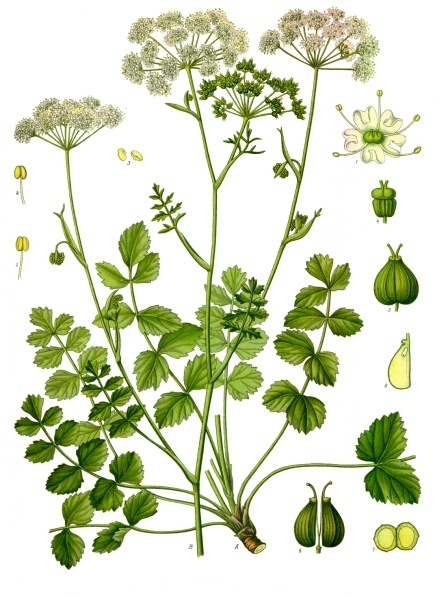
Photo: Franz Eugen Köhler, Köhler's Medizinal-Pflanzen, Public domain · source

Herbaceous plant · Carrot family (Apiaceae)
Burnet-saxifrage
Pimpinella saxifraga
In other languages: Kleine bevernel (Nederlands) · Petit boucage (Français)
Grows wild in Belgium.
Burnet-saxifrage is a slender perennial umbellifer with small white umbels on an almost leafless stem. In the wild it grows in dry, thin grassland, chalk grassland, on dykes, sunny verges and railway banks. In Belgium it is scattered: fairly common on chalk grassland and dry banks in Wallonia, while in Flanders you mainly see it on dry, sandy or loamy verges, dykes and in the Campine, but never in large numbers. You can recognise it by the rosette of pinnate basal leaves with round, toothed leaflets, reminiscent of salad burnet, and by the round, finely ridged stem with hardly any leaves. It flowers late in summer and is then a busy feeding table for hoverflies, beetles and small bees.
Caution: Burnet-saxifrage itself is not poisonous, but it resembles highly poisonous umbellifers such as fool’s parsley and hemlock. Never pick or eat wild umbellifers unless you are completely sure of the species, and teach children not to pick them or put them in their mouths.
Light
Full sun
warm and bright
Moisture
Dry
tolerates drought
Hardiness
Fully hardy
down to -30 °C
Size
0.5 m
tall, 0.3 m wide
Flowering
July–September
| Pruning months | March and October |
|---|---|
| Height | 0.5 m |
| Native to Belgium | Yes |
| Flowering | July–September |
Identify
How to recognise it
- Growth habit
- Slender perennial umbellifer, 30–60 cm tall, with a rosette of pinnate leaves at the base and an almost leafless stem branching near the top.
- Leaf
- Basal leaves once pinnate, with 3–6 pairs of round to oval, toothed leaflets, sometimes deeply cut. The stem leaves are small, with narrow, finely divided segments, or reduced to little more than a sheath.
- Flower
- White, sometimes pinkish umbels 2–5 cm across with 6–15 rays, without bracts or bracteoles, from July to September.
- Fruit/Seed
- Small, oval, hairless fruits of 2–3 mm, brown when ripe.
- Stem
- Round, finely ridged, hairless to slightly hairy, with hardly any leaves near the top. At the base a sturdy taproot with a sharp smell.
- Confusion with
- Greater burnet-saxifrage is more robust, with an angular, deeply furrowed stem and larger, glossy leaflets, and grows on moister, richer soil. Salad burnet has similar leaves but round, green-and-red flower heads instead of umbels. Wild carrot has finely divided leaves and conspicuous, divided bracts under the umbel. Above all, watch out for poisonous umbellifers such as fool’s parsley and hemlock.
Flowering: July–September · Pruning: March and October
In your garden
Why grow it?
- Flowers from July into September, when many grassland flowers are already over, and attracts hoverflies, beetles, parasitic wasps, small bees and other short-tongued insects.
- The caterpillars of a small pug moth, Eupithecia pimpinellata, feed on the flowers and seeds.
- A fine, graceful umbellifer for a dry flower meadow or a thin bank: it stays modest in size and does not spread aggressively.
- If you leave the spent umbels standing, small insects shelter in the stems in winter and birds find seeds.
- The root was used in the past in folk medicine and as a flavouring; the genus is related to anise.
Burnet-saxifrage: where does it grow best?
- In the wild in dry, thin grassland, chalk grassland, on dykes, sunny verges and railway banks, and along the edges of heath and dry woodland.
- Full sun to light half shade.
- Dry to fairly dry, poor and free-draining soil: sand, loam or chalky soil. On wet soil it does not last long.
- In the garden, in a thin flower meadow, a dry bank, a chalky corner or a sunny strip by a low wall.
Goes well with
- Wild marjoram: Flowers at the same time on the same dry, chalky soil and attracts butterflies and bees.
- Knapweed: Purple knobs among the white umbels, excellent for butterflies.
- Bird’s-foot trefoil: Small yellow flowers low in the grass, food plant of the common blue.
- Lady’s bedstraw: Fragrant yellow sprays in July, on the same poor soil.
- Harebell: Blue bells in late summer, pretty beside the delicate umbels.
Maintenance
Burnet-saxifrage: when and how to plant it?
- Buy young plants from a nursery that specialises in native plants, or sow seed of native origin.
- Sow outdoors from September to November: the seed needs a cold period and only germinates in spring. Scatter it on loosened, weed-free soil and press it in.
- You can also sow in a tray that you leave outside all winter, and plant out the seedlings in April–May.
- Plant 25–30 cm apart, among low grasses and other wild flowers. It forms a taproot, so move it while it is young.
- Water after planting and keep the soil moist for the first few weeks; after that watering is no longer needed.
- Never dig up plants from the wild, and never pick wild umbellifers to eat unless you are sure of the species.
Care
- Watering
- Only while it establishes. Thanks to its taproot, an established plant copes well with drought.
- Feeding
- Not needed: on poor soil it stays sturdy and flowers better, whereas fertiliser mainly helps the grasses.
- Mowing
- Mow a flower meadow with burnet-saxifrage in late September or October, after the seed has set, and remove the cuttings. If you also mow earlier, leave part of the meadow uncut.
- Competition
- In tall, dense grass it disappears. On richer soil, mowing twice a year and removing the cuttings keeps the meadow open.
- Self-seeding
- Let the seed ripen before you mow: it self-seeds modestly.
Tip: Sow burnet-saxifrage in autumn directly into a thin meadow, on small patches you have first scratched open with a rake: it will germinate among the grasses in spring.
Pruning and mowing
Pruning months: March and October.
When: Mow in late September or October, after the seed has set. Leave some of the stems standing until March.
How:
- Mow or cut off the spent stems once the seed is ripe and brown.
- Remove the cuttings so that the soil stays poor.
- In one corner, leave some of the stems standing all winter: small insects overwinter in them and birds eat the seeds.
- Cut those stems down in March, before the new rosettes start to grow.
Propagation
- Seed
- Sow outdoors in autumn; it germinates after the winter. Seedlings often only flower from their second year.
- Self-seeding
- Let seed ripen in the meadow: new plants will gradually appear in open patches.
Burnet-saxifrage: how does it get through the winter?
Hardy to −30 °C.
- In autumn the stem dies back; the plant overwinters as buds at the top of the taproot, sometimes with a few leaves.
- Fully hardy, to about −30 °C.
- Dry umbels left standing give structure to a winter meadow and shelter small insects.
Diseases and pests
- Lost in tall grass: On rich soil it gets swamped. Mow, remove the cuttings and do not feed.
- Confusion with poisonous species: Fool’s parsley and hemlock look like burnet-saxifrage from a distance. Hemlock has hairless, purple-blotched stems and a mousy smell; fool’s parsley has long, drooping bracteoles under the small umbels. Never eat wild umbellifers without absolute certainty.
- Rotting: On heavy, wet soil in winter. Choose a dry, free-draining spot.
- Aphids: Sometimes on the umbels. Ladybirds and hoverfly larvae usually deal with them.
Through the year
- March: Cut down old stems. The rosettes start growing.
- April: Plant out seedlings from the outdoor tray.
- May: Leaf rosettes grow. Plant young plants.
- July: Flowering begins. Hoverflies and beetles on the umbels.
- August: Full flower.
- September: Late flowering and seed set. Collect seed.
- October: Mow and remove the cuttings. Sow outdoors.
- November: Sow. Leave some stems standing.
- December: Rest. Dry umbels along the edge.
You and this species
Did you know?
- Burnet-saxifrage belongs to the same genus as anise (Pimpinella anisum).
- The name burnet-saxifrage refers to the leaves, which resemble those of salad burnet. Saxifraga literally means ‘stone-breaker’.
- The Dutch name bevernel, like the German Bibernelle, is a corruption of the old name pimpinella.