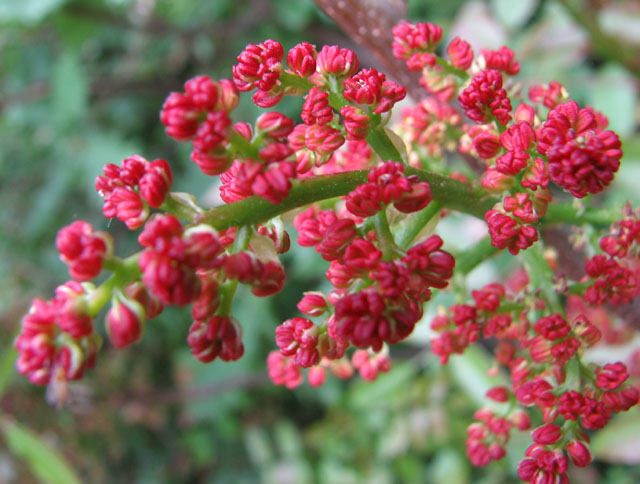
Photo: greffer.net, CC BY 2.5 · source

Tree · Cashew family (Anacardiaceae)
Terebinth
Pistacia terebinthus
In other languages: Terpentijnboom (Nederlands) · Pistachier térébinthe (Français)
Grows wild in Europe, but not in Belgium.
The terebinth is a deciduous shrub or small tree from the Mediterranean, a relative of the pistachio. It grows wild on dry, sunny rocky slopes, in garrigue and in open oak woodland, from Portugal and Morocco to Turkey, and in southern France also inland in warm limestone country. You can recognise it by its glossy pinnate leaves, which smell strongly of resin when crushed, by its reddish flower clusters in spring and by its small fruits, which are red at first and later turn brown to blue-black. Also striking are the long, horn-shaped galls that an aphid causes on its twigs. In Belgium it is only found planted, as an unusual shrub for a warm, dry spot.
Light
Full sun
warm and bright
Moisture
Dry
tolerates drought
Hardiness
down to -15 °C
protect young plants
Size
5 m
tall, 4 m wide
Flowering
April–May
| Pruning months | March–April |
|---|---|
| Height | 5 m |
| Native to Belgium | No, planted |
| Flowering | April–May |
Identify
How to recognise it
- Habit
- Shrub or small tree of 2–6 m, sometimes taller, with a broad, open crown and grey bark that later becomes furrowed.
- Leaves
- Alternate, pinnate with 5–11 oval to lance-shaped leaflets and a terminal leaflet; leathery, glossy dark green, with a strong resinous smell. Red in autumn.
- Flowers
- Dioecious: male and female flowers on separate plants. Small flowers without petals in reddish to purple clusters, in April–May, together with the young leaves. Wind-pollinated.
- Fruit
- Small, round to egg-shaped stone fruits of 5–7 mm in clusters, red at first, brown to blue-black when ripe; only on female plants.
- Galls
- Long, curved, horn-shaped galls of more than 10 cm, green or red at first, later brown; made by an aphid.
- Confusion with
- Mastic tree: evergreen, with pinnate leaves lacking a terminal leaflet. True pistachio: larger leaflets, usually 3–5 per leaf, and large fruits. Stag’s-horn sumach: pinnate leaves, but with toothed leaflets and velvety hairy twigs.
Flowering: April–May · Pruning: March–April
In your garden
Why grow it?
- Superb autumn colour: the leaves turn red to purple in October.
- Tolerates drought, heat and lime: a shrub for the hottest, driest spot in the garden.
- In its homeland birds such as blackcaps and thrushes eat the fruits and so spread the seeds.
- Historically interesting: turpentine was once obtained from its resin, and it is still used as a rootstock for the true pistachio.
- The strange horn-shaped galls are a fascinating bit of nature: inside lives a whole colony of aphids.
Terebinth: where does it grow best?
- In the wild: dry, sunny rocky slopes, garrigue, maquis and open woods of downy oak and holm oak, often on limestone.
- Full sun and warmth; the hotter the spot, the better it grows and colours.
- Poor, stony, free-draining soil, chalky or neutral; it cannot tolerate wet, heavy ground.
- In Belgium: against a south-facing wall, in a gravel garden or on a warm slope, sheltered from the cold east wind. A large pot also works.
Goes well with
- Downy oak: Often grows with terebinth in the wild on warm limestone slopes.
- Lavender: Purple flowers and scent on the same dry, sunny soil.
- Rock rose: Pink or white flowers in early summer, even on poor soil.
- Sage: Grey leaves and purple flowers for bees, just as drought-tolerant.
- Smoke bush: A relative with smoky flower plumes and equally fiery autumn colour.
Maintenance
Terebinth: when and how to plant it?
- Buy a plant from a nursery for Mediterranean or unusual shrubs. Never take plants or seedlings from the wild, not even on holiday.
- Plant in April–May, after the hardest frosts, so it has a whole summer to root.
- Dig a planting hole twice as wide as the root ball and mix heavy soil with gravel or coarse sand.
- Set the plant at the same depth as in the pot and water in thoroughly straight away.
- If you want fruit, plant a male and a female plant near each other.
- Water during long dry spells in the first year; after that it looks after itself.
Care
- Water
- Only in the first year during dry spells. Established plants need no watering.
- Feeding
- Not needed: on poor soil it stays compact and colours better in autumn.
- Winter protection
- For the first few winters, give young plants a mulch over the roots and fleece over the branches in severe frost.
- In a pot
- In winter, stand the pot against a sheltered wall and wrap it, or keep it cool and frost-free; little water in winter.
- Patience
- It grows slowly, especially in the first few years; that is normal.
Tip: Plant terebinth against a south-facing wall in a gravel bed: the warmth of the wall and the dry roots turn a shrub of doubtful hardiness into a sturdy plant with fiery autumn colour.
Pruning and mowing
Pruning months: March–April.
When: Little needed. Remove frost damage and awkward branches in March–April, once the hardest frosts are over.
How:
- Cut frozen shoot tips back to healthy wood, just above a bud.
- Remove crossing or inward-growing branches to keep the crown airy.
- If you want a small tree, keep one or a few trunks and gradually remove the lowest side branches.
Caution: The sap and resin are sticky and strong-smelling; wear gloves if you have sensitive skin.
Propagation
- Seed
- Harvest ripe, dark fruits in autumn, remove the flesh and soak the seeds in water for a day. Sow them in autumn in a pot outdoors, or keep them cold and moist in the fridge for one to two months and sow in spring. Red fruits are often empty.
- Cuttings
- Semi-ripe cuttings taken in summer root with difficulty; sowing works better.
Terebinth: how does it get through the winter?
Hardy to −15 °C: protect young plants.
- Deciduous: after its red autumn colour it stands bare in winter.
- Hardy to about −15 °C once established; young plants are more sensitive.
- Wet winters are more dangerous than dry cold: free-draining soil is the best protection.
- Old brown galls sometimes stay on the twigs all winter.
Diseases and pests
- Frost damage: Frozen shoot tips after a severe winter. Cut back in spring; it usually regrows without trouble.
- Wet soil: Yellow leaves and a sickly shrub caused by root rot. Plant in a dry, free-draining spot.
- Galls: The horn-shaped galls look odd but hardly harm the shrub. Feel free to leave them.
- No fruit: It is dioecious: without a male plant nearby, a female plant gives no fruit, or only empty ones.
Through the year
- January: Dormant. Keep a pot dry and sheltered.
- March: Cut back frost damage.
- April: Planting. Young leaves and reddish flower clusters appear. Pruning still possible.
- May: Flowering. Plant in a gravel garden or pot.
- June: The first galls become visible on the twigs.
- July: Water young plants during long dry spells.
- September: The fruits turn from red to brown or blue-black.
- October: Red to purple autumn colour. Harvest ripe fruits for sowing.
- November: Leaf fall. Mulch over the roots of young plants.
- December: Dormant. Protect young plants in severe frost.
You and this species
Did you know?
- On the Greek island of Chios a fragrant resin, ‘Chian turpentine’, used to be tapped from the trunk. The word turpentine comes from terebinthos, the Greek name for this tree.
- The horn-shaped galls are made by an aphid: a whole colony grows inside, which later in the year moves to the roots of grasses.
- In Turkey the roasted fruits are ground to make a coffee-like drink, menengiç kahvesi.