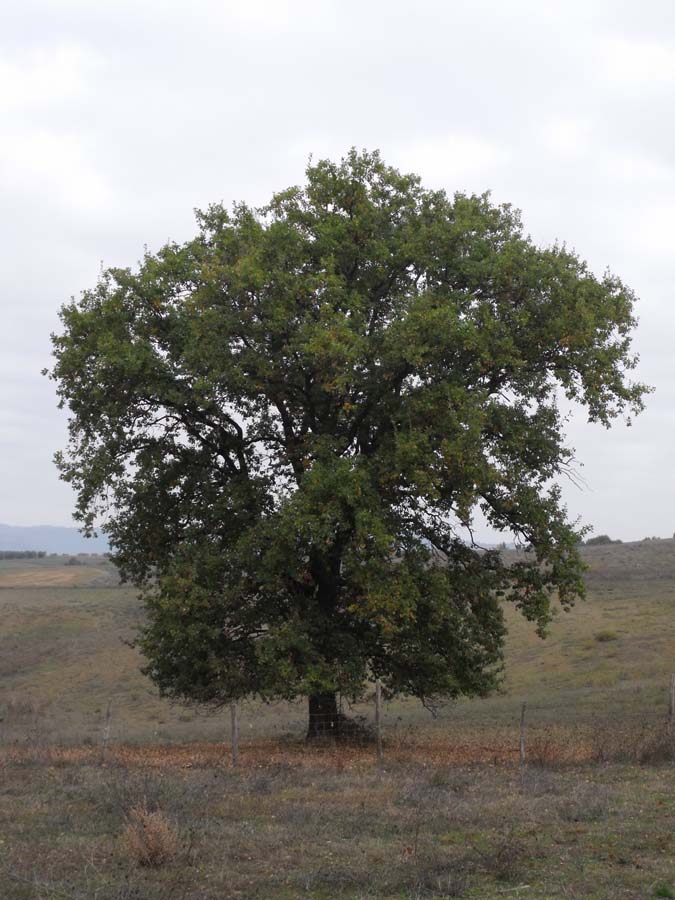
Photo: Etrusko25, CC BY-SA 3.0 · source

Tree · Beech family (Fagaceae)
Downy oak
Quercus pubescens
In other languages: Donzige eik (Nederlands) · Chêne pubescent (Français)
Grows wild in Europe, but not in Belgium.
Downy oak is a small to medium-sized deciduous oak from southern and central Europe, from Spain and France to the Caucasus and Asia Minor. It grows wild on warm, dry slopes, often on limestone, in open woods and scrub together with Cornelian cherry, wayfaring tree and Montpellier maple. It is not wild in Belgium; the nearest wild populations are in France and southern Germany. You can recognise it by its young twigs and buds covered in grey hairs, by its lobed leaves that stay felted underneath and by its dead leaves, which often hang on the branches until spring. Like all oaks it feeds many insects and birds, and because it copes well with heat and drought it is increasingly planted as a tree for a changing climate.
Caution: Acorns and young oak leaves are rich in tannins and harmful in large amounts to horses, cattle and dogs. Do not plant it in or right next to a field with horses or livestock, and do not let dogs chew acorns.
Light
Full sun
warm and bright
Moisture
Dry
tolerates drought
Hardiness
Fully hardy
down to -25 °C
Size
12 m
tall, 10 m wide
Flowering
April–May
| Pruning months | January–February and August |
|---|---|
| Height | 12 m |
| Native to Belgium | No, planted |
| Flowering | April–May |
Identify
How to recognise it
- Habit
- Small to medium-sized tree of 10–15 m, often a twisted tree or large shrub on poor soil. Broad, irregular crown; bark dark grey and finely cracked into small plates.
- Leaves
- Alternate, 5–10 cm, with 4–8 pairs of rounded to slightly pointed lobes; leathery and grey-green. Hairy on both sides when young, later almost hairless above and permanently grey-felted below. Leaf stalk 0.5–1.5 cm, also hairy.
- Twigs and buds
- Young twigs and buds are densely covered in grey hairs: the clearest feature, even in winter.
- Flowers
- Monoecious: hanging yellow male catkins and inconspicuous female flowers on the same tree, in April–May, together with the young leaves. Wind-pollinated.
- Fruit
- Acorns of 1.5–2 cm, single or in small groups, stalkless or short-stalked, in a cup with hairy, flat-lying scales. Ripe in September–October.
- Confusion with
- Sessile oak: leaves hairless or only slightly hairy below, twigs hairless. English oak: hairless leaves with small lobes at the base and a very short stalk, acorns on long stalks. Turkey oak: cup with long, curly scales and thread-like stipules at the buds. It often hybridises with sessile oak, giving intermediate trees.
Flowering: April–May · Pruning: January–February and August
In your garden
Why grow it?
- Like all oaks it is a food plant for the caterpillars of dozens of moth species and many other insects, which in turn feed tits and other birds.
- The acorns are winter food for jays, wood pigeons, squirrels and mice; jays bury them and so plant new oaks.
- Tolerates heat, drought and lime better than English oak and sessile oak: a tree for warm, stony spots and for drier summers.
- Gall wasps make all kinds of strange galls on its leaves, buds and twigs, a fascinating world to discover.
- The dead, coppery brown leaves often stay on all winter and give the tree colour even then.
- Grows slowly and stays smaller and more twisted than our native oaks, so it also fits in a fairly large garden.
Downy oak: where does it grow best?
- In the wild: sunny, dry limestone slopes, rocky ground, open woods and scrub; in southern Europe also on other poor soils.
- Full sun; in the shade of other trees it grows poorly.
- Dry to moderately moist, free-draining soil; chalky is ideal, but loam and sand also work. It copes badly with wet, heavy soil.
- In the garden: a warm, open spot in a large garden, at least 8–10 m from the house, or as a single tree on a sunny slope.
- Copes well with the heat of paved surroundings and is therefore also planted as a street or park tree.
Goes well with
- Cornelian cherry: Small yellow flowers in February and red fruits in summer; grows in the same warm oak woods in the wild.
- Wayfaring tree: A shrub for chalky soil, with white flower heads and red to black berries for birds.
- Montpellier maple: A small maple with three-lobed leaves, a regular neighbour of downy oak in the wild.
- Bloody crane’s-bill: Bright magenta flowers at the sunny woodland edge, on the same dry soil.
- Terebinth: A Mediterranean shrub with red autumn colour, which often grows with downy oak in the wild.
Maintenance
Downy oak: when and how to plant it?
- Buy a young tree from a nursery for native and European trees. Never take seedlings from the wild, not even on holiday.
- Choose a young plant of 1–2 years: oaks form a deep taproot and establish much better as small plants than as large trees.
- Plant while dormant, from November to March, when the ground is not frozen.
- Dig a generous hole, loosen the subsoil and mix heavy soil with coarse sand or gravel. Set the plant at the same depth as before and firm the soil well.
- Protect young trees from rabbits and deer with a tree guard or mesh, and water thoroughly straight away.
- Water during long dry spells for the first two summers; after that it is no longer needed.
Care
- Water
- Only during dry spells for the first two years. After that it is very drought-tolerant.
- Feeding
- Not needed: on poor soil it grows sturdy and healthy.
- Mulching
- A layer of leaf mould or wood chips around young trees keeps grass and weeds away and the soil cool.
- Patience
- It grows slowly, especially in the first years while the taproot develops. That is normal.
- Fallen leaves
- The dead leaves only drop in spring. Leave them under the tree as mulch and shelter for insects.
Tip: Plant a small young tree or sow an acorn where it is to grow: with an undisturbed taproot it will, after a few years, grow faster and cope better with drought than a large nursery tree.
Pruning and mowing
Pruning months: January–February and August.
When: Little needed. Formative pruning while dormant, in January–February, or in late August, after the nesting season. Not in hard frost.
How:
- Young tree: choose one central leader if you want a tall tree, or let it grow multi-stemmed for a natural shape.
- Remove dead, broken and crossing branches just outside the branch collar, without leaving a stub.
- Raise the crown gradually, never more than a quarter of the crown at once.
- Leave dead wood in old trees wherever possible: it is valuable for insects and birds, unless it is a danger.
Caution: Large pruning wounds heal slowly on oaks. Prune young and lightly rather than sawing off thick branches later.
Propagation
- Seed (acorns)
- Collect ripe brown acorns without holes in October. Do not let them dry out and sow them straight away, 3–5 cm deep, in a deep pot or where they are to grow. Protect them from mice and jays with mesh. They often send out a root in autumn and shoot in spring.
- Transplanting
- Move seedlings in their first or second winter, while the taproot is still short.
Downy oak: how does it get through the winter?
Hardy to −25 °C.
- Deciduous, but the dead brown leaves often hang on the branches until spring.
- Hardy to about −25 °C; no protection needed in Belgium.
- The grey, hairy buds and twigs make it easy to recognise in winter.
- In winter jays and squirrels dig up the acorns they buried.
Diseases and pests
- Oak processionary moth: The caterpillars live in nests on the trunk and branches in May–July; their irritating hairs cause itching and rashes in people and animals. Do not touch them and have nests removed by a specialist. Tits and parasitic wasps help keep them in check.
- Powdery mildew: White powder on young leaves in summer, especially on new shoots. A nuisance, but rarely harmful to an established tree.
- Galls: Balls, marbles and other growths on leaves, buds and twigs, made by gall wasps. Harmless: leave them be.
- Wet soil: On wet, heavy soil it struggles and sometimes dies. Plant it in a dry, free-draining spot.
- Deer and rabbit damage: Rabbits and deer nibble young trees. A tree guard or mesh prevents this.
Through the year
- January: Dormant. Formative pruning in mild weather. Planting.
- February: Last formative pruning. Planting.
- March: The old dead leaves drop. Last chance to plant.
- April: The grey, hairy young leaves unfold. Yellow catkins appear.
- May: Flowering. Watch for oak processionary moth nests.
- June: Look for insects and galls on the leaves. Water young trees in dry weather.
- August: Small pruning corrections, after the nesting season.
- September: The acorns turn brown.
- October: Collect acorns and sow them straight away. Jays bury acorns.
- November: Brown autumn colour; some leaves stay on. Planting.
- December: Dormant. Plant in mild weather.
You and this species
Did you know?
- In southern France downy oak is the classic truffle oak: the black truffle lives in partnership with its roots.
- The species name pubescens means ‘covered in fine down’, after the hairs on its twigs, buds and leaves. In southern France it is also called chêne blanc, white oak.
- Dead leaves staying on the branches in winter is called marcescence; you also see it on young beeches and oaks.