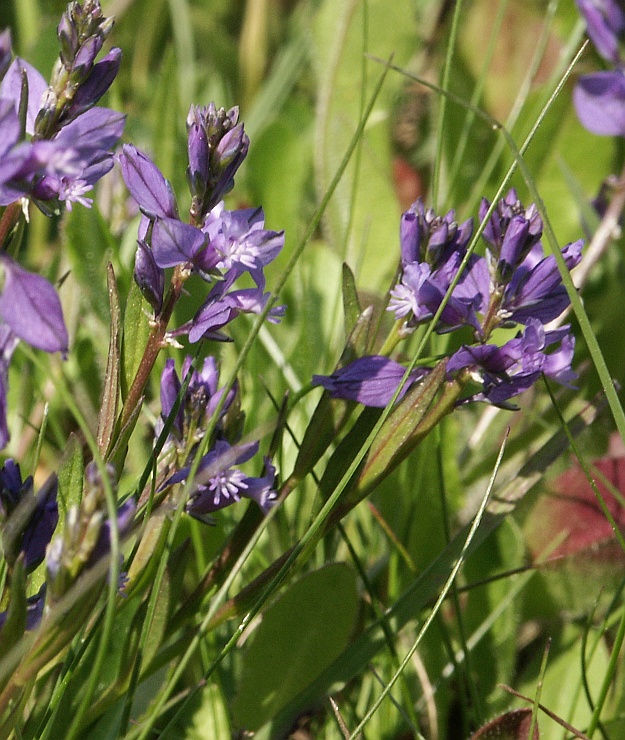
Photo: Wikimedia Commons, CC BY-SA 3.0 · source

Herbaceous plant · Milkwort family (Polygalaceae)
Common milkwort
Polygala vulgaris
In other languages: Gewone vleugeltjesbloem (Nederlands) · Polygala commun (Français)
Grows wild in Belgium.
Common milkwort is a small perennial with sprays of tiny flowers in an intense blue, sometimes pink, purple or white. It grows in thin grassland, on heath, in dune grassland, chalk grassland and on poor verges. In Flanders it has become rare, mainly because many grasslands have been fertilised or have become overgrown; in Wallonia you come across it more often, in thin and chalk grassland. You can recognise it by its slender, sprawling to rising stems with narrow, alternate leaves, and by the flowers with two large, coloured ‘wings’ and a small fringed crest. It is a little gem for anyone with short, thin grassland, and it tells you that the soil is poor and valuable.
Light
Full sun
warm and bright
Moisture
Dry to normal
no wet feet
Hardiness
Fully hardy
down to -30 °C
Size
0.2 m
tall, 0.15 m wide
Flowering
May–August
| Pruning months | August–September |
|---|---|
| Height | 0.2 m |
| Native to Belgium | Yes |
| Flowering | May–August |
Identify
How to recognise it
- Growth habit
- Small perennial, 10–30 cm tall, with slender, sprawling to rising stems from a slightly woody base.
- Leaf
- Alternate, narrowly lance-shaped, 1–3.5 cm long, hairless and untoothed. The lower leaves are smaller and slightly broader, but do not form a rosette.
- Flower
- Sprays of 10–40 flowers of 4–8 mm, usually blue but also pink, purple or white. Two inner sepals are large and coloured, like wings; the lower petal carries a fringed crest. Flowers from May to August.
- Fruit/Seed
- A flat, heart-shaped capsule enclosed by the wings, holding two hairy seeds, each with a small, nutritious appendage.
- Stem
- Slender, round, hairless to slightly hairy, somewhat woody at the base.
- Confusion with
- Heath milkwort has opposite lower leaves and grows on acid heath and in damp, thin grassland. Tufted milkwort has long bracts that make the top of the spray look tufted before flowering. Dwarf milkwort has a leaf rosette at the base and smaller flowers. Common milkwort: all leaves alternate along the stem, no rosette.
Flowering: May–August · Pruning: August–September
In your garden
Why grow it?
- A gem of thin grassland: tiny flowers in intense blue, pink or white from May into August.
- Visited by bumblebees, bees and butterflies, although the flowers can also pollinate themselves.
- The seeds carry a nutritious appendage and are carried off by ants: the ants get food and spread the plant.
- An indicator of nutrient-poor, unfertilised soil: where it grows, you often find valuable grassland or a well-managed verge.
- Suits short grassland, a heather garden or a rock garden, where it forms a fine carpet of flowers with other low plants.
Common milkwort: where does it grow best?
- In the wild in thin grassland, heath, dune grassland, chalk grassland and on poor verges.
- Full sun to very light half shade.
- Poor, unfertilised soil, slightly acid to chalky, dry to moderately moist.
- In the garden, in short, thin grassland, a heather garden, a rock garden or an open patch on a dry bank, without competition from tall plants.
Goes well with
- Tormentil: Small yellow flowers in the same thin, slightly acid grassland.
- Wild thyme: A low, fragrant carpet on the same dry, poor soil.
- Mouse-ear hawkweed: Lemon-yellow heads among the blue sprays.
- Heath bedstraw: White starry flowers on acid heath and in thin grassland.
Maintenance
Common milkwort: when and how to plant it?
- Buy plants or seed of native origin from a nursery that specialises in native plants.
- Sow in September–October, preferably fresh seed, in a tray of poor, sandy seed compost. Leave the tray outside all winter: the seed often only germinates after a cold period.
- Plant in April or September, 15–20 cm apart, among low grasses and herbs, without enriching the soil.
- Water in and keep the soil slightly moist until the plants have established.
- It stays small and needs light and open ground: do not put it among vigorous plants.
- Never dig up plants from the wild: it is rare in Flanders, and wild plants rarely take anyway.
Care
- Watering
- Only while it establishes. After that it manages without.
- Feeding
- Never: fertiliser and compost make grass and vigorous plants grow, and it disappears beneath them.
- Mowing
- Mow short grassland in late August or September and remove the cuttings. On richer soil, a second cut in autumn may be needed to keep the grass short.
- Open patches
- In March, rake away some moss and thatch so that there are open patches where the seed can germinate.
- Self-seeding
- Let the seed ripen before you mow: ants carry it further.
Tip: In March, scratch open a few small patches around the plants: on bare, poor soil the seed germinates far better than in a dense sward.
Pruning and mowing
Pruning months: August–September.
When: In late August or September, after seed set.
How:
- Mow short along with the grassland and remove the cuttings.
- Do not mow from May to July: you would cut away the flowers and the seed.
- In a rock garden, cut the spent stems back to a few centimetres above the base.
Propagation
- Seed
- Sow fresh seed in autumn and let it overwinter outside. Seedlings grow slowly and usually flower from their second year.
- Self-seeding
- In thin grassland it seeds itself, helped by ants. Keep small bare patches around the plants.
Common milkwort: how does it get through the winter?
Hardy to −30 °C.
- The stems mostly die back; the plant overwinters as buds on its slightly woody base.
- Fully hardy, to about −30 °C.
- It dislikes heavy, wet soil in winter.
Diseases and pests
- Overgrowth: Tall grass and vigorous plants soon smother it. Mow, remove the cuttings and never fertilise.
- Moss and thatch: A thick mat stops the seed from germinating. Rake it away gently in spring.
- Slugs: Young plants are sometimes eaten. Plant in a dry, open spot and pick off slugs in the evening.
- Short life: Plants often live only a few years. Let them self-seed so that young plants keep coming.
Through the year
- March: Rake away moss and thatch around the plants.
- April: Plant. New shoots appear.
- May: Flowering begins.
- June: Full flower: blue, pink and white mixed together.
- July: Flowering and seed set. Do not mow.
- August: Seed ripens. Mow in late August and remove the cuttings.
- September: Mow if not yet done. Plant or sow.
- October: Sow fresh seed in a tray outside.
- December: Rest.
You and this species
Did you know?
- The name Polygala means ‘much milk’: people once believed that cows eating the plant gave more milk. Hence the English name milkwort.
- In England the flowers were once carried in Rogationtide processions, hence old names such as rogation flower and gang flower.
- The wings are not petals but two enlarged, coloured sepals. After flowering they turn greenish and enclose the fruit.