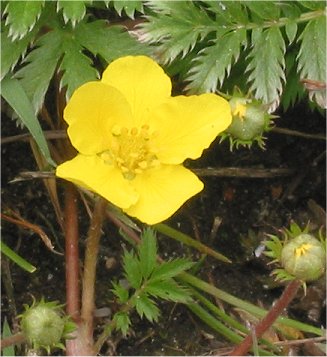
Photo: Rasbak, CC BY-SA 3.0 · source

Herbaceous plant · Rose family (Rosaceae)
Silverweed
Potentilla anserina
In other languages: Zilverschoon (Nederlands) · Potentille ansérine (Français)
Grows wild in Belgium.
Silverweed is a low, creeping plant with silvery, feathery leaves and bright yellow flowers, found all over Belgium wherever the ground is trampled or now and then flooded. It grows along farm tracks, in wheel ruts, in farmyards, on dykes and ditch banks, in damp pastures and in dune slacks. With long, reddish runners that keep forming new rosettes, it quickly covers bare ground. You recognise it at once by the leaves with many toothed leaflets, silvery-haired especially underneath, and by the five-petalled yellow flowers on long stalks. It is a tough ground cover for wet, sunny spots where little else will grow.
Light
Full sun
warm and bright
Moisture
Normal to wet
must not dry out
Hardiness
Fully hardy
down to -30 °C
Size
0.15 m
tall, 0.8 m wide
Flowering
May–August
| Height | 0.15 m |
|---|---|
| Native to Belgium | Yes |
| Flowering | May–August |
Identify
How to recognise it
- Habit
- Low rosette plant 5–20 cm tall with long, reddish runners that root at the nodes.
- Leaf
- Pinnate, 5–25 cm long, with 7–12 pairs of toothed leaflets and smaller leaflets in between. Silky silver hairs, especially underneath.
- Flower
- One flower per long stalk, 1.5–2 cm across, with five bright yellow petals, from May to August.
- Fruit/Seed
- Small, dry achenes clustered on the receptacle.
- Roots
- Thickened, starchy roots under the rosette.
- Confusion with
- Creeping cinquefoil also has runners and yellow flowers, but palmate leaves with five leaflets. Creeping buttercup has glossy yellow flowers and three-lobed leaves. Agrimony has pinnate leaves, but long, upright spikes of small yellow flowers.
Flowering: May–August
In your garden
Why grow it?
- Yellow flowers from May to August for hoverflies, small bees and little beetles.
- Beautiful silvery foliage that stands out all season, even without flowers.
- Tolerates trampling and temporary flooding: a plant for difficult spots.
- A fast, low ground cover for a pond edge, a wet path or between stepping stones.
- The roots were once eaten boiled or roasted, especially in times of scarcity.
Silverweed: where does it grow best?
- In the wild: farm tracks, wheel ruts, farmyards, dykes, ditch banks, damp pastures, banks and dune slacks.
- Full sun; in shade it grows leggy and flowers little.
- Moist to wet, often compacted soil, on clay, loam or sand. Tolerates temporary flooding.
- In the garden: a pond edge, a wet strip along a path, between stepping stones or on a bare, trodden spot.
Goes well with
- Water forget-me-not: Pale blue flowers along the same wet edge.
- Ragged-robin: Pink, ragged flowers in May–June, in the same wet grassland.
- Cuckooflower: Lilac flowers in April–May, before silverweed blooms.
- Water mint: Fragrant lilac pompoms along the pond edge in summer.
Maintenance
Silverweed: when and how to plant it?
- Buy plants from a native-plant nursery and plant them in March–April or September–October.
- Space them 30–40 cm apart; within one season the runners grow together.
- You can sow in pots in autumn: scatter the seed on moist compost, cover it thinly and leave the pots outside over winter.
- Water after planting and keep the soil moist until the runners root.
- In the first year, weed out grass and weeds between the young plants until they form a dense mat.
- Never dig up plants from the wild.
Care
- Water
- Only after planting, or on dry sandy soil in a hot summer.
- Feeding
- Not needed; on poor soil it stays compact.
- Trampling
- You can walk on it freely: it recovers quickly.
- Spreading
- Cut off or pull out runners that go too far; they root shallowly.
- Light
- It needs light. Among tall plants it disappears; keep neighbours short or mow around it.
Tip: Plant silverweed between the stepping stones to your pond: it tolerates trampling, fills the gaps and lets its silver leaves shine with every step.
Pruning and mowing
When: Not needed. You can shorten runners all season.
How:
- Cut off runners that grow outside the intended area.
- In grassland it can simply be mown along with the rest; it copes well.
- Leave the dead leaves in place in autumn.
Propagation
- Runners
- From June to September, cut off a rooted rosette from a runner and replant it. It almost always works.
- Seed
- Sow in pots in autumn and leave them outside over winter.
Silverweed: how does it get through the winter?
Hardy to −30 °C.
- The leaves mostly die back; the plant overwinters with a bud in the heart of the rosette.
- In mild winters a few small, silvery leaves sometimes remain visible.
- Fully hardy, to about −30 °C.
Diseases and pests
- Spreading: In an open spot it soon covers everything. Cut off runners or lay an edge of stones.
- Too little light: Leggy growth and no flowers. Move it into the sun or keep neighbours short.
- Drought: On dry soil the leaves wilt in summer. Water, or choose a moister spot.
- Grass growing through: Grass grows through a young mat. Weed in the first year; after that the mat closes up.
Through the year
- March: New rosettes appear. Plant.
- April: The silvery leaves unfold. Plant or transplant.
- May: Flowering begins.
- June: Flowering. The runners form new plants; you can transplant them.
- July: Flowering. Shorten runners that are too long.
- August: Last flowers. Water during drought on sandy soil.
- September: Plant. Collect seed and sow in pots.
- October: Plant. Leave the pots outside.
- November: The leaves die back. Rest.
You and this species
Did you know?
- Anserina comes from the Latin anser, goose: the plant was associated with geese and the greens where they grazed.
- In the Scottish Hebrides the roots were once eaten, especially in times of famine.
- Botanists now often place silverweed in a separate genus, Argentina, from the Latin argentum, silver.