Photo: Rasbak at Dutch Wikipedia., CC BY-SA 3.0 · source

Herbaceous plant · Daisy family (Asteraceae)
Smooth sow-thistle
Sonchus oleraceus
In other languages: Gewone melkdistel (Nederlands) · Laiteron potager (Français)
Grows wild in Belgium.
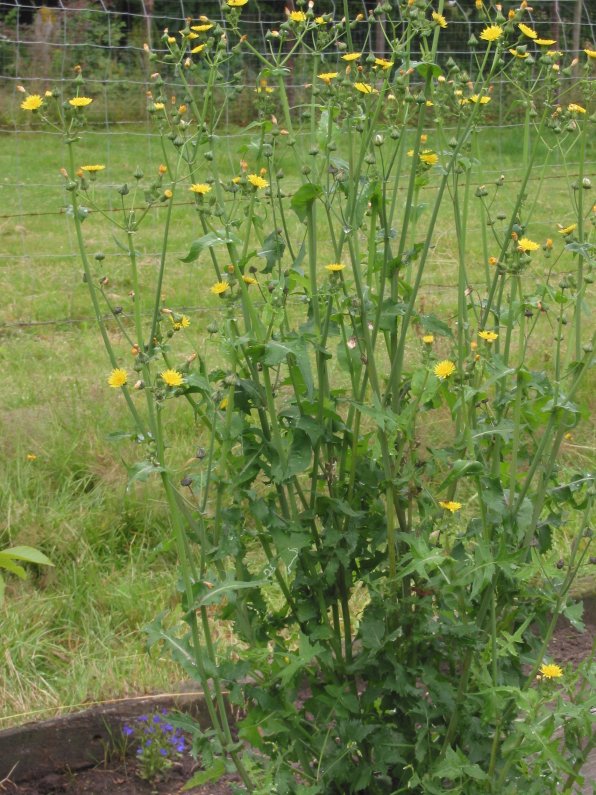
Smooth sow-thistle is an annual or biennial herb, 20–100 cm tall, and one of the commonest wild plants of vegetable gardens, fields, verges, waste ground and pavement edges in Belgium. It turns up on almost any open, rich spot, even between paving stones and at the foot of walls. You can recognise it by the hollow stem with white milky sap, the soft, hairless, dull green leaves with a large triangular end lobe and pointed lobes clasping the stem, and the pale yellow flower heads of 2–2.5 cm. It flowers from May into October and its white fluff blows everywhere. The leaves were once eaten as a vegetable, and rabbits, guinea pigs and hens love them.
Light
Sun or partial shade
preferably some sun
Moisture
Normal
no wet feet
Hardiness
down to -15 °C
protect young plants
Size
0.6 m
tall, 0.3 m wide
Flowering
May–October
| Pruning months | July–September |
|---|---|
| Height | 0.6 m |
| Native to Belgium | Yes |
| Flowering | May–October |
Identify
How to recognise it
- Habit
- Upright annual or overwintering herb, 20–100 cm, with a hollow stem, often tinged purple, that oozes white milky sap when damaged. Branched at the top with a cluster of flower heads.
- Leaf
- Soft, hairless, dull green to bluish green, lobed with a large triangular end lobe, sometimes almost undivided. The margin has fine, soft teeth that do not prick. The leaf base clasps the stem with pointed, backward-facing lobes.
- Flower
- Pale yellow heads of 2–2.5 cm made up of ray florets only, often in small clusters, from May to October.
- Fruit/Seed
- Brown, flattened seeds with fine cross-wrinkles and white fluff; the head opens into a small seed clock, smaller than a dandelion’s.
- Roots
- A short taproot; the plant is easy to pull up.
- Confusion with
- Prickly sow-thistle has glossy, stiffer, spiny leaves with rounded, curled basal lobes and smooth seeds. Perennial sow-thistle has creeping roots and larger, golden-yellow heads. Prickly lettuce has a row of prickles under the midrib.
Flowering: May–October · Pruning: July–September
In your garden
Why grow it?
- Flowers for months, from May to October: pollen and nectar for hoverflies, wild bees and bumblebees.
- The seed is a favourite of goldfinches, which you see clinging to the fluffy heads in late summer.
- A favourite food for rabbits, guinea pigs and hens: give it to them instead of throwing it on the compost heap.
- Young leaves are edible and have been eaten as a vegetable in Europe for centuries.
- Aphids on the shoot tips feed ladybirds and hoverfly larvae, which then help your vegetable garden too.
Smooth sow-thistle: where does it grow best?
- In the wild in fields, vegetable gardens, verges, waste ground, building sites, pavement edges and wall bases: wherever the soil is open and rich.
- Sun to half shade.
- Rich, moderately moist soil; it also copes with dry, stony spots.
- In the garden: it turns up by itself in the vegetable bed, between paving or in a border; leave a few in a wild corner.
Goes well with
- Common poppy: Red beside the pale yellow on an open, sunny spot.
- Cornflower: Blue flowers in a home-sown cornfield border.
- Scented mayweed: Small white daisies with yellow centres on the same open soil.
- Common chickweed: Another herb for hens and rabbits that comes by itself.
Maintenance
Smooth sow-thistle: when and how to plant it?
- Sowing is rarely necessary: smooth sow-thistle appears by itself, because the fluff blows everywhere.
- If you want it as a vegetable or as food for your animals, sow seed of native origin from March to May or in September, thinly and where it is to grow, on loose soil.
- Barely cover the seed and keep the soil moist until germination.
- Thin to 20–30 cm between plants.
- Harvest young leaves before flowering and pick only in clean places, not along busy roads or where dogs go.
- Never dig up plants in nature reserves; seedlings from your own garden are enough.
Care
- Water
- Not needed. If you want tender leaves to harvest, water in dry spells.
- Feeding
- Not needed.
- Weeding
- Pull unwanted plants before they flower, and certainly before the fluff is ripe. The short root makes this easy.
- Letting it seed
- Let a few plants ripen in a wild corner for the goldfinches.
- Harvesting
- Pick the youngest leaves from plants that are not yet flowering; older leaves become tough and bitter. Use them raw in a mixed salad or briefly cooked like spinach.
Tip: Do not simply throw away the sow-thistles from your vegetable garden: give them to your rabbits or hens, or eat the youngest leaves yourself in a mixed salad.
Pruning and mowing
Pruning months: July–September.
When: No real pruning: it is an annual. From July to September, pull or cut plants before the fluff ripens if you do not want seedlings.
How:
- Pull faded plants out roots and all, preferably before the seed clocks open.
- Let a few plants ripen for the birds.
- Plants without ripe seed can go on the compost heap; plants with fluff had better not.
- In autumn, leave a few dead stems standing in a wild corner.
Propagation
- Seed
- The fluff ripens a few weeks after flowering and blows away on the wind. There can be several generations a year; you can sow from March to September.
Smooth sow-thistle: how does it get through the winter?
Hardy to −15 °C: protect young plants.
- Plants that germinate in late summer overwinter as a rosette and flower early the next year.
- It tolerates moderate frost; in hard frost the plants die, but the seed in the soil survives.
- In autumn birds still eat the last seed from the heads.
Diseases and pests
- Aphids: The shoot tips are often covered in aphids. Leave them for ladybirds and hoverflies, or pull badly infested plants in the vegetable garden.
- Powdery mildew: White powder on the leaves in late summer. Harmless to the plant, but stop picking leaves to eat.
- Self-seeding: The fluff blows everywhere. Weed out young plants or do not let them set seed.
- Bitter leaves: Older leaves and flowering plants taste bitter. Harvest young, or cook briefly and pour away the cooking water.
Through the year
- March: Overwintered rosettes start growing again; first seedlings.
- April: Sow as a vegetable or animal food. Pick young leaves.
- May: First flowers. Harvest young leaves from plants not yet in flower.
- June: In flower; hoverflies and bees on the heads.
- July: Flowers and first fluff. Pull before the seed ripens if you do not want seedlings.
- August: Goldfinches feed on the fluffy heads. Pulling possible.
- September: Still flowering. Sow for rosettes that will overwinter.
- October: Last flowers; the plants die in the first hard frost.
You and this species
Did you know?
- Oleraceus is Latin for ‘used as a vegetable’: the plant has been eaten for centuries in large parts of Europe.
- Smooth sow-thistle has now spread across almost the whole world: it travelled with seed and soil.
- In New Zealand sow-thistle is still eaten as a vegetable, under the Māori name pūhā.