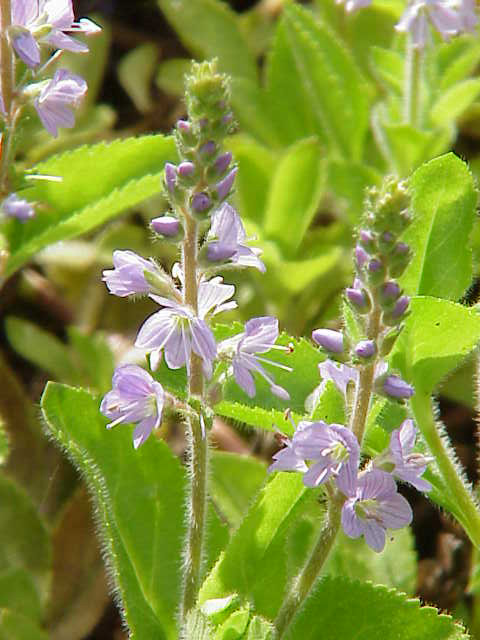
Photo: Kurt Stüber [1], CC BY-SA 3.0 · source

Herbaceous plant · Plantain family (Plantaginaceae)
Heath speedwell
Veronica officinalis
In other languages: Mannetjesereprijs (Nederlands) · Véronique officinale (Français)
Grows wild in Belgium.
Heath speedwell is a low perennial from the plantain family that forms mats with creeping, rooting stems, from which upright spikes of pale lilac-blue flowers rise to 10–25 cm. It grows on dry, acid, nutrient-poor soil: heathland, dry grassland, poor verges, woodland edges, open woods and along forest tracks. In Belgium it is fairly common in the Campine, on other sandy soils and in the Ardennes, but rare on rich loam and clay. You can recognise it by the stems that are hairy all round, the opposite, toothed, hairy leaves and the dense flower spikes that rise from the leaf axils from June to August. In a heath or woodland garden on sandy soil it makes a fine, mostly evergreen ground cover for small bees and hoverflies.
Light
Sun or partial shade
preferably some sun
Moisture
Dry to normal
no wet feet
Hardiness
Fully hardy
down to -25 °C
Size
0.15 m
tall, 0.4 m wide
Flowering
June–August
| Pruning months | September |
|---|---|
| Height | 0.15 m |
| Native to Belgium | Yes |
| Flowering | June–August |
Identify
How to recognise it
- Habit
- Perennial herb with creeping stems 10–40 cm long that root at the nodes and form mats; the flowering stems rise to 10–25 cm.
- Leaf
- Opposite, elliptic to obovate, 2–5 cm, toothed, hairy on both sides and short-stalked; largely evergreen.
- Flower
- Small, 5–8 mm, pale lilac-blue with dark veins and four petal lobes, in dense, upright spikes from the leaf axils, from June to August.
- Fruit/Seed
- A hairy capsule shaped like an upside-down heart, with many small, flat seeds.
- Stem
- Hairy all round, not in two lines as in germander speedwell.
- Confused with
- Germander speedwell has larger, bright blue flowers, almost stalkless leaves and stems with two lines of hairs. Thyme-leaved speedwell is almost hairless, with small oval leaves and white to light blue flowers in a spike at the top.
Flowering: June–August · Pruning: September
In your garden
Why grow it?
- Small bees, hoverflies and other small insects visit the flower spikes from June to August.
- A mostly evergreen ground cover for poor, dry, acid soil, where few other plants do well.
- Typical of heathland and poor grassland: where it grows, the soil is low in nutrients.
- It used to be dried as a tea substitute; in French it was therefore also called ‘thé d’Europe’ (European tea).
- Looks lovely among heather, thyme and fine grasses in a heath garden or on a sunny, dry bank.
Heath speedwell: where does it grow best?
- In the wild: heathland, dry poor grassland, sandy verges, woodland edges, open oak and pine woods and along forest tracks.
- Sun to half shade; it grows well in light shade under trees, but flowers poorly in deep shade.
- Dry to moderately moist, acid, nutrient-poor soil: sand or loamy sand, also stony ground.
- In the garden: in a heath garden, on a sunny bank, as ground cover under birches or pines or between stepping stones on sandy soil.
Goes well with
- Heather: The heathland classic on the same dry, acid, sandy soil.
- Wild thyme: Pink cushions with a scent that draws bees, on the same poor soil.
- Tormentil: Small yellow star-shaped flowers in the same poor grassland.
- Sheep’s sorrel: Red flower spikes on acid sandy soil, and food plant of the small copper.
- Wavy hair-grass: A fine, glossy grass for a heath or woodland garden on sand.
Maintenance
Heath speedwell: when and how to plant it?
- Buy plants or seed of native origin from a wild-plant nursery.
- Plant in March–April or September–October, 25–30 cm apart, in poor, acid soil; do not add compost or potting compost.
- Or sow in autumn or spring in a tray of sandy seed compost. Barely cover the seed, as it is very fine.
- Water in dry spells for the first few weeks, until the stems have rooted.
- Never dig up plants from the wild; a rooted piece from your own garden or a neighbour’s is a better source.
Care
- Water
- Only in the first year during long dry spells; after that not at all.
- Feeding
- Never: on rich soil it gets overgrown by grass and other plants.
- Mowing
- In heathland or poor grassland: mow once a year in September and remove the cuttings.
- Space
- Weed tall, fast-growing plants and grasses out of the mat so light keeps reaching the ground.
- Self-seeding
- Let some of the spikes ripen: on open, sandy patches it self-seeds.
Tip: Heath speedwell does best in soil you leave alone: no manure, no compost and no spade. In a poor, sunny spot under birches it forms a lovely green mat all by itself.
Pruning and mowing
Pruning months: September.
When: Not needed; if you like, cut off the faded spikes in September.
How:
- You can leave the faded spikes standing: they self-seed and give shelter to small insects.
- For a tidy mat, cut the withered flower stems in September, just above the leaves.
- In heathland or poor grassland: mow every year or every other year in September and remove the cuttings.
Propagation
- Runners
- In April or September, snip off rooted pieces of creeping stem and replant them elsewhere.
- Division
- Cut large mats into pieces in spring or autumn and replant them straight away.
- Seed
- Ripens in August–September. Sow in autumn or spring in sandy seed compost.
Heath speedwell: how does it get through the winter?
Hardy to −25 °C.
- The leaves stay largely green: a low, mostly evergreen mat.
- Fully hardy, even in severe winters.
- The dry flower stems remain standing; small insects and spiders shelter in the mat.
Diseases and pests
- Overgrown by grass: On soil that is too rich it disappears under grass and other plants. Do not feed, mow and remove the cuttings, and weed grasses out of the mat.
- Powdery mildew: White powder on the leaves in dry late summers. Usually harmless; cut away badly affected stems.
- Bare patches: After a very dry summer the mat can go bare in places. Lay rooted stems over the gap and give it time.
- Soil too wet: In wet, heavy soil it rots. Choose a dry, free-draining spot.
Through the year
- March: Plant. Weed grass out of the mat.
- April: New growth; snip off rooted runners and replant them.
- May: The flower spikes appear.
- June: First flowers: pale lilac-blue spikes.
- July: Full flower, with small bees and hoverflies.
- August: Last flowers; the seed ripens.
- September: Cut or leave the faded spikes. Mow heathland or poor grassland.
- October: Plant and divide.
- December: The evergreen mat covers the ground.
You and this species
Did you know?
- Officinalis means the plant was once used in the apothecary’s shop. It was also dried as a tea substitute and was known in French as ‘thé d’Europe’.
- The genus Veronica used to be placed in the figwort family; it now belongs to the plantain family.
- The creeping stems root at the nodes, so a single plant can form a mat of half a metre or more within a few years.