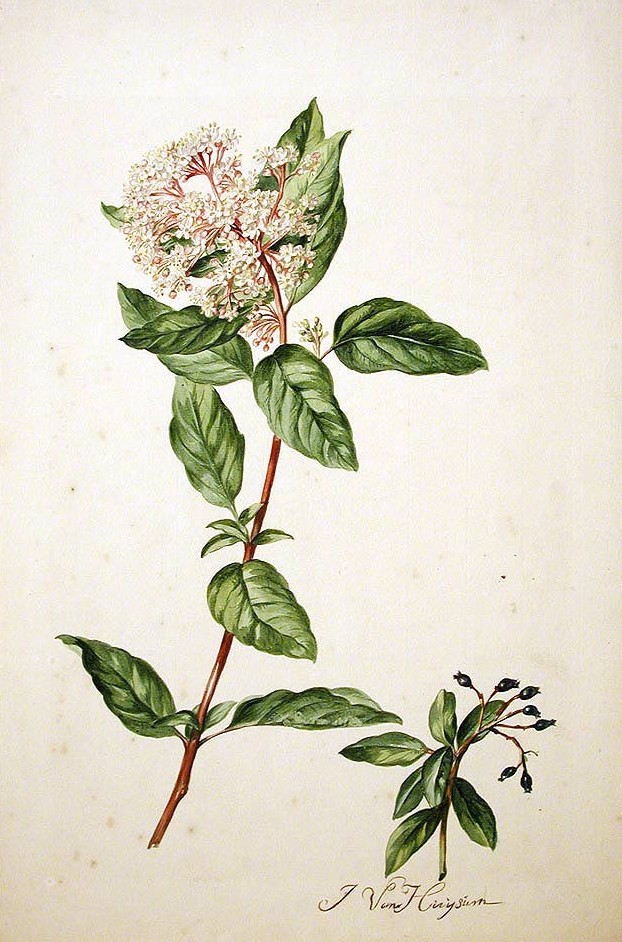
Photo: Jacob van Huysum, Public domain · source

Pruning guide · Shrub
Laurustinus: when and how to prune
Viburnum tinus
Laurustinus: clip a hedge in May–June; prune a free-standing tree or shrub in April–May.
| Pruning months | April–June |
|---|---|
| As a hedge | May–June |
| As a free-standing shrub | April–May |
| Nesting season (15 March–15 August) | Take care in April–June |
| Flowering | December–April |
| Good for bees, butterflies and birds | Yes, for bees and birds |
| Native to Belgium | No, planted |
| Poisonous to people and pets | Yes, take care with children and pets |
Laurustinus: when to prune it?
As a hedge
As a free-standing shrub
After flowering, in April–June.
Laurustinus: how to prune it?
- Clip a hedge once a year after flowering.
- A free-standing shrub needs little pruning: shorten overlong branches and remove dead wood.
- An overgrown, bare shrub tolerates hard rejuvenation pruning in April; it regrows, but flowers less the following winter.
How much to cut, and how often?
- Trim a hedge once or twice a year, after the first flush of growth (late June) and, if needed, in late summer. Check first that no birds are nesting.
What does it mean for wildlife?
- Pruning in April–June can fall in the nesting season (15 March–15 August). Check carefully for nesting birds first: disturbing an active nest is against the law.
- A dense hedge gives birds a place to nest and shelter, and hedgehogs take cover underneath. Leave some leaves at the base.
- Laurustinus flowers in December–April, when it attracts bees.
- If pruning falls during flowering, wait until it is over or leave part of the plant to flower, so bees and butterflies still benefit.
- Prunings can go on a dead hedge or brash pile in a corner of the garden: shelter for hedgehogs, wrens and insects.
Common mistakes
- Clipping without first checking for nesting birds.
- Letting the hedge grow wider at the top than at the bottom: the base then goes bare.
Caution: Clipping after June costs you the following winter’s flowers. Before clipping, check that no birds are nesting in the hedge. Laurustinus is poisonous: wear gloves and keep clippings away from children, pets and livestock.
Nearby: related pruning guides
Similar to: Difference from guelder rose · Difference from garden privet
Plant profile: Laurustinus · Pruning calendar and basic rules
This guide is compiled from the Bladwijzer plant profile and pruning calendar.