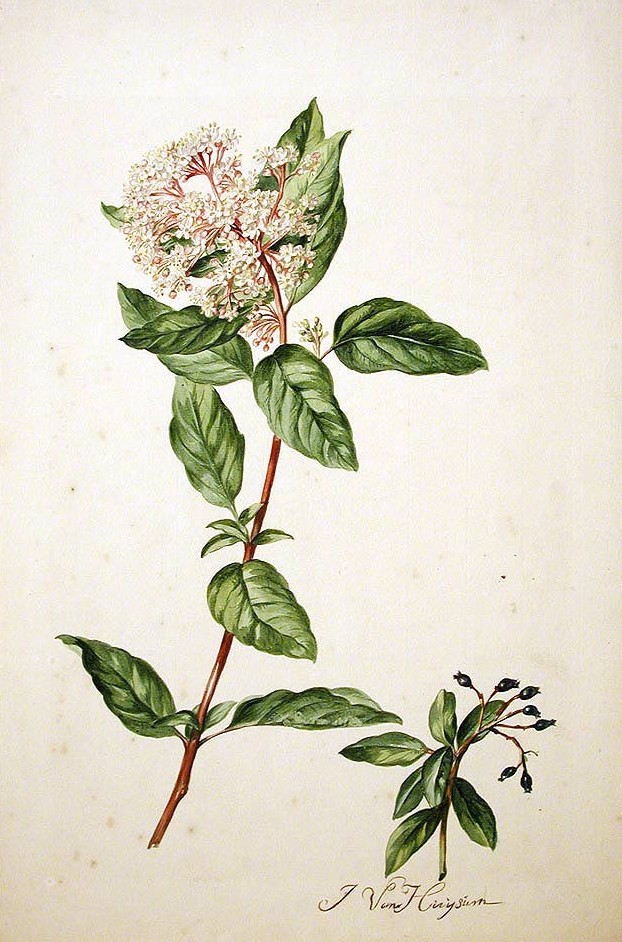
Photo: Jacob van Huysum, Public domain · source

Shrub · Moschatel family (Adoxaceae)
Laurustinus
Viburnum tinus · also: Viburnum tinus
Laurustinus comes from the Mediterranean and is one of the few evergreen shrubs that flower in the middle of winter. From November to April it carries flat heads of pink buds and white, lightly scented flowers. In summer these are followed by metallic blue berries, which are poisonous. It grows 2–3 m tall, thrives in sun and shade and makes a dense evergreen hedge that still flowers.
Caution: The metallic blue berries are poisonous: if eaten they cause vomiting and stomach ache. Keep an eye on young children and pets.
Light
Sun to shade
not fussy
Moisture
Normal
no wet feet
Legal basis
Any garden soil
any pH
Hardiness
Throughout Belgium
no protection needed
Size
2–3 m
tall
Flowering
December–April
| Pruning months | April–June |
|---|---|
| Height | 2–3 m |
| Native to Belgium | No, planted |
| Good for bees, butterflies and birds | Yes, for bees and birds |
| Poisonous to people and pets | Yes, take care with children and pets |
| Flowering | December–April |
Identify
Laurustinus: how do you recognise it?
- Habit
- Dense, rounded, evergreen shrub of 2–3 m.
- Leaf
- Opposite, 4–10 cm, oval, untoothed, dark green and glossy, with hairs in the vein axils.
- Bark
- Reddish young twigs, later greyish-brown.
- Flower
- Pink buds and white, lightly scented flowers in flat heads, from November to April.
- Fruit
- Metallic blue berries in summer; poisonous.
- Difference from guelder rose
- Guelder rose drops its lobed leaves and bears red berries.
- Difference from garden privet
- Garden privet has smaller leaves, white panicles in July and black berries.
Flowering: December–April · Pruning: April–June
Identify by feature: Evergreen leaves · Winter flowers · Blue berries
Looks like it, but isn’t
- Guelder rose Viburnum opulus: drops its lobed leaves and bears red berries. Difference from guelder rose
- Garden privet Ligustrum ovalifolium: smaller leaves, white panicles in July and black berries. Difference from garden privet
In your garden
Why grow it?
- Flowers from November to April, when little else is in bloom.
- Evergreen: a dense hedge or shrub all year round.
- Grows in sun, partial shade and shade, on almost any soil.
- Winter flowers for the first bumblebees and bees; berries for birds.
Laurustinus: where does it grow best?
- Sun to shade; in sun it flowers most freely.
- Almost any free-draining soil, chalky ones too; no wet feet.
- Allow 2–3 m width as a free-standing shrub; as a hedge you keep it narrower.
- Preferably sheltered from cold east winds: in hard winters the leaves can scorch.
- Light
- Sun to shade
- Legal basis
- Any garden soil
- Moisture
- Normal
- Size
- 3 m tall, 2.5 m wide
- Hardiness
- Throughout Belgium, no protection needed
Goes well with
- Winter heath: Pink winter flowers at its feet, in the same months.
- Witch hazel: Fragrant yellow or orange flowers on bare branches, in front of the evergreen leaves.
- Holly: Red berries beside the white flower heads: an evergreen winter group.
Good and bad companions
Goes well with
- Tolerates shade and suits planting under large trees such as: ginkgo, box elder, ash, honey locust, field maple, silver maple
Maintenance
Laurustinus: when and how to plant it?
- Plant pot-grown plants in spring (April–May) or early autumn.
- For a hedge: 2–3 plants per metre.
- Dig a generous planting hole and mix in some compost.
- Water well after planting and keep the soil moist during the first year.
Care
- Watering
- In dry spells during the first year; after that only in long dry summers.
- Feeding
- A little compost in spring.
- Hedge
- Clip once a year, straight after flowering.
- In a pot
- Also grows in a large pot; water regularly and protect the pot in hard frost.
Tip: Plant it by the front door or in front of a window: you will have flowers in view all winter.
Laurustinus: when to prune it?
Pruning months: April–June.
When: After flowering, in April–June.
How:
- Clip a hedge once a year after flowering.
- A free-standing shrub needs little pruning: shorten overlong branches and remove dead wood.
- An overgrown, bare shrub tolerates hard rejuvenation pruning in April; it regrows, but flowers less the following winter.
Caution: Clipping after June costs you the following winter’s flowers. Before clipping, check that no birds are nesting in the hedge.
Propagation
- Cuttings
- In summer, take 10 cm semi-ripe cuttings and root them in a pot of sandy compost under plastic.
- Layering
- Bend a low branch to the ground and cover it with soil; after a year it will have roots.
Laurustinus: how does it get through the winter?
Hardy throughout Belgium: no protection needed.
- Hardy in a normal winter; in hard frost the leaves can turn brown or twigs can be killed back, but it usually regrows in spring.
- Frost can damage open flowers; the buds simply carry on opening afterwards.
Diseases and pests
- Viburnum beetle: Larvae and small beetles eat holes in the leaves in spring and summer. Cut off twigs with eggs (rows of small bumps) as soon as you see them.
- Vine weevil: Half-moon notches in the leaf edges. Control the grubs with nematodes in spring or late summer.
- Frost damage: Brown leaves after a hard winter. Wait until April, then cut out the dead parts.
Through the year
- January: Flowering: white heads with pink buds.
- March: Flowering continues; first bumblebees.
- April: Flowering ends; pruning and planting.
- May: Clip the hedge.
- June: Last pruning: no clipping after this.
- July: Metallic blue berries.
- November: First flowers.
- December: Winter flowering.
Use
What can you use it for?
- Garden and landscape
- Evergreen hedge or shrub that flowers in winter; tolerates partial shade.
- For wildlife
- Winter flowers for the first bumblebees and bees; berries for birds.
Caution: The berries are poisonous.
Good for wildlife
- Bumblebees
- Nectar and pollen for bumblebees, also from deep flowers and early in spring.
- Bees
- Nectar and pollen for honeybees and wild bees.
- Birds
- Berries, seeds or insects as food, or a place to nest.
You and this species
Did you know?
- One of the few shrubs that flower in winter: good for an evergreen hedge that still flowers.
- The blue sheen of the berries comes not from a pigment, but from a layered structure in the skin that reflects light.
- It grows wild in the Mediterranean maquis; that is why it is somewhat sensitive to hard frost here.
- It comes from the Mediterranean. Tinus was already its Latin name; laurustinus roughly means ‘laurel tinus’, after its laurel-like leaves.
- The metallic blue sheen of the berries comes not from a pigment but from tiny layers of fat droplets in the skin that reflect light: a structural colour.