Photo: Rasbak, CC BY-SA 3.0 · source

Pruning guide · Shrub
Juneberry: when and how to prune
Amelanchier lamarckii
Prune a juneberry lightly, in winter (November–February) or just after flowering, in May: if needed, remove an old stem at the base, along with dead, crossing and inward-growing branches.
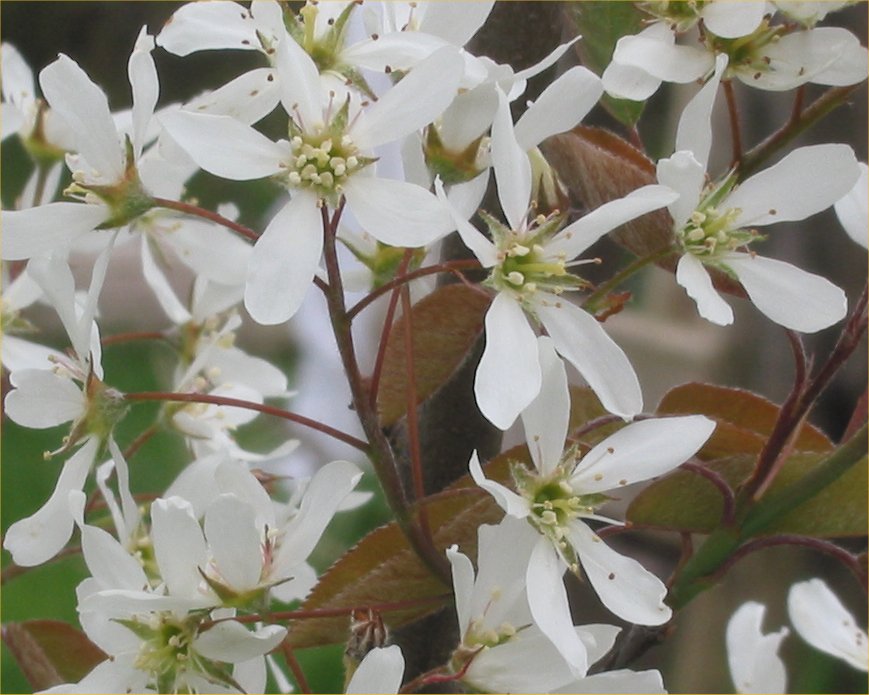
The juneberry (Amelanchier lamarckii) is a multi-stemmed shrub or small tree of 4–8 m, with white flowers in April, sweet berries in summer and glorious autumn colour. It naturally grows in a loose, graceful shape, and that is worth keeping: shorten it every year and you get a broom of straight shoots. So pruning is limited to maintenance and, if you wish, training a small tree with a clear trunk. Two things need attention: fireblight and spreading into the wild.
| Pruning months | May and November–February |
|---|---|
| Nesting season (15 March–15 August) | Take care in May |
| Flowering | April |
| Good for bees, butterflies and birds | Yes, for bees and birds |
| Native to Belgium | No, naturalised |
Juneberry: when to prune it?
Prune in winter, November–February, while the shrub is bare and you can see its shape clearly. Or just after flowering, in May, if you want to remove a branch that bothered you while it was in flower.
Don’t prune in June–July: you would cut off the berries, for you and for the birds.
Cut out branches with fireblight immediately, even outside the pruning season, preferably in dry weather.
What else to prune in those months? January · February · May · November · December
Juneberry: how to prune it?
- Keep the natural, multi-stemmed shape. If needed, saw off one of the oldest stems at the base, so a young one can replace it.
- Remove dead, crossing and inward-growing branches, and water shoots that shoot straight up.
- If you want a small tree with a clear trunk, gradually remove the lowest branches and the shoots at the base over a few years.
- Brown-black flowers and leaves that look scorched, and shoot tips bent over like a shepherd’s crook, may be fireblight. Cut well back, at least 30 cm into healthy wood, disinfect your secateurs after every cut and dispose of the prunings, not on the compost heap. In Belgium, report any suspicion to the FASFC (AFSCA).
- Don’t shorten branches to random lengths: that gives a tuft of straight shoots that spoils the shape.
How much to cut, and how often?
- Little: an old stem every few years, and each year only what is dead or crossing.
- Reduce a shrub that has grown too big over a few years, by removing one or two tall stems at the base each time, not by shortening everything.
What does it mean for wildlife?
- Pruning in May falls in the nesting season (15 March–15 August): first check that no blackbirds, song thrushes or chaffinches are nesting in the shrub, and spare an active nest.
- The April blossom is early food for wild bees and bumblebees, and the berries in June–July are loved by blackbirds, thrushes and starlings.
- The juneberry is a non-native plant spread by those birds, especially on sandy soils in woods and heathland, where it crowds out native plants. If you live close to woodland or heath, don’t plant it, or choose a native berrying shrub such as rowan, hawthorn or guelder rose.
- Pull up seedlings in the garden while they are young. Dig out a larger shrub roots and all: if you only saw it off, it sprouts again.
Common mistakes
- Shortening the shrub every year, so it loses its graceful shape and flowers less.
- Pruning in June–July, just as the berries ripen.
- Not cutting branches with fireblight back far enough, or carrying on with the same secateurs without disinfecting them.
- Planting it right next to a nature reserve, or letting seedlings grow up.
Caution: Cut out branches with fireblight (brownish-black, scorched-looking leaves and curled-over tips) well into healthy wood; disinfect your secateurs afterwards.
Nearby: related pruning guides
Similar to: Difference from bird cherry · Difference from black chokeberry