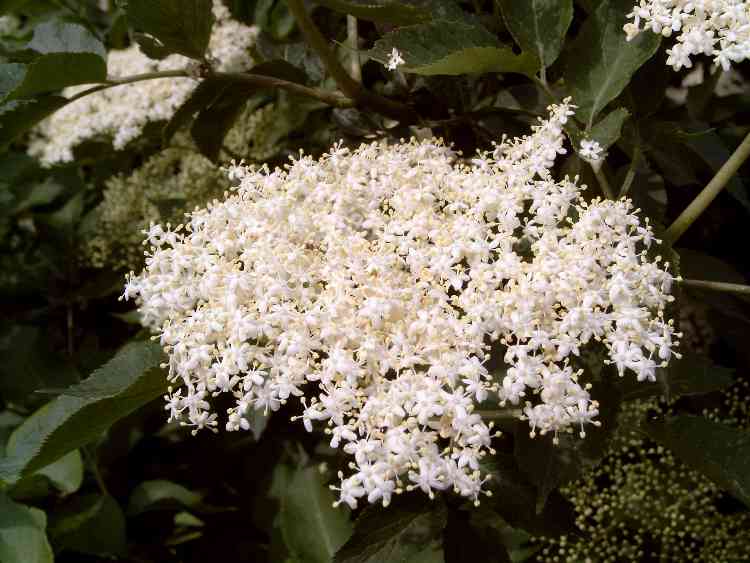
Photo: Kku, Public domain · source

Pruning guide · Shrub
Elder: when and how to prune
Sambucus nigra
Prune an elder while it is dormant, in November–March: every year, saw a few of the oldest stems off at ground level, as the young stems bear the most flowers and berries.
Elder grows fast and tolerates almost anything, including hard pruning. Leave it alone for years and it becomes a broad, rather untidy shrub full of dead wood, with the flowers high out of reach. A little pruning every winter keeps it young and at picking height: then you will have flowerheads for cordial in May–June, and berries for you and the birds in August–September.
| Pruning months | November–March |
|---|---|
| Nesting season (15 March–15 August) | Take care in March |
| Flowering | May–June |
| Good for bees, butterflies and birds | Yes, for birds |
| Native to Belgium | Yes |
Elder: when to prune it?
Prune while it is dormant, in November–March, when the shrub is bare and you can clearly see which stems are old. Don’t prune when it is freezing.
Finish before mid-March: elder comes into leaf early, and blackbirds, song thrushes and whitethroats like to build their nests in it.
Don’t prune in spring or summer: the flowers come on last year’s stems, and anything you cut off then costs you flowers and berries.
What else to prune in those months? January · February · March · November · December
Elder: how to prune it?
- An elder grows either as a clump of stems from the base or as a small tree on a short trunk. Choose a shape and stick to it: renew a shrub from ground level, a small tree from the trunk and main branches.
- Every year, saw off a few of the oldest, thickest stems as low as possible. You can recognise them by their grey-brown, corky, furrowed bark and the many thin twigs at the top.
- Keep the strongest young shoots and thin them out where they are too crowded. Young stems have smooth, paler bark dotted with conspicuous lenticels.
- Remove dead stems, and stems growing inwards or along the ground. Jelly ear, a harmless fungus, often grows on dead elder wood.
- An old, bare elder can be cut right back, to a hand’s breadth above the ground: it will sprout again. But expect few or no flowers the following year.
- Ornamental varieties with dark or finely cut leaves can be cut back hard in late February: you get large, handsome leaves, but fewer flowers and berries.
How much to cut, and how often?
- About a third of the stems every year, the oldest ones: that way no stem is older than three or four years, and the flowers stay at picking height.
- A mature shrub has six to ten strong stems. Thin out any extra, starting with the weakest.
- Cutting everything back every few years is fine too, but then you miss a year’s flowering. A few old stems a year is kinder, both to you and to the birds.
What does it mean for wildlife?
- Blackbirds, song thrushes and whitethroats like to nest in an elder. Winter pruning falls outside the nesting season (15 March–15 August); if you are still at it in the second half of March, look carefully first, as disturbing an active nest is against the law.
- The flowers in May–June produce no nectar, but plenty of pollen: hoverflies, beetles and wild bees visit them. So don’t pick every flowerhead for cordial.
- The berries in August–September are a feast for blackbirds, blackcaps, starlings, thrushes and dozens of other birds. Always leave some on the shrub.
- Put thick sawn-off stems on a dead hedge, and tie a few dead stems upright: small wild bees gnaw their nest tunnels in the soft pith.
Common mistakes
- Cutting back every stem every year, so the shrub fills up with long shoots without flowers.
- Sawing old stems off halfway instead of at the base, so a broom of thin shoots appears.
- Never pruning, until the shrub is full of dead wood and the flowers hang high out of reach.
- Still pruning hard in the second half of March without checking for nests first.
Caution: Don’t prune during the nesting season if birds are nesting in the shrub.
Nearby: related pruning guides
Similar to: Difference from red-berried elder · Difference from ash