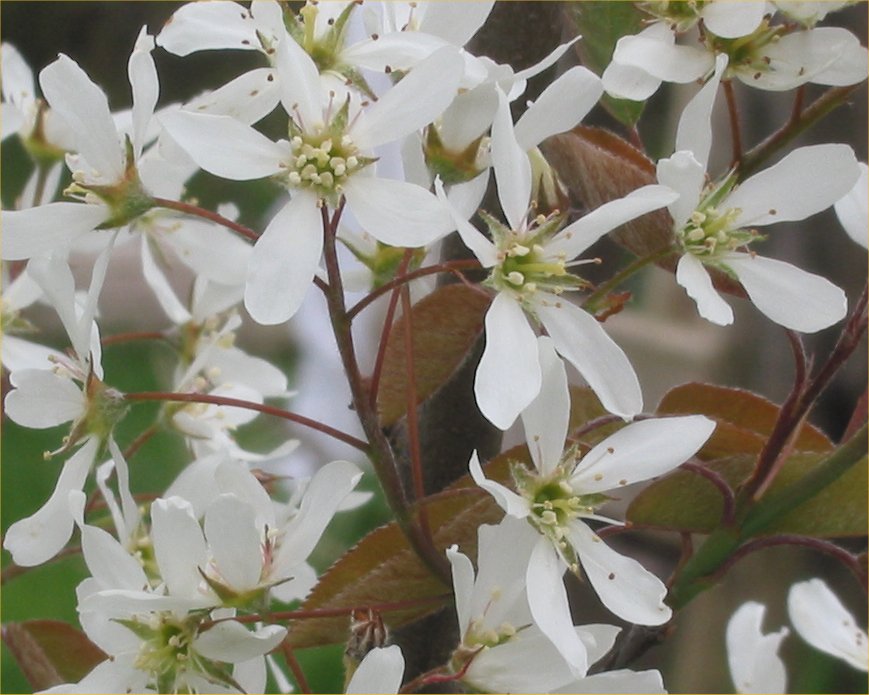
Photo: Rasbak, CC BY-SA 3.0 · source

Shrub · Rose family (Rosaceae)
Snowy mespilus
Amelanchier lamarckii · also: Juneberry, Serviceberry, Amelanchier
Snowy mespilus is a multi-stemmed shrub or small tree of 4–8 m that has something to offer in every season: white starry flowers in April, coppery young leaves, sweet purplish-black berries in June–July and orange-red autumn colour. It grows in almost any soil, in sun or partial shade, and needs little care. To be honest, though, it is a non-native species that birds spread into the wild, especially on sandy soils in woods and heaths. It is fine in the garden, but don’t plant it near nature reserves.
Caution: A non-native species that birds spread into the wild, especially on sandy soils in woods and heaths: don’t plant it near nature reserves, and pull up seedlings. It is also a host plant of fireblight: don’t put it right next to pear or apple trees.
Light
Sun or partial shade
preferably some sun
Moisture
Normal
no wet feet
Legal basis
Any garden soil
any pH
Hardiness
Throughout Belgium
no protection needed
Size
4–8 m
tall
Flowering
April
| Pruning months | May and November–February |
|---|---|
| Height | 4–8 m |
| Native to Belgium | No, naturalised |
| Good for bees, butterflies and birds | Yes, for bees and birds |
| Poisonous to people and pets | Not known to be poisonous |
| Flowering | April |
Identify
Snowy mespilus: how do you recognise it?
- Habit
- Multi-stemmed shrub or small tree of 4–8 m with a loose, broad crown.
- Leaf
- Alternate, oval, 4–8 cm, finely toothed; coppery when young, orange-red in autumn.
- Bark
- Smooth and grey.
- Flower
- Clusters of white, star-shaped flowers in April, with the leaves.
- Fruit
- Purplish-black, edible berries in June–July; birds love them.
- Difference from bird cherry
- Bird cherry has long, hanging flower spikes and bitter cherries.
Flowering: April · Harvest and fruit: June–July · Pruning: May and November–February
Identify by feature: White blossom · Black berries
Looks like it, but isn’t
- Bird cherry Prunus padus: long, hanging flower spikes and bitter cherries. Difference from bird cherry
In your garden
Why grow it?
- Lovely in every season: blossom, coppery young leaves, berries and autumn colour.
- Sweet, edible berries in June–July.
- Early flowers for bees, berries for birds.
- As a multi-stemmed tree, a focal point even in a smaller garden.
Snowy mespilus: where does it grow best?
- Sun to partial shade; in sun it flowers more freely and the autumn colour is brighter.
- Almost any soil, preferably somewhat moisture-retentive; no wet feet.
- Allow 4–5 m in width: on its own in the lawn or at the back of the border.
- Not near woods or heaths on sandy soil, and not right next to fruit trees such as pear (fireblight).
- Light
- Sun or partial shade
- Legal basis
- Any garden soil
- Moisture
- Normal
- Size
- 8 m tall, 5 m wide
- Hardiness
- Throughout Belgium, no protection needed
Goes well with
- Guelder rose: A native shrub with white flower heads and red berries for the same garden edge.
- Hazel: Together a mixed border with early pollen, nuts and berries.
- Lesser periwinkle: Evergreen ground cover with small blue flowers beneath the multi-stemmed shrub.
Good and bad companions
Best kept away from
- Fruit trees that can catch fireblight from this plant: apple, pear, nashi pear
Maintenance
Snowy mespilus: when and how to plant it?
- Plant from November to March, bare-root or with a root ball; container plants all year, except in frost or drought.
- Plant at the same depth as before and mix some compost into the soil.
- Water well after planting and in dry spells during the first year.
- Do you live near woods or heath on sandy soil? Then choose a native shrub instead, such as guelder rose, rowan, alder buckthorn or hawthorn.
Care
- Watering
- In dry spells during the first year; rarely needed after that.
- Feeding
- Not needed; some compost in spring is enough.
- Harvest
- Pick the berries as soon as they are purplish-black; they don’t all ripen at once.
- Seedlings
- Birds spread it: pull up seedlings in the garden while young, roots and all.
Tip: Pick the berries as soon as the first ones turn purplish-black and come back every few days: otherwise the blackbirds will beat you to it.
Snowy mespilus: when to prune it?
Pruning months: May and November–February.
When: In winter or just after flowering.
How:
- If needed, remove an old stem at the base; keep the natural shape.
- Remove dead, crossing and inward-growing branches.
- For a small tree with a clear trunk, gradually remove the lowest branches and the shoots from the base.
Caution: Cut out branches with fireblight (brownish-black, scorched-looking leaves and curled-over tips) well into healthy wood; disinfect your secateurs afterwards.
Propagation
- Sowing
- Sow the seeds from ripe berries outdoors in autumn; they germinate after a cold winter.
- Layering
- Bend a low branch to the ground, cover it with soil and cut it free after a year.
Snowy mespilus: how does it get through the winter?
Hardy throughout Belgium: no protection needed.
- Fully hardy.
- Even bare it is attractive, with smooth grey stems and slender, pointed buds.
Diseases and pests
- Fireblight: Blossom and shoot tips wilt and turn brownish-black, as if scorched. Cut them out well into healthy wood in dry weather and disinfect your tools.
- Birds: Blackbirds, thrushes and starlings often eat the berries before you can pick them. A net over a small shrub helps.
- Spreading: Seedlings in the garden and in nearby woods or heath. Pull them up while young; dig out larger shrubs, as they resprout after cutting.
Through the year
- January: Winter pruning if needed.
- February: Finish winter pruning.
- April: Flowering: white starry flowers for the first bees.
- May: Prune just after flowering; watch out for fireblight.
- June: Pick the berries before the birds do.
- July: Last berries; pull up seedlings.
- October: Orange-red autumn colour.
- November: Planting; winter pruning can start.
- December: Winter pruning.
Use
What can you use it for?
- Food and drink
- The berries are sweet and delicious fresh, in pies or in jam.
- For wildlife
- Early flowers for bees, berries for birds.
Caution: Host plant of fireblight.
Edible and useful
- Berries (June–July)
- The berries ripen in June–July, turning from red to dark purple-black. Pick them quickly, as blackbirds and starlings love them too; a net helps. They taste sweet, a little of cherry and almond, and are lovely fresh, in muffins or pancakes, as jam or dried like currants.
- Storing
- A few days in the fridge; they can be frozen spread out on a tray. Dried, they keep for months in a closed jar.
Caution: Like many plants in the rose family, the small seeds contain small amounts of substances that can release cyanide. Normal portions of fresh or cooked fruit are no problem, but do not grind the seeds. Only eat berries from a tree you have identified with certainty.
Eating and using is at your own risk: see the terms of use.
Recipes
- Juneberry jam (Jam · ± 3 jars · 30 min)
- Dried juneberries (Dried · ± 150 g · 15 min + 8–12 hours drying)
- Juneberry muffins (Dish · 12 muffins · 15 min + 25 min baking)
- Juneberry syrup (Syrup · ± 500 ml · 30 min + overnight draining)
Good for wildlife
- Bees
- Nectar and pollen for honeybees and wild bees.
- Birds
- Berries, seeds or insects as food, or a place to nest.
- Hoverflies
- Open flowers for hoverflies; many of their larvae eat aphids.
You and this species
Did you know?
- Lovely in every season: blossom, fruit and autumn colour. It does run wild on sandy soils, though.
- Its Dutch name, ‘krentenboompje’ (currant tree), refers to the small berries, which look like currants.
- In North America the berries of related species are called juneberries or serviceberries and go into pies and jam.
- The Dutch name, ‘little currant tree’, comes from the small dark berries that look like currants. In English the genus is also called juneberry, after the time the fruit ripens.
- Indigenous peoples of North America mixed the berries of related species, such as the saskatoon, into pemmican: a long-keeping blend of dried meat and fat.