Side by side
Snowy mespilus or bird cherry? How to tell them apart
Amelanchier lamarckii · Prunus padus
You can tell a snowy mespilus by its loose clusters of white, star-shaped flowers in April, its coppery young leaves and its sweet purple-black berries; a bird cherry has long, hanging spikes of strongly scented white flowers, dull, finely toothed leaves and bitter black cherries.
Look at the flower clusters: loose and short, with narrow, star-like petals, on the snowy mespilus; dense, up to 15 cm long and hanging on the bird cherry. Scratch the bark of a twig: on the bird cherry damaged bark smells unpleasant. At 4–8 m the snowy mespilus stays a multi-stemmed shrub or small tree, while the bird cherry reaches 5–15 m.
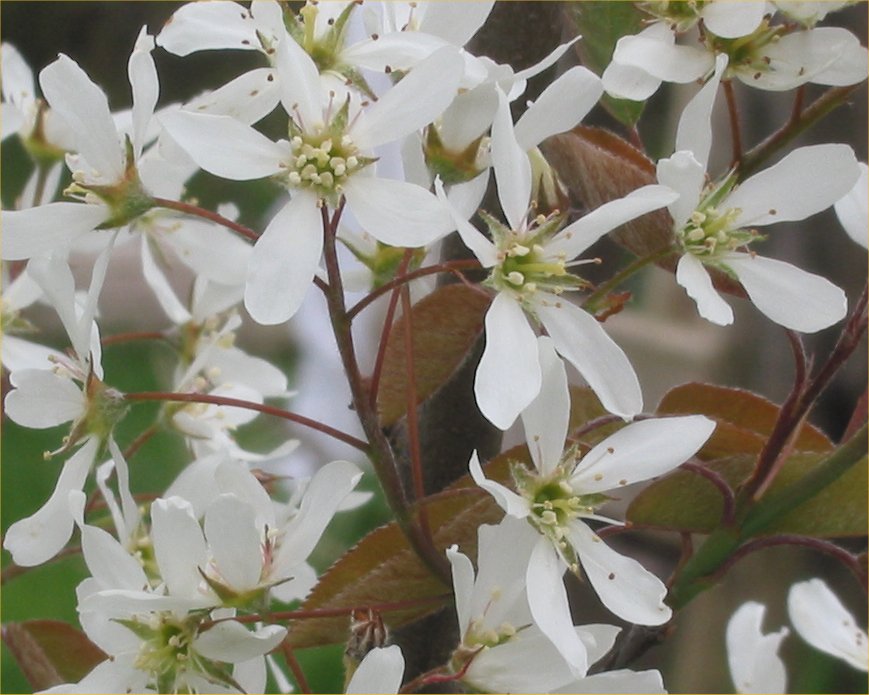


| Snowy mespilus | Bird cherry | |
|---|---|---|
| Leaves | Alternate, oval, 4–8 cm, finely toothed; coppery when young, orange-red in autumn. | Alternate, elliptical, 6–12 cm, thin and dull, finely and sharply toothed; small glands at the top of the leaf stalk. |
| Flowering | Clusters of white, star-shaped flowers in April, with the leaves (April). | Long hanging spikes of white, strongly scented flowers in April–May (April–May). |
| Fruit | Purplish-black, edible berries in June–July; birds love them. | Black, bitter little cherries. |
| Bark | Smooth and grey. | Grey-brown, smells unpleasant when damaged. |
| Shape and height | Shrub, 4–8 m | Broadleaf tree, 5–15 m |
| Site | Sun or partial shade, any garden soil, normal | Sun or partial shade, any garden soil, moist to wet |
| Native to Belgium | No, naturalised | Yes |
| Good for bees, butterflies and birds | Yes, for bees and birds | Yes, for bees, butterflies and birds |
| Poisonous to people and pets | Not known to be poisonous | Not known to be poisonous |
| Pruning months | May and November–February | June–August |
The best feature in each season
- Spring
- The snowy mespilus flowers in April, together with its coppery young leaves; in April–May the bird cherry is hung with long, strongly scented spikes among its green leaves.
- Summer
- Do not taste at random: the purple-black berries of the snowy mespilus ripen in June–July and are sweet and edible; the black cherries of the bird cherry are bitter, and their stones are poisonous. Birds eat both.
- Autumn
- The snowy mespilus turns a fiery orange-red and is then one of the finest shrubs in the garden; the leaves of the bird cherry colour less strikingly, yellow to reddish.
- Winter
- Look at the bark: smooth and grey on the snowy mespilus, grey-brown on the bird cherry, which smells unpleasant when damaged. The snowy mespilus often has several slender stems from the ground.
Where do they grow?
The bird cherry is native and grows along streams, in damp woods and shelterbelts; it is rare in the wild. The snowy mespilus is a non-native shrub that escapes from gardens with the help of birds, especially on sandy soil in woods and heathland.
Which one for your garden?
- The snowy mespilus is an excellent garden plant with something to offer in every season, but it spreads into woods and heathland on sandy soil: do not plant it near nature areas and pull up seedlings. Do not put it right next to pear or apple trees either, as it is a host of fireblight.
- The native bird cherry is a beautiful flowering tree for a moist, medium-sized to large garden, a shelterbelt or a woodland edge. Its stones and leaves contain hydrogen cyanide and are poisonous: do not let children bite the stones and do not leave wilted leaves in a pasture.
Did you know? In some years a bird cherry is completely wrapped in the webs of ermine moth caterpillars in May–June, like a ghostly white veil; afterwards the tree simply comes into leaf again.
Read on
- Plant profile: Snowy mespilus
- Plant profile: Bird cherry
- Snowy mespilus: when and how to prune
- Bird cherry: when and how to prune
- Identification key
Also looks like
- Bird cherry or black cherry
- Snowy mespilus or black chokeberry
- Bird cherry or St Lucie cherry
- Bird cherry or wild cherry