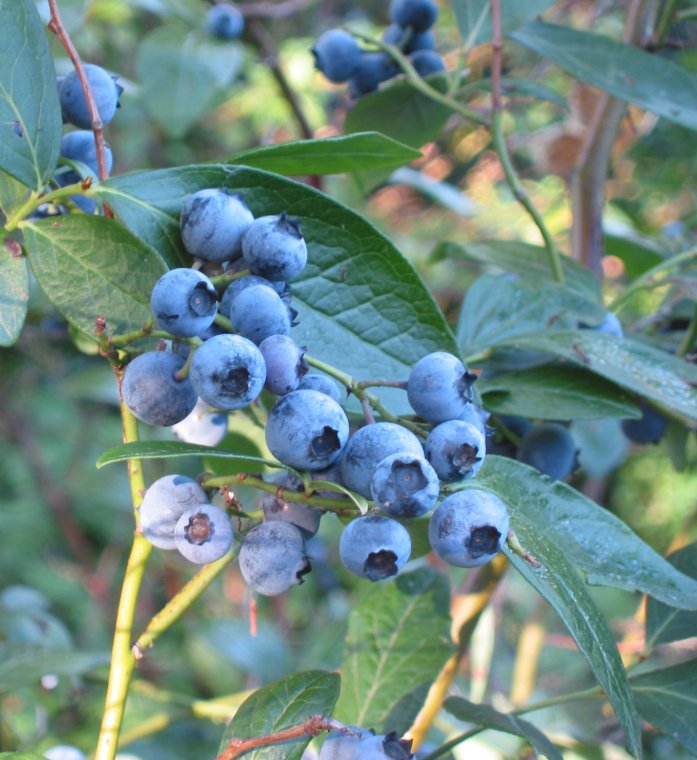
Photo: Rasbak at Dutch Wikipedia, CC BY-SA 3.0 · source

Pruning guide · Shrub
Blueberry: when and how to prune
Vaccinium corymbosum
Prune a blueberry in winter, in January–March: hardly at all in the first few years, and from the fifth year on, saw one or two of the oldest stems off at the base every year.
A blueberry grows as a clump of stems from the ground and renews itself: every year, young shoots appear. The best berries grow on sturdy two- and three-year-old stems; at around six years, stems turn grey, branch heavily and give only small berries. Pruning is therefore mainly about replacing old stems in good time. But without acid soil no amount of pruning helps: that comes first.
| Pruning months | January–March |
|---|---|
| Nesting season (15 March–15 August) | Take care in March |
| Flowering | April–May |
| Good for bees, butterflies and birds | Yes, for bees and birds |
| Native to Belgium | No, naturalised |
Blueberry: when to prune it?
Prune in January–March, when the bush is bare. You can then tell the fat, round flower buds at the tips of last year’s shoots from the small, pointed leaf buds.
Ideally finish before the buds start to swell in spring: all the plant’s energy then goes into flowering and new shoots.
Don’t prune in summer or autumn: next year’s flower buds are already forming then, and you would cut them off.
What else to prune in those months? January · February · March
Blueberry: how to prune it?
- For the first two or three years, only cut out dead, weak and low-lying stems. A young bush first needs to build a sturdy framework.
- From the fifth year on, saw out one or two of the oldest stems every year, as low as you can. You can recognise them by their grey, rough bark and the many thin twigs at the top.
- Keep the strongest young shoots from the base in their place and remove the weak ones: a mature bush has six to ten stems of different ages.
- Cut out thin, floppy twigs and shoots growing inwards: the best berries grow on sturdy wood in the light.
- Don’t cut off the fat, round flower buds at the tips. If a stem carries a great many, shorten it to a strong side branch: you will get fewer but bigger berries.
- After pruning, mulch with pine bark or pine needles, and water with rainwater rather than limy tap water: that keeps the soil acid.
How much to cut, and how often?
- One or two old stems a year and some thin, weak wood: that leaves enough young and middle-aged wood to fruit.
- Rejuvenate an old, neglected bush over three winters: each time, take a third of the oldest stems out at the base. You lose some fruit for a couple of years, but afterwards it crops heavily again.
- Prune a blueberry in a pot the same way, but a little more lightly. Every few years, also replace some of the ericaceous compost.
What does it mean for wildlife?
- In April–May the white bells are full of bumblebees. They shake the pollen loose by vibrating their flight muscles, which makes them the best pollinators; solitary bees and honeybees visit too.
- Winter pruning falls largely outside the nesting season (15 March–15 August). If you only prune in the second half of March, first check that no blackbird is starting to nest in the dense bush, as disturbing an active nest is against the law.
- Blackbirds, thrushes and starlings love the berries. Stretch a fine net over a frame around the bushes so no bird gets caught in it, and leave the last berries for the birds.
- Birds spread the seeds, and here and there the blueberry has gone wild in damp heathland and bogs: pull up seedlings nearby while they are small. Healthy prunings can go on a dead hedge, shelter for hedgehogs and insects.
Common mistakes
- Shortening every stem each year, so the flower buds at the tips are gone.
- Never removing old stems, so the bush turns grey and gives only small berries.
- Pruning in summer or autumn, when next year’s flower buds have already formed.
- Trying to rescue with pruning a bush whose leaves are yellow from limy soil or tap water: only acid soil and rainwater will help.
Caution: Only on acid soil (pH 4–5.5); water with rainwater rather than tap water.
Nearby: related pruning guides
Similar to: Difference from bilberry · Difference from honeyberry