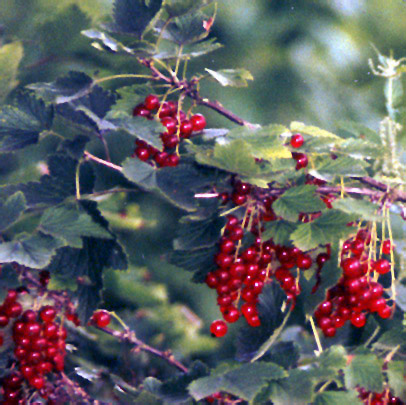
Photo: Agnieszka Kwiecień (Nova); Phptpshoped by H20, CC BY-SA 3.0 · source

Pruning guide · Shrub
Redcurrant: when and how to prune
Ribes rubrum
Prune a redcurrant in winter, in November–February, with a light summer prune after picking in July.
A redcurrant fruits mainly on short spurs on the older wood and at the base of last year’s shoots: that is why you prune it differently from a blackcurrant, with a permanent framework of branches.
| Pruning months | July and November–February |
|---|---|
| Nesting season (15 March–15 August) | Take care in July |
| Flowering | April |
| Good for bees, butterflies and birds | Yes, for bees and birds |
| Native to Belgium | Yes |
Redcurrant: when to prune it?
Do the formative pruning in winter, from November to February, when the bush is bare and you can see the framework clearly. Prune in mild weather, not when it is freezing.
After picking, in July, comes a light summer prune of the new side shoots: it lets light and air into the bush and checks its growth.
Prune a cordon or a fan on a wire or wall at the same times: in summer the side shoots to 4–5 leaves, in winter to 1–2 buds.
What else to prune in those months? January · February · July · November · December
Redcurrant: how to prune it?
- Keep 6–8 main branches on a short leg of 10–15 cm, as an open goblet, so light reaches the centre.
- In winter, shorten the side shoots to 1–2 buds: short fruiting spurs form, and that is where the strings of berries hang.
- Also shorten the tip of each main branch: by about half on a young bush, and to a few buds above last year’s wood on a bush that has reached its full height.
- Saw branches older than 4 years off at the base and let a strong young shoot take their place; that keeps the framework young.
- Remove shoots coming from low on the leg or from the ground, and branches growing inwards or too low.
- After picking, cut the new side shoots back to 4–5 leaves, and remove tips badly affected by currant blister aphid at the same time.
- White currants are a form of the redcurrant: prune them in exactly the same way.
How much to cut, and how often?
- In winter, remove one or two of the oldest branches each year and shorten all the side shoots; in summer, only the new side shoots.
- Don’t prune a redcurrant like a blackcurrant: cutting a third of the branches off at the base every year removes the fruiting wood.
- Renovate a neglected bush over two or three winters: each year some of the oldest branches out, and young shoots in their place.
What does it mean for wildlife?
- The redcurrant is native. In April its small greenish-yellow flowers are a welcome early source of food for honeybees, queen bumblebees and solitary bees.
- Blackbirds, thrushes and blackcaps love the berries in June–July: net what you want to pick yourself, but leave a few strings for the birds.
- The July summer prune falls in the nesting season (15 March–15 August): blackbirds and whitethroats sometimes nest in a dense currant bush. Look first, as disturbing an active nest is against the law.
- The leaves feed the caterpillars of the comma butterfly and the magpie moth, a striking white, black and yellow moth. Healthy prunings can go on a dead hedge.
Common mistakes
- Pruning it like a blackcurrant, so the fruiting wood on the older branches disappears.
- Letting the bush grow too dense, with too many main branches: the berries then get too little sun and picking is awkward.
- Never replacing old branches, so the bush ages and bears less and less.
- Pruning in July without checking for nests first.
Caution: Don’t prune a redcurrant like a blackcurrant: it fruits mainly on short spurs on older wood and at the base of last year’s shoots.
Nearby: related pruning guides
Similar to: Difference from gooseberry · Difference from blackcurrant · Difference from mountain currant
Plant profile: Redcurrant · Pruning calendar and basic rules