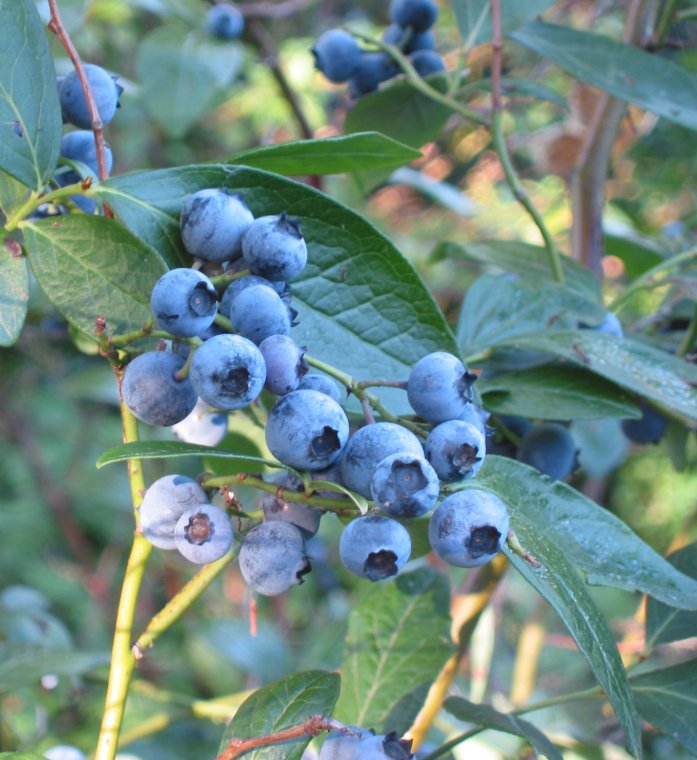
Photo: Rasbak at Dutch Wikipedia, CC BY-SA 3.0 · source

Shrub · Heather family (Ericaceae)
Highbush blueberry
Vaccinium corymbosum · also: Blueberry
The highbush blueberry is a shrub of 1–2 m from North America that gives the same large, sweet blueberries you buy in the shops. In April–May it carries white bells for bumblebees and bees, from July to September the berries ripen, and in autumn the leaves turn fiery red. The secret of success is acid soil (pH 4–5.5): in ordinary garden soil, grow it in a raised bed or a large pot of ericaceous compost. That way it is an asset even on a patio.
Caution: Only grows on acid soil (pH 4–5.5); water with rainwater rather than tap water. Don’t plant it near a walnut: blueberries are sensitive to the juglone that walnuts release.
Light
Full sun
warm and bright
Moisture
Moist to wet
must not dry out
Legal basis
Acid soil
acid
Hardiness
Throughout Belgium
no protection needed
Size
1–2 m
tall
Flowering
April–May
| Pruning months | January–March |
|---|---|
| Height | 1–2 m |
| Native to Belgium | No, naturalised |
| Good for bees, butterflies and birds | Yes, for bees and birds |
| Poisonous to people and pets | Not known to be poisonous |
| Flowering | April–May |
Identify
Highbush blueberry: how do you recognise it?
- Habit
- Upright, multi-stemmed shrub of 1–2 m that sends up new shoots from the base every year.
- Leaf
- Alternate, oval, 3–8 cm, untoothed or finely toothed; glorious red autumn colour.
- Bark
- Green to red twigs with small warts.
- Flower
- White to pink bells in clusters, April–May.
- Fruit
- Blue berries with a waxy bloom in July–August; pale green to white inside.
- Difference from bilberry
- Bilberry is a low, wild shrublet of heaths and woods, with smaller berries that are blue inside too.
Flowering: April–May · Harvest and fruit: July–September · Pruning: January–March
Identify by feature: Red autumn colour · Blue berries
Looks like it, but isn’t
- Bilberry (Vaccinium myrtillus): low, wild shrublets on heaths and in woods.
In your garden
Why grow it?
- Your own blueberries from July to September, with the right varieties.
- White bells in April–May for bumblebees and bees.
- Glorious red autumn colour.
- Grows well in a large pot on a patio or balcony.
Highbush blueberry: where does it grow best?
- Full sun: that gives you the most and sweetest berries.
- Acid, humus-rich soil (pH 4–5.5) that stays moist but not waterlogged; not on chalk or heavy clay.
- Without acid soil, grow it in a raised bed or a pot at least 40 cm across, filled with ericaceous compost.
- Allow 1–1.5 m between bushes, and don’t plant them under or next to a walnut.
- Light
- Full sun
- Legal basis
- Acid soil
- Moisture
- Moist to wet
- Size
- 2 m tall, 1.5 m wide
- Hardiness
- Throughout Belgium, no protection needed
Goes well with
- Rhododendron: Likes the same acid, humus-rich soil.
- Heather: A low edging on acid soil that flowers in August–September.
- Cowberry: An evergreen berry shrublet for the same acid soil.
- American cranberry: Creeps as ground cover around the bushes on acid, moist soil, with red berries in autumn.
Good and bad companions
Goes well with
- Likes the acid soil near: scots pine, black pine, weymouth pine, english oak, sessile oak, giant redwood
- Like acid soil, just like this plant: heather, rhododendron, japanese skimmia, raspberry, witch hazel, broom, gorse, camellia
Best kept away from
- Walnut releases juglone, to which this plant is sensitive: walnut
- Do not plant under the dense crown of these trees: norway spruce, european silver fir, nordmann fir, douglas fir, yew, horse chestnut, norway maple, sycamore
Maintenance
Highbush blueberry: when and how to plant it?
- Plant from October to March; a container plant can also go in later in spring.
- Dig a generous planting hole and fill it with ericaceous compost mixed with some pine bark.
- Don’t plant deeper than before, and water in with rainwater.
- Plant two or more varieties together: they pollinate each other and give more and bigger berries.
Care
- Watering
- Keep the soil moist, especially in a pot. Use rainwater: tap water is often hard.
- Feeding
- In April and June, an ericaceous fertiliser; never lime.
- Mulching
- A 5 cm layer of pine bark or pine needles keeps the soil acid, cool and moist.
- Harvest
- Pick every week: a berry is ripe when it is completely blue and comes away easily. It won’t ripen further after picking.
- Birds
- Net the bushes as soon as the first berries colour.
Tip: Plant varieties that ripen at different times, such as ‘Duke’ (early), ‘Bluecrop’ (mid-season) and ‘Elliott’ (late): they pollinate each other and you harvest from July to September.
Highbush blueberry: when to prune it?
Pruning months: January–March.
When: In winter (January–March).
How:
- In the first years, only remove dead, weak and low-lying branches.
- From the fifth year on, saw 1–2 of the oldest branches off at the base every year.
- Cut out thin, weak twigs: the best berries grow on sturdy two- and three-year-old branches.
Caution: Only on acid soil (pH 4–5.5); water with rainwater rather than tap water.
Propagation
- Cuttings
- Take soft tip cuttings in June–July or hardwood cuttings in winter and root them in acid cutting compost, under plastic or glass.
- Layering
- Bend a low branch to the ground, cover it with acid soil and cut it free after a year.
Highbush blueberry: how does it get through the winter?
Hardy throughout Belgium: no protection needed.
- Fully hardy.
- In a pot: put it in a sheltered spot against a wall in winter and don’t let the compost dry out.
- The red twigs give the bare shrub colour, even in winter.
Diseases and pests
- Yellow leaves: Yellow leaves with green veins: the soil is not acid enough, or you are using hard tap water. Give rainwater, an ericaceous fertiliser and a mulch of pine bark.
- Mummy berry: Berries shrivel into hard, grey mummies and drop. Pick them up and dispose of them, so the fungus doesn’t overwinter.
- Root rot: The plant wilts even though the soil is wet. Make sure drainage is good, especially in a pot with a hole in the bottom.
- Spotted wing drosophila: Soft, sunken berries with tiny maggots in late summer. Pick often and thoroughly, and clear up fallen berries.
- Birds: Blackbirds take the ripe berries. A net helps.
Through the year
- January: Winter pruning: remove the oldest branches.
- February: Winter pruning.
- March: Last pruning; mulch with pine bark; planting.
- April: Flowering; first feed with ericaceous fertiliser.
- June: Second feed; net the bushes.
- July: The harvest begins.
- August: Main harvest; give rainwater in dry spells.
- September: Last berries of late varieties.
- October: Red autumn colour; planting is possible again.
Use
What can you use it for?
- Food and drink
- Blueberries, fresh or frozen.
- Garden and landscape
- Lovely autumn colour; goes well with rhododendron and heather on acid soil.
Edible and useful
- Berries (July–September)
- Only pick blueberries when they are completely blue, even around the stalk, and then wait a few more days: that is when they are sweetest. They ripen over several weeks; roll them off the cluster with your thumb and the unripe ones stay on. Fresh, in pancakes, muffins, pies, jam or frozen for smoothies.
- Storing
- Do not wash them before storing: the waxy bloom protects them. That way they keep for up to two weeks in the fridge. They freeze very well, spread out on a tray.
Caution: Cultivated blueberries are safe. If you pick wild bilberries, wash them well, as they grow close to the ground (fox tapeworm). Do not confuse them with poisonous blue-black berries such as those of privet or Virginia creeper.
Eating and using is at your own risk: see the terms of use.
Recipes
- Blueberry jam (Jam · ± 4 jars · 30 min)
- Blueberry compote (Compote · 4 people · 15 min)
- Blueberry muffins (Dish · makes 12 muffins · 20 min + 25 min baking)
- Blueberry vinegar (Vinegar · makes ± 500 ml · 15 min + 2 weeks infusing)
Good for wildlife
- Bumblebees
- Nectar and pollen for bumblebees, also from deep flowers and early in spring.
- Bees
- Nectar and pollen for honeybees and wild bees.
- Birds
- Berries, seeds or insects as food, or a place to nest.
You and this species
Did you know?
- Needs acid soil (pH 4–5.5); in ordinary garden soil it is best grown in a container of ericaceous compost.
- Unlike the wild bilberry, the cultivated blueberry has pale flesh: it won’t turn your mouth blue.
- Here and there it has gone wild on damp heaths and in bogs, where birds spread the seeds from the berries.
- The highbush blueberry is a young crop: in the early 20th century, the American botanist Frederick Coville and grower Elizabeth White domesticated it in New Jersey.
- Cut a blueberry open and the flesh is pale green to white. In the wild bilberry of our heaths and woods, the flesh is purplish blue.