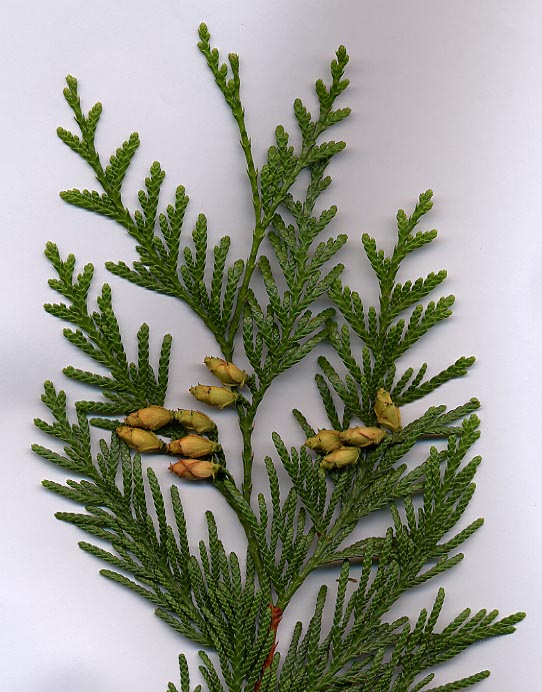
Photo: MPF at English Wikipedia, CC BY-SA 3.0 · source

Pruning guide · Conifer
Thuja: when and how to prune
Clip a thuja hedge in May–June and again in late August, by mid-September at the latest, and always only into the green: it will not regrow from bare brown wood.
Thuja is probably the most widely planted hedge in Belgium and the Netherlands: it grows fast, stays green and forms a dense screen. But like most conifers, yew excepted, it does not regrow from bare brown wood. Cut too deep and you will be looking at a brown hole for years. So the whole art is to clip often and lightly.
| Pruning months | May–June and August–September |
|---|---|
| Nesting season (15 March–15 August) | Take care in May–June and August |
| Good for bees, butterflies and birds | Yes, for birds |
| Native to Belgium | No, planted |
| Poisonous to people and pets | Yes, take care with children and pets |
Thuja: when to prune it?
The first clip comes in May–June, once the spring growth is complete. Check carefully for nests first: a thuja hedge is a favourite nesting site.
The second clip is in late August, when most young birds have fledged. Don’t clip after mid-September: the new growth still needs to harden off before winter.
Don’t clip in bright sun, heat or drought: the cut tips scorch and the hedge turns brown. An overcast day after a little rain is ideal.
What else to prune in those months? May · June · August · September
Thuja: how to prune it?
- Wear gloves and long sleeves: the sap can irritate the skin, and the foliage contains poisonous thujone.
- With a hedge trimmer, cut back only the new, light green growth, to a few centimetres above the previous cut. Always stay in the green.
- Cut the sides at a slight slant, with the top narrower than the base: the bottom then gets light and the hedge stays green down to the ground.
- Stretch a line for a straight top. Cut the top as soon as the hedge reaches the height you want: if you let it shoot up first, it is hard to bring it down later.
- An overgrown hedge can be reduced in height once by a good amount. The top stays bare for a while, until the surrounding side shoots grow upwards and close the gap. This doesn’t work on the sides: a bare side stays bare.
- Rake up the clippings under and around the hedge thoroughly. Never put them in a field, and don’t give them to horses, cattle, sheep, rabbits or guinea pigs.
How much to cut, and how often?
- Two clips a year keep a hedge neat and dense. A single clip in late August is also fine, but the hedge then looks a little shaggier in summer.
- Only ever remove the current year’s growth. A hedge you let get a little wider every year is too wide after ten years, and there is no going back.
- Brown scales on the inside in autumn are normal. Brown patches on the outside are usually caused by drought, cutting too deep, dog urine or the thuja leaf miner: cut out the brown twigs and water in dry spells.
What does it mean for wildlife?
- A dense thuja hedge is one of the favourite nesting sites in the garden: blackbirds, song thrushes, dunnocks, greenfinches and woodpigeons like to breed in it. The nesting season runs from 15 March to 15 August, and disturbing an active nest is against the law: check thoroughly before the May–June clip and leave a wide area around any nest.
- If you only clip once a year, do it in late August: the breeding season is then almost over.
- In winter the evergreen hedge is a sheltered roost for sparrows, blackbirds and other small birds, and hedgehogs look for a spot at the bottom. Leave the fallen leaves under the hedge.
- Thuja has little to offer insects: it is wind-pollinated and few caterpillars eat its foliage. Plant a strip of flowering and berrying shrubs in front of it, such as hawthorn, wild privet or holly, or choose a mixed native hedge when planting a new one.
Common mistakes
- Cutting too deep, into the brown wood: bare patches never fill in again.
- Letting the hedge grow for years and then trying to make it narrower in one go.
- Clipping in heat or drought, so the cut tips scorch and the hedge turns brown.
- Letting the top get wider than the base, so the hedge goes bare at the bottom.
- Clipping in May without checking for nests first.
Caution: Don’t clip in bright sun or drought, and check first that no birds are nesting in the hedge. Thuja is poisonous: wear gloves and keep clippings away from children, pets and livestock.
Nearby: related pruning guides
Similar to: Difference from Lawson cypress · Difference from Leyland cypress · Difference from ornamental juniper