Side by side
Thuja or Lawson cypress? How to tell them apart
Thuja · Chamaecyparis lawsoniana
You can tell a thuja by its elongated little cones that open like a flower and its upright leader; a Lawson cypress has round cones like a tiny football, a drooping leader and usually a white X pattern under the sprays.
Both have flat sprays covered in scale leaves. Look at the top of the tree or hedge: upright on the thuja, drooping like a limp fishing rod on the Lawson cypress. Crush a spray: the thuja smells fruity, the Lawson cypress resinous, a little like parsley.
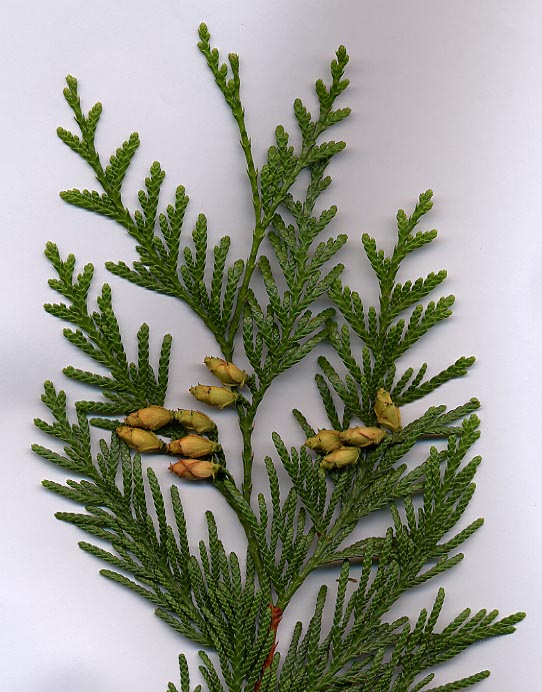

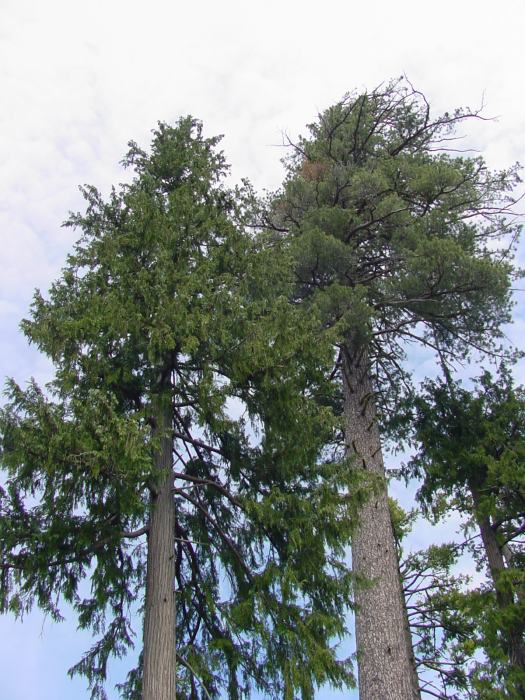
Photo: US Forest Service Dorena Genetic Resource Center, Public domain · source

Lawson cypress Chamaecyparis lawsoniana
| Thuja | Lawson cypress | |
|---|---|---|
| Needles | Scale-like leaves pressed closely together, in flat, fern-like sprays. When crushed they smell fruity (western red cedar: of pineapple or apple). | Scale leaves in flat, fern-like sprays; underneath often with white X- or Y-shaped marks. When crushed they smell resinous, a little like parsley. |
| Flowering | – | – |
| Cones and seeds | Egg-shaped cones 1–1.5 cm with overlapping scales that open like a little flower. | Globular cones of about 8–10 mm with shield-shaped scales (like a football); blue-green and bloomy at first. |
| Bark | Red-brown, in long fibrous strips. | Red-brown, in plates or strips. |
| Shape and height | Conifer, 10–20 m (western red cedar up to 40 m) | Conifer, 15–30 m |
| Site | Sun or partial shade, any garden soil, normal | Sun or partial shade, any garden soil, normal |
| Native to Belgium | No, planted | No, planted |
| Good for bees, butterflies and birds | Yes, for birds | Yes, for birds |
| Poisonous to people and pets | Yes, take care with children and pets | Not known to be poisonous |
| Pruning months | May–June and August–September | May–June and August–September |
The best feature in each season
- Spring
- In March–April the Lawson cypress often shows small red male cones at the tips of the sprays; on the thuja they are yellowish and inconspicuous.
- Summer
- Turn a spray over: on the Lawson cypress you usually see white X- or Y-shaped marks, on the white cedar thuja you do not. The western red cedar does have white marks, but it smells of pineapple.
- Autumn
- The little cones ripen: elongated, 1–1.5 cm, with overlapping scales that fold open on the thuja; round, 8–10 mm, with shield-shaped scales on the Lawson cypress.
- Winter
- The white cedar thuja often turns brownish in winter, the Lawson cypress stays blue-green to green. A bare, brown patch in a hedge will not regrow on either.
Where do they grow?
Both come from North America and grow here only where planted: in gardens, cemeteries and above all as hedges or windbreaks. You rarely see them in the wild.
Which one for your garden?
- As a hedge they give quick, year-round privacy, but they offer little to insects; birds do like to nest in them. A native hedge, such as yew, holly or beech, is better for wildlife.
- Clip them every year, because they will not regrow from brown, bare wood. Thuja foliage is poisonous if eaten, also to livestock: never throw clippings into a field.
Did you know? The name arborvitae, tree of life, is said to come from French explorers in Canada who were cured of scurvy with a thuja brew.
Read on
- Plant profile: Thuja
- Plant profile: Lawson cypress
- Thuja: when and how to prune
- Lawson cypress: when and how to prune
- Identification key: the question that separates them
Also looks like
- Thuja or Leyland cypress
- Thuja or ornamental juniper
- Lawson cypress or Leyland cypress
- Lawson cypress or western red cedar
- Lawson cypress or northern white cedar