Side by side
Thuja or Leyland cypress? How to tell them apart
Thuja · × Cuprocyparis leylandii
How to tell them apart – thuja: flat sprays, a fruity scent and elongated cones; Leyland cypress: very fast-growing conifer with scale leaves, widely used for tall hedges, the shoots point every which way.
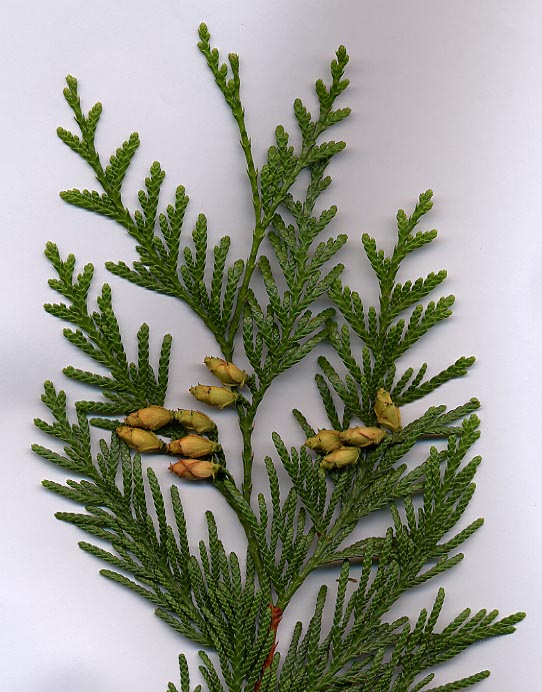
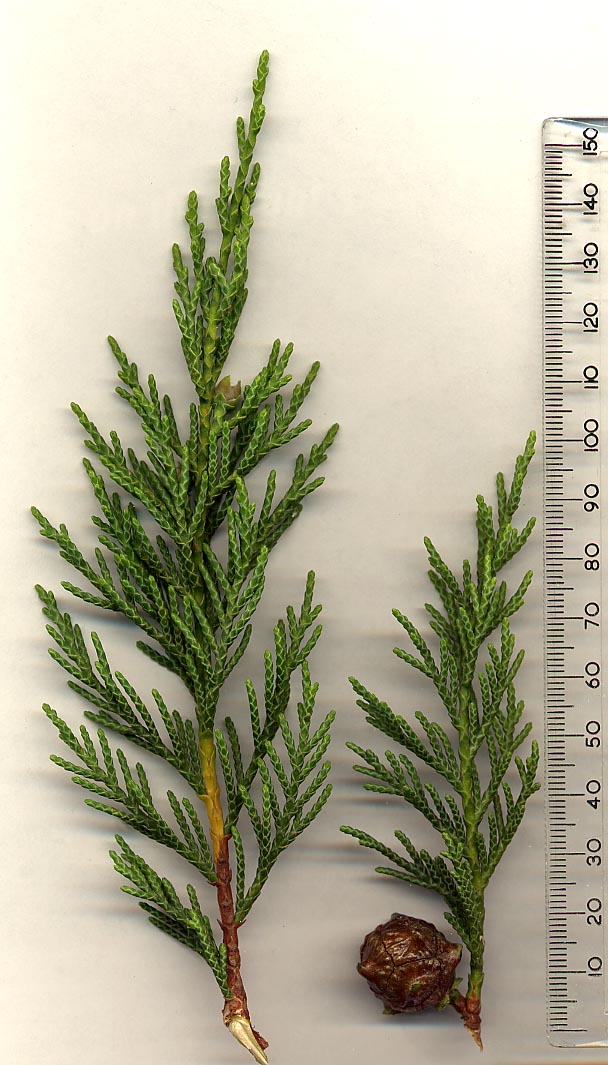


How do you recognise them?
- Thuja
- Flat sprays of scented, scale-like leaves; small oblong cones that open like a little flower.
- Compared with Leyland cypress: flat sprays, a fruity scent and elongated cones.
- Leyland cypress
- Very fast-growing conifer with scale leaves, widely used for tall hedges; the shoots point every which way.
| Thuja | Leyland cypress | |
|---|---|---|
| Needles | Scale-like leaves pressed closely together, in flat, fern-like sprays. When crushed they smell fruity (western red cedar: of pineapple or apple). | Small scale leaves pressed close to the shoots, dark to greyish green. The shoots do not form flat sprays but stick out irregularly in all directions; no white markings underneath. |
| Flowering | – | – |
| Cones and seeds | Egg-shaped cones 1–1.5 cm with overlapping scales that open like a little flower. | Round cones of 1.5–2 cm with eight scales; you rarely see them on a clipped hedge. |
| Bark | Red-brown, in long fibrous strips. | Reddish-brown, with long furrows. |
| Shape and height | Conifer, 10–20 m (western red cedar up to 40 m) | Conifer, 20–30 m (as a hedge, as tall as you trim it) |
| Site | Sun or partial shade, any garden soil, normal | Sun or partial shade, any garden soil, dry to wet |
| Native to Belgium | No, planted | No, planted |
| Good for bees, butterflies and birds | Yes, for birds | Yes, for birds |
| Poisonous to people and pets | Yes, take care with children and pets | Not known to be poisonous |
| Pruning months | May–June and August–September | May–September |
What does it mean for your garden?
- Thuja is poisonous to people and pets: take care with children and animals.
- Thuja (10–20 m (western red cedar up to 40 m)) and Leyland cypress (20–30 m (as a hedge) both grow into large trees: too big for an ordinary garden, but fine in a large garden, a park or a meadow.
Read on
- Plant profile: Thuja
- Plant profile: Leyland cypress
- Thuja: when and how to prune
- Leyland cypress: when and how to prune
- Identification key: the question that separates them
Also looks like
Identify by feature
This comparison is compiled from the Bladwijzer species pages.