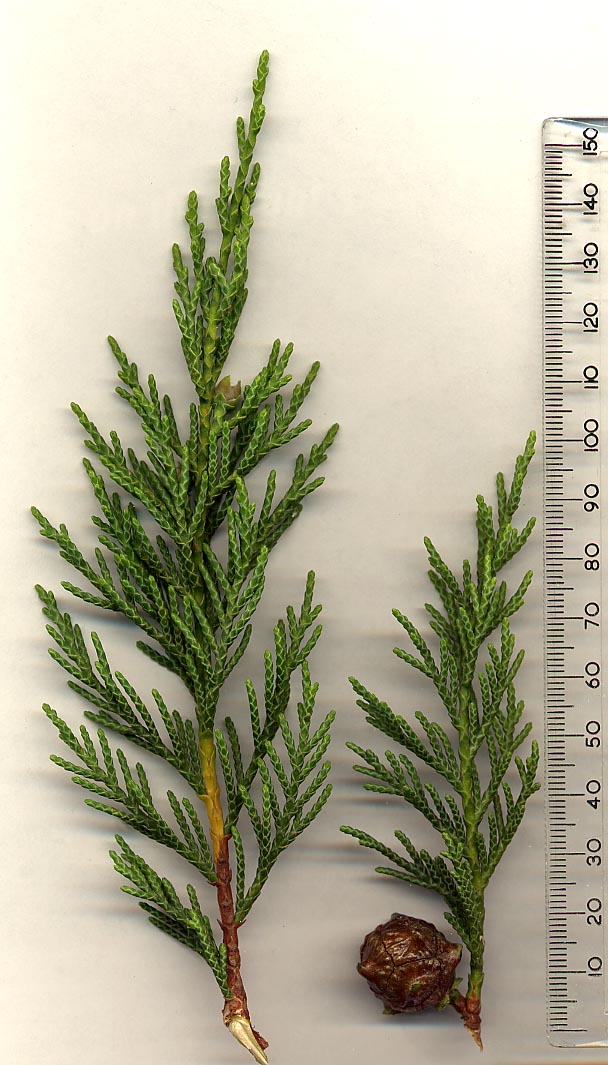
Photo: Wikimedia Commons, CC BY-SA 3.0 · source

Pruning guide · Conifer
Leyland cypress: when and how to prune
× Cuprocyparis leylandii
Clip a Leyland cypress hedge two or three times a year, from May to early September; prune a free-standing tree in May–August. Always cut into the green, never into the brown wood.
Leyland cypress grows up to a metre a year: that is what makes it so popular as a quick hedge, but also so demanding. Left unclipped it becomes a 20–30 m tree, and a hedge left to its own devices for a few years can never be made narrow again, because it does not regrow from bare wood. So clip from the very first year, often and lightly.
| Pruning months | May–September |
|---|---|
| As a hedge | May–June and August–September |
| As a free-standing tree | May–August |
| Nesting season (15 March–15 August) | Take care in May–August |
| Good for bees, butterflies and birds | Yes, for birds |
| Native to Belgium | No, planted |
Leyland cypress: when to prune it?
As a hedge
As a free-standing tree
Clip a hedge two or three times a year: first in May–June, then in August and, if it grows strongly, a last time by early September at the latest. Then stop: the new growth still needs to harden off before winter.
Prune a free-standing Leyland cypress, or a windbreak you let grow more freely, in May–August, when it is growing strongly and wounds close quickly.
Prune in dry, overcast weather. In wet weather cypress canker (Seiridium) gets into wounds more easily, and in bright sun the cut tips scorch.
What else to prune in those months? May · June · July · August · September
Leyland cypress: how to prune it?
- With a hedge trimmer, cut the new growth back to a few centimetres above the previous cut, and always stay in the green. Leyland cypress does not regrow from bare brown wood.
- Keep the hedge wider at the bottom than at the top, with slightly sloping sides: light then reaches the base and the hedge stays green right down.
- Cut the top as soon as the hedge is 15–30 cm below the height you want: it then still branches at the top and will be dense once it reaches height.
- If the hedge has grown too tall, you can reduce its height: after a few years the side branches grow over the cut. Reducing its width is impossible without bare brown sides.
- Cut out brown twigs caused by aphids or canker back to healthy wood, in dry weather, and disinfect your tools afterwards.
- Work on a tall hedge from a sturdy ladder or a mobile scaffold tower, never from wobbly steps, and clear up the clippings: a thick layer under the hedge smothers the soil.
How much to cut, and how often?
- Better three light trims than one heavy one: each time, only remove the growth since the previous cut.
- Never let the hedge get wider or taller than you want to keep it: whatever it gains can never be removed later without bare patches. Also bear in mind the rules on height and distance from the boundary.
- A neglected hedge several metres wide and tall can never be made narrow again. Often the best solution is to grub it out and replace it with a mixed native hedge.
What does it mean for wildlife?
- A dense Leyland hedge is a favourite nesting site for blackbirds, song thrushes, woodpigeons and dunnocks. The May–June and August clips fall in the nesting season (15 March–15 August): check carefully before every clip, as disturbing an active nest is against the law.
- If there is a nest, leave a generous section of hedge around it and trim that later, once the young have fledged.
- In winter sparrows, finches and other small birds like to roost in the shelter of a conifer hedge, and hedgehogs find a spot underneath.
- A Leyland hedge does little for bees and butterflies, and beside and under it the ground is dry and dark. Plant a strip of native shrubs and flowers in front of it, or for a new hedge choose hornbeam, wild privet, hawthorn or yew: they grow more slowly, but need less work and bring more life to the garden.
Common mistakes
- Not clipping a young hedge for the first few years, so it gets too wide.
- Cutting into the brown wood, leaving bare patches that never fill in again.
- Clipping hard just once a year instead of lightly two or three times.
- Still clipping after early September: the new growth doesn’t harden off before winter.
- Clipping without checking for nests first.
Caution: Never cut into the brown wood: bare patches stay bare.
Nearby: related pruning guides
Similar to: Difference from Lawson cypress · Difference from thuja
Plant profile: Leyland cypress · Pruning calendar and basic rules