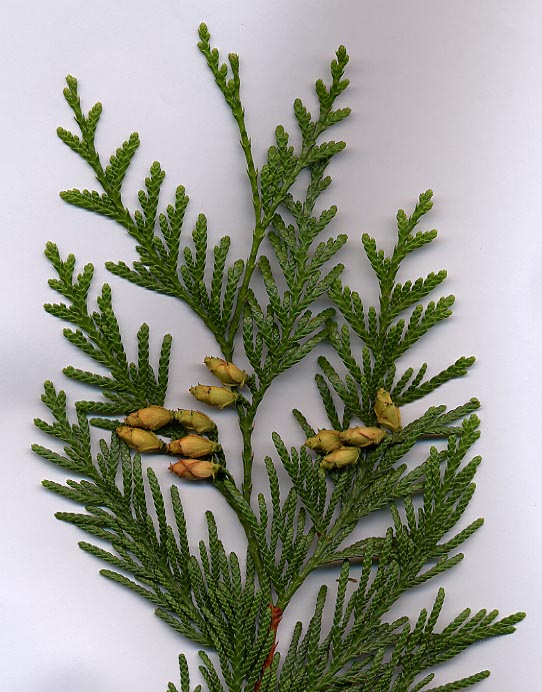
Photo: MPF at English Wikipedia, CC BY-SA 3.0 · source

Conifer · Cypress family (Cupressaceae)
Thuja
· also: Western red cedar, Northern white cedar, Arborvitae
Thuja, or arborvitae, is an evergreen conifer from North America with flat, fern-like sprays of scented, scale-like leaves. Left to grow freely it reaches 10–20 m (western red cedar even up to 40 m), but in our gardens it is mainly grown as a hedge or windbreak: it grows fast, is cheap and gives privacy all year round. A thuja hedge offers little to insects, although birds like to nest in it. Clip it every year, because it won’t regrow from brown, bare wood. The foliage is poisonous if eaten, to livestock too.
Caution: The foliage contains thujone and is poisonous if eaten, to livestock too: never throw clippings into a field and keep them away from horses, cattle, sheep, rabbits and guinea pigs. In some people the sap irritates the skin: wear gloves when pruning.
Light
Sun or partial shade
preferably some sun
Moisture
Normal
no wet feet
Legal basis
Any garden soil
any pH
Hardiness
Throughout Belgium
no protection needed
Size
10–20 m (western red cedar up to 40 m)
tall
| Pruning months | May–June and August–September |
|---|---|
| Height | 10–20 m (western red cedar up to 40 m) |
| Native to Belgium | No, planted |
| Good for bees, butterflies and birds | Yes, for birds |
| Poisonous to people and pets | Yes, take care with children and pets |
Identify
Thuja: how do you recognise it?
- Habit
- Evergreen conifer of 10–20 m with a narrow, conical crown and an upright leading shoot; as a hedge usually 1.5–3 m.
- Leaf
- Scale-like leaves pressed closely together, in flat, fern-like sprays. When crushed they smell fruity (western red cedar: of pineapple; northern white cedar: of apple).
- Bark
- Red-brown, in long fibrous strips.
- Cones
- Egg-shaped cones 1–1.5 cm with overlapping scales that open like a little flower.
- Species
- In gardens mainly northern white cedar (Thuja occidentalis, with cultivars such as ‘Smaragd’ and ‘Brabant’) and western red cedar (Thuja plicata).
- Difference from Lawson cypress
- Lawson cypress has round cones like a football and a drooping leading shoot.
Pruning: May–June and August–September
Identify by feature: Scales instead of needles
Looks like it, but isn’t
- Lawson cypress Chamaecyparis lawsoniana: round cones like a football and a drooping leading shoot. Difference from Lawson cypress
In your garden
Why grow it?
- A fast, dense hedge or windbreak that stays green all year round.
- A clipped hedge stays narrow and takes up little space.
- Grows on almost any soil, in sun or partial shade.
- Blackbirds, song thrushes and greenfinches like to nest in a dense thuja hedge.
Thuja: where does it grow best?
- Sun to partial shade; in deep shade a hedge becomes thin.
- Almost any soil that is neither too dry nor waterlogged; in wet ground the roots rot.
- Shallow roots: in dry summers a hedge quickly struggles, especially on sand.
- As a hedge it suits any garden; a free-standing tree grows 4 m wide or more.
- Light
- Sun or partial shade
- Legal basis
- Any garden soil
- Moisture
- Normal
- Size
- 15 m tall, 4 m wide
- Hardiness
- Throughout Belgium, no protection needed
Goes well with
- Hydrangea: Large flower heads in summer, lovely in front of a green hedge in partial shade.
- English lavender: Silver-grey and purple in front of a dark green hedge in a sunny spot; bees love it.
- Japanese maple: Fine red or orange foliage that stands out against a dark hedge.
Good and bad companions
Goes well with
- Tolerate the shade under this tree: oregon grape, rhododendron, oleaster, japanese skimmia, garden privet, camellia, laurustinus, box-leaved honeysuckle
Maintenance
Thuja: when and how to plant it?
- Plant root-balled or from a pot in September–October or March–April.
- For a hedge: 2–3 plants per metre, depending on their size.
- Dig a wide trench, mix compost into the soil and plant at the same depth as before.
- Water generously straight away, then every week in dry spells during the first year; a layer of mulch keeps the soil moist.
Care
- Watering
- Regularly in dry spells during the first two years; later too in long dry summers, as the roots are shallow.
- Feeding
- In March–April, a little compost or organic fertiliser along the hedge.
- Mulch
- A layer of wood chips or leaf mould at the base keeps the soil cool and moist.
- Inside the hedge
- In autumn the oldest scale leaves on the inside turn brown and drop: that is normal.
Tip: Want a hedge that also does something for wildlife? Plant a mixed hedge of native species, or put a row of flowering and berrying shrubs in front of the thuja.
Thuja: when to prune it?
Pruning months: May–June and August–September.
When: Clip a hedge in May–June and late August. Not later than mid-September, so the new growth can still harden off.
How:
- Only cut into the green part. Bare brown patches won’t fill in again.
- Clip the hedge slightly narrower at the top than at the bottom, so the base gets light and stays green.
- Keep the hedge at height from the start: cut back the top as soon as it reaches the height you want. A hedge that has grown too tall is hard to lower later.
Caution: Don’t clip in bright sun or drought, and check first that no birds are nesting in the hedge.
Propagation
- Cuttings
- In August–September, pull off a 10–15 cm side shoot with a heel and root it in cutting compost under glass or in a cold frame.
Thuja: how does it get through the winter?
Hardy throughout Belgium: no protection needed.
- Fully hardy.
- Northern white cedar often turns brownish in winter and greens up again in spring.
- Shake wet snow off the hedge: otherwise the branches splay apart.
Diseases and pests
- Drought: Brown patches and bare sections after a dry summer, especially on sand. Water young hedges and mulch the soil; dead sections won’t fill in again.
- Root rot: On wet soil, plants turn brown and die (Phytophthora). Only replace them once the drainage has been improved.
- Thuja leaf miner: Brown shoot tips with tiny holes in spring: little caterpillars feeding inside the scale leaves. Trim off the brown tips; a healthy hedge soon grows over them.
- Dog urine and road salt: Brown patches at the foot of a hedge along the street. Rinse with plenty of water, and plant a new hedge a little further from the pavement.
Through the year
- March: Plant (March–April); compost along the hedge.
- April: Water young hedges in a dry spring.
- May: First trim (May–June), once birds have finished nesting.
- June: Clipping still possible; water in dry spells.
- July: Water during long dry periods.
- August: Second trim in late August; take cuttings.
- September: Last trim by mid-September at the latest; planting season starts.
- October: Brown scale leaves drop on the inside: that is normal.
- December: Shake wet snow off the hedge.
Use
What can you use it for?
- Garden and landscape
- Widely used hedging plant and windbreak.
- Wood
- The rot-resistant wood of the giant arborvitae (‘western red cedar’) is used for cladding and roof shingles.
Caution: The foliage contains thujone and is poisonous if eaten, to livestock too.
Good for wildlife
- Birds
- Berries, seeds or insects as food, or a place to nest.
You and this species
Did you know?
- Very popular for hedging. Northern white cedar often turns brownish in winter.
- The rot-resistant wood of western red cedar is used for cladding and roof shingles.
- Rub a spray between your fingers: western red cedar smells of pineapple, northern white cedar of apple.
- The name arborvitae, ‘tree of life’, is said to go back to Jacques Cartier: in the winter of 1535–36 in Canada his crew recovered from scurvy with a brew taught by the Indigenous people, probably made from this tree.
- The Indigenous peoples of the North American west coast have long carved their totem poles and canoes from western red cedar.