Photo: Wikimedia Commons, CC BY-SA 3.0 · source

Conifer · Cypress family (Cupressaceae)
Leyland cypress
× Cuprocyparis leylandii · also: Leylandii
The Leyland cypress is a chance cross between the Monterey cypress and the Nootka cypress, which arose in a British park in 1888. It grows up to a metre a year and so became one of the most popular conifer hedges. That vigour is also its biggest drawback: without two or three trims a year it becomes a 20–30 m tree, and a neglected hedge can never be made narrow again, because it won’t regrow from brown, bare wood. It tolerates sun and part shade and almost any soil. If you are considering an evergreen hedge, think about a native hedge too, such as yew, holly or hornbeam: it needs less work and is better for wildlife.
Caution: Grows very fast and, left unclipped, becomes a 25 m tree. A neglected hedge can never be made narrow again.
Light
Sun or partial shade
preferably some sun
Moisture
Dry to wet
not fussy
Legal basis
Any garden soil
any pH
Hardiness
Throughout Belgium
no protection needed
Size
20–30 m (as a hedge, as tall as you trim it)
tall
| Pruning months | May–September |
|---|---|
| Height | 20–30 m (as a hedge, as tall as you trim it) |
| Native to Belgium | No, planted |
| Good for bees, butterflies and birds | Yes, for birds |
| Poisonous to people and pets | Not known to be poisonous |
Identify
Leyland cypress: how do you recognise it?
- Habit
- Very fast-growing, narrowly conical tree of 20–30 m with a crown about 5 m wide; as a hedge, as tall as you trim it.
- Leaves
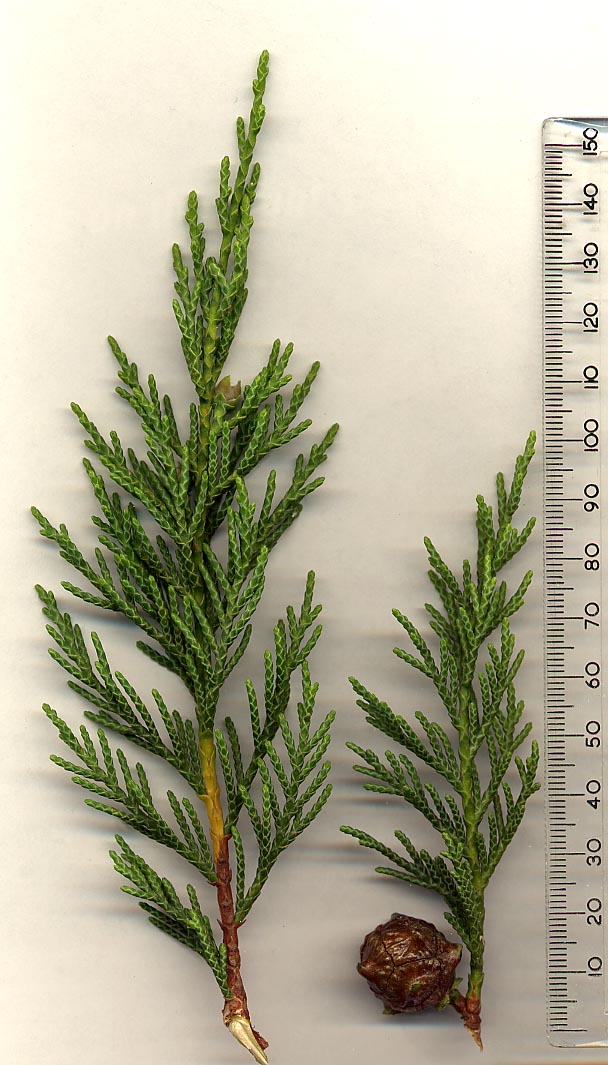
- Small scale leaves pressed close to the shoots, dark to greyish green. The shoots do not form flat sprays but stick out irregularly in all directions; no white markings underneath.
- Bark
- Reddish-brown, with long furrows.
- Cones
- Round cones of 1.5–2 cm with eight scales; you rarely see them on a clipped hedge.
- Difference from Lawson cypress
- Lawson cypress has flat sprays with white X-shaped markings underneath, and a drooping leader.
- Difference from thuja
- Thuja has flat sprays, a fruity scent and elongated cones.
Pruning: May–September
Identify by feature: Scales instead of needles
Looks like it, but isn’t
- Lawson cypress Chamaecyparis lawsoniana: flat sprays with white X-shaped markings underneath, and a drooping leader. Difference from Lawson cypress
- Thuja Thuja: flat sprays, a fruity scent and elongated cones. Difference from thuja
In your garden
Why grow it?
- Grows fast: within a few years you have a tall evergreen hedge or windbreak.
- Dense all year: a nesting site for blackbirds and pigeons.
- Tolerates sun and part shade and almost any soil.
- But be honest with yourself: it needs two or three trims every year, and a native hedge is often the better choice.
Leyland cypress: where does it grow best?
- Sun or part shade; in deep shade it grows thin.
- Almost any soil, from sand to clay, dry or moist.
- A dense crown: next to and under a Leyland hedge it is dry and dark, and little grows.
- As a free-standing tree it grows 20–30 m tall: that fits in no ordinary garden. As a hedge it has to be trimmed every year; also bear in mind the rules on height and distance from the boundary.
- Light
- Sun or partial shade
- Legal basis
- Any garden soil
- Moisture
- Dry to wet
- Size
- 25 m tall, 5 m wide
- Hardiness
- Throughout Belgium, no protection needed
Goes well with
- Yew: A native evergreen alternative that grows more slowly, even in shade, and regrows from old wood too. Be aware: yew is poisonous.
- Hornbeam: A native hedge that stays neat with one or two trims a year and often keeps its dead leaves until spring.
- Holly: A native evergreen hedge with glossy, prickly leaves and red berries for birds.
- Wild privet: A native semi-evergreen hedge with fragrant flowers for bees and black berries for birds.
Good and bad companions
Goes well with
- Tolerate the shade under this tree: oregon grape, rhododendron, oleaster, japanese skimmia, garden privet, camellia, laurustinus, box-leaved honeysuckle
Best kept away from
- Sun-loving plants get too little light under the dense crown: english lavender, heather, butterfly bush, blackthorn, highbush blueberry, sea buckthorn, japanese rose, broom
Maintenance
Leyland cypress: when and how to plant it?
- Plant in April or in September–October, when the soil is warm and moist; choose pot-grown plants.
- For a hedge, 2–3 plants per metre are enough: they close up quickly.
- Don’t plant deeper than in the pot, and water during dry spells for the first two years.
- Consider a native alternative first: yew, holly, hornbeam or a mixed hedge grow more slowly, but stay neat with one or two trims a year.
Care
- Trimming
- Two or three times a year, from May to early September; start in the very first year, so it stays dense and narrow.
- Height
- Cut back the leader as soon as the hedge is 15–30 cm below the height you want: it will then still branch at the top.
- Watering
- In dry spells for the first two years; rarely needed after that.
- Feeding
- Usually not needed: it grows fast enough already.
Tip: If you do opt for Leyland cypress, trim it two or three times a year from the very first year, so it never gets too wide. Or plant a mixed native hedge: it grows more slowly, but needs less work and brings more life to the garden.
Leyland cypress: when to prune it?
Pruning months: May–September.
When: Clip a hedge two or three times a year, from May to early September. Check first that no birds are nesting.
How:
- Always cut into green growth: it won’t regrow from brown, bare wood.
- Keep the hedge wider at the bottom than at the top, so light reaches the base.
- A hedge that is too tall can be reduced in height: the side branches grow over the cut after a few years. Reducing the width is impossible without leaving bare, brown walls.
Caution: Never cut into the brown wood: bare patches stay bare.
Propagation
- Cuttings
- It is a hybrid and is almost always grown from cuttings: take semi-ripe cuttings of 10–15 cm in late summer or autumn and let them root in a cold frame; that takes months.
Leyland cypress: how does it get through the winter?
Hardy throughout Belgium: no protection needed.
- Hardy in Belgium and the Netherlands.
- Wet snow can push a tall, narrow hedge apart: gently shake heavy snow off.
Diseases and pests
- Brown patches in the hedge: Often caused by cypress aphid, which feeds on the shoots in spring. Cut out brown shoots; if there is still some green, the patch slowly fills in again.
- Seiridium canker: Branches suddenly turn brown, with resin and sunken patches on the bark. Cut out affected branches in dry weather, back into healthy wood.
- Bare patches after trimming: If you cut too deep, into the brown wood, you are left with bare patches. Trim more often and less deeply.
- Overgrown hedge: A neglected hedge can never be made narrow again. Often the best solution is to grub it out and replace it with a native hedge.
Through the year
- April: Planting season for pot-grown plants.
- May: First trim; check for nesting birds first.
- June: Hedge trimming possible; watch for brown patches caused by aphids.
- July: A free-standing tree can be pruned; water young hedges in dry spells.
- August: Second trim.
- September: Last trim, by early September at the latest; planting season starts.
- October: Plant pot-grown plants.
Use
What can you use it for?
- Garden and landscape
- Fast-growing evergreen hedge or windbreak.
- For wildlife
- Dense nesting site for blackbirds and pigeons.
Caution: Grows very fast and, left unclipped, becomes a 25 m tree. A neglected hedge can never be made narrow again.
Good for wildlife
- Birds
- Berries, seeds or insects as food, or a place to nest.
You and this species
Did you know?
- A chance cross between the Californian Monterey cypress and the Nootka cypress, which arose in a British park in 1888. It grows up to a metre a year.
- A chance cross between the Monterey cypress and the Nootka cypress, which arose in a British park in 1888. It grows up to a metre a year.
- In Britain, neighbour disputes over overgrown Leyland hedges led in 2003 to legislation on high hedges.
- Because it is almost always grown from cuttings, all plants of one clone are genetically identical.
- The hybrid almost never produces viable seed: practically every Leyland cypress is a clone propagated from cuttings.
- In Britain, overgrown leylandii hedges caused so many neighbour disputes that a law on high hedges was passed in 2003.