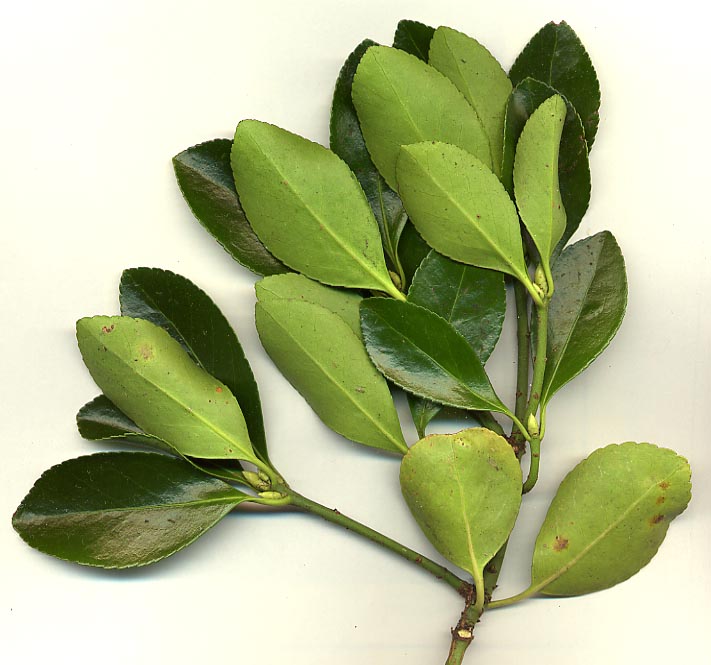
Photo: MPF (talk) (Uploads), CC BY-SA 3.0 · source

Shrub · Spindle family (Celastraceae)
Japanese spindle
Euonymus japonicus · also: Evergreen spindle, Euonymus japonicus
Japanese spindle is an evergreen shrub of 2–4 m with thick, very glossy, scalloped leaves on green twigs. It tolerates sea wind and salt like few other shrubs, which is why it is one of the most widely planted hedging plants on the coast. Variegated forms with a yellow or white leaf edge give colour in winter. It grows in sun and shade, on almost any soil. Like the native spindle, all parts are poisonous.
Caution: All parts are poisonous, including the fruits and seeds, which rarely appear in our climate: they cause vomiting and diarrhoea. Keep young children and pets away and don’t give prunings to livestock. In a sheltered, dry spot it quickly gets powdery mildew.
Light
Sun to shade
not fussy
Moisture
Normal
no wet feet
Legal basis
Any garden soil
any pH
Hardiness
Throughout Belgium
no protection needed
Size
2–4 m
tall
Flowering
June–July
| Pruning months | May–June and August–September |
|---|---|
| Height | 2–4 m |
| Native to Belgium | No, planted |
| Poisonous to people and pets | Yes, take care with children and pets |
| Flowering | June–July |
Identify
Japanese spindle: how do you recognise it?
- Habit
- Dense, upright evergreen shrub of 2–4 m.
- Leaf
- Opposite, 3–7 cm, oval to elliptic, bluntly toothed, thick, leathery and very glossy; often variegated, with a yellow or white edge.
- Twigs
- Green, slightly square twigs.
- Flower
- Inconspicuous, greenish-white flowers in June–July.
- Fruit
- Pink capsules with orange seeds, rare in our climate; poisonous.
- Difference from spindle
- Spindle is deciduous, with thinner, finely toothed leaves and large pink fruits.
- Difference from wintercreeper
- Euonymus fortunei has smaller leaves on creeping or climbing shoots.
Flowering: June–July · Pruning: May–June and August–September
Identify by feature: Evergreen leaves
Looks like it, but isn’t
- Spindle Euonymus europaeus: deciduous, with thinner, finely toothed leaves and large pink fruits. Difference from spindle
- Wintercreeper (Euonymus fortunei): smaller leaves on creeping or climbing shoots.
In your garden
Why grow it?
- An evergreen hedge that tolerates sea wind and salt: ideal on the coast.
- Variegated forms give colour in winter.
- Grows in sun, partial shade and shade, on almost any soil.
- Easy to clip as a hedge or ball.
Japanese spindle: where does it grow best?
- Sun, partial shade or shade; variegated forms colour best in sun.
- Almost any free-draining soil, acid or chalky.
- Ideal on the coast: it tolerates sea wind, salt and sandy soil.
- Better an open, airy spot than a sheltered, dry corner, where it soon gets powdery mildew.
- Light
- Sun to shade
- Legal basis
- Any garden soil
- Moisture
- Normal
- Size
- 3 m tall, 2 m wide
- Hardiness
- Throughout Belgium, no protection needed
Goes well with
- Sea buckthorn: A native coastal shrub with orange berries, for the same windy, salty spot.
- Tamarisk: Pink plumes and feathery foliage: together a windbreak by the sea.
- Escallonia: Another evergreen coastal hedge, with pink or white flowers in summer.
Good and bad companions
Goes well with
- Tolerates shade and suits planting under large trees such as: ginkgo, box elder, ash, honey locust, field maple, silver maple
Maintenance
Japanese spindle: when and how to plant it?
- Plant in spring (April) or early autumn (September–October), root-balled or from a pot.
- For a hedge: 3–4 plants per metre.
- Dig a generous planting hole and mix in a little compost.
- Water generously after planting and in dry spells during the first year.
Care
- Watering
- In dry spells during the first year; rarely after that.
- Feeding
- A little compost in spring.
- Clipping
- Trim a hedge twice a year (see pruning).
- Checks
- In summer, look out for powdery mildew and scale insects (see problems).
Tip: By the sea, plant it as the front line against the wind: in the shelter of a Japanese spindle hedge, more delicate plants can grow too.
Japanese spindle: when to prune it?
Pruning months: May–June and August–September.
When: In May–June and at the end of August.
How:
- Trim a hedge twice a year: in May–June and from late August into September.
- On variegated forms, remove shoots with all-green leaves: they grow more strongly and crowd out the variegated parts.
- It sprouts well from old wood: a hedge that has grown too big or bare can be cut back hard.
Caution: Wear gloves and clear up the prunings: all parts are poisonous, to pets and livestock too.
Propagation
- Cuttings
- Semi-ripe cuttings of 10–15 cm root readily in summer or autumn under glass or plastic.
Japanese spindle: how does it get through the winter?
Hardy throughout Belgium: no protection needed.
- Hardy in Belgium and the Netherlands; on the coast it suffers least.
- In hard frost with cold east winds the leaves may scorch brown, especially on variegated forms and young plants; it sprouts again in spring.
Diseases and pests
- Powdery mildew: A white, powdery coating on the leaves, especially in a sheltered, dry spot. Cut off affected shoots and give it a more airy position.
- Scale insects: Small white and brown scales on twigs and leaves; the leaves turn yellow and drop. Cut off affected branches.
- Green shoots: Variegated forms sometimes produce shoots with all-green leaves. Cut them off at their base.
Through the year
- April: Plant root-balled or pot-grown plants.
- May: First trim.
- June: Trim; greenish-white flowers.
- July: Watch for powdery mildew and scale insects.
- August: Late August: second trim.
- September: Finish the second trim; plant and take cuttings.
- December: Variegated forms give colour in winter.
Use
What can you use it for?
- Garden and landscape
- Evergreen hedge that tolerates sea wind and salt; variegated forms give colour in winter.
Caution: All parts are poisonous. In a sheltered, dry spot it quickly gets powdery mildew.
You and this species
Did you know?
- It tolerates sea wind and salt like few other shrubs: that is why you see it in so many hedges on the coast.
- It is related to our native spindle: after a warm summer it sometimes bears the same pink fruits with orange seeds.