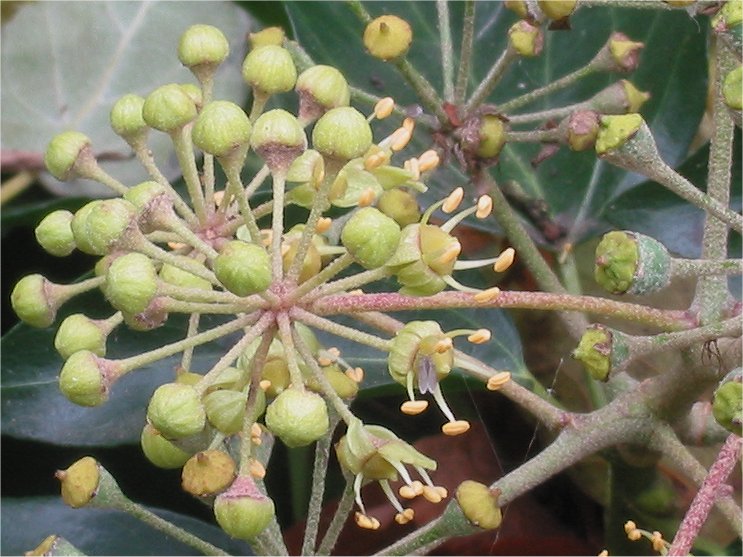
Photo: Rasbak, CC BY-SA 3.0 · source

Climber · Ivy family (Araliaceae)
Common ivy
Hedera helix · also: Ivy, English ivy
Ivy is our only native evergreen climber. With countless short aerial roots it climbs walls, fences and trees unaided to 20–30 m, and in shade it also covers the ground. At the top, where it gets light, it flowers from September to November: a late nectar feast for bees, wasps and butterflies. Bluish-black berries follow in late winter for birds. The berries and leaves are poisonous to people and pets, and the sap can irritate the skin.
Caution: The berries and leaves are poisonous: they cause vomiting and diarrhoea in children, dogs and cats. The sap can irritate the skin: wear gloves when pruning.
Light
Sun to shade
not fussy
Moisture
Dry to wet
not fussy
Legal basis
Any garden soil
any pH
Hardiness
Throughout Belgium
no protection needed
Size
climbs to 20–30 m
tall
Flowering
September–November
| Pruning months | March–April and August–September |
|---|---|
| Height | climbs to 20–30 m |
| Native to Belgium | Yes |
| Good for bees, butterflies and birds | Yes, for bees, butterflies and birds |
| Poisonous to people and pets | Yes, take care with children and pets |
| Flowering | September–November |
Identify
Common ivy: how do you recognise it?
- Habit
- Evergreen climber reaching 20–30 m, or creeping over the ground as ground cover. At the top it forms bushy, flowering shoots without aerial roots.
- Leaf
- Alternate, leathery and glossy dark green; 3–5-lobed on climbing stems, diamond-shaped and unlobed on the flowering shoots at the top.
- Stems
- Stems with countless short aerial roots that it uses to cling on.
- Flower
- Rounded umbels of small yellowish-green flowers in September–November: a late nectar feast for insects.
- Fruit
- Bluish-black berries in late winter; poisonous to people, loved by birds.
- Difference from Virginia creeper
- Virginia creeper loses its leaves and turns bright red in autumn.
Flowering: September–November · Pruning: March–April and August–September
Identify by feature: Black berries · Aerial roots and sucker pads
Looks like it, but isn’t
- Virginia creeper Parthenocissus: loses its leaves and turns bright red in autumn. Difference from Virginia creeper
In your garden
Why grow it?
- Evergreen: a green wall or fence all year round.
- Grows in sun, partial shade and deep shade, on any soil.
- Late flowers for insects, berries for birds in late winter and dense nesting sites.
- Climbs without support: no wires or trellis needed.
- Excellent ground cover under trees, where little else will grow.
Common ivy: where does it grow best?
- Sun, partial shade or deep shade; on a sunny wall the leaves may scorch brown in harsh winters.
- Any soil, dry or moist.
- It climbs with aerial roots and needs no support. On a sound wall with firm mortar it does no harm; in crumbling joints or loose render, the roots widen the cracks.
- Keep it away from gutters, roof tiles, timber cladding and window frames, or cut it back there every year.
- Light
- Sun to shade
- Legal basis
- Any garden soil
- Moisture
- Dry to wet
- Size
- 20 m tall, 3 m wide
- Hardiness
- Throughout Belgium, no protection needed
Goes well with
- Holly: Another native evergreen for shade. The holly blue lays its eggs on holly in spring and on ivy in summer.
- Lesser periwinkle: Together an evergreen ground cover under trees, with blue flowers in spring.
- English oak: Ivy in an old oak provides extra nesting sites and winter food for birds.
Good and bad companions
Goes well with
- Can climb into old, large trees: english oak, scots pine, sycamore, large-leaved lime
Maintenance
Common ivy: when and how to plant it?
- Plant in autumn or spring; from a pot almost all year, except in frost or drought.
- Plant 30–50 cm from the wall and lean the shoots against the wall or a small cane.
- In the first year it grows slowly: keep the soil moist until it has rooted.
- As ground cover: plant every 30–40 cm and weed until the soil is covered.
Care
- Watering
- In dry spells during the first year; after that it rarely needs water.
- Feeding
- Not needed; a little compost if it is slow to get going.
- Upkeep
- Twice a year, cut away shoots around windows, gutters, roof tiles and joints.
- Flowers and berries
- Leave the flowering shoots at the top: they carry the flowers for insects and the berries for birds.
Tip: Be patient: as the saying goes, the first year it sleeps, the second year it creeps and the third year it leaps. After that it grows fast.
Common ivy: when to prune it?
Pruning months: March–April and August–September.
When: In March–April or in late summer (August–September). Check first for nesting birds: they start as early as March.
How:
- Keep gutters, windows and joints clear; cut back hard where it isn’t wanted.
- Trim an ivy-clad wall every year, so it doesn’t get too thick and heavy.
- It’s fine to let ivy grow in a healthy tree: there is no need to cut it out.
Caution: First check that no birds are nesting: blackbirds and wrens nest in ivy from March onwards. Wear gloves: the sap can irritate the skin.
Propagation
- Cuttings
- Cuttings of climbing shoots root easily, in summer or autumn, in a small pot or straight into the ground.
- Layering
- Creeping shoots root by themselves: dig up a rooted shoot and replant it.
- Tree ivy
- A cutting taken from a flowering shoot at the top gives a non-climbing shrublet that does flower and bear berries.
Common ivy: how does it get through the winter?
Hardy throughout Belgium: no protection needed.
- Fully hardy and evergreen.
- The berries ripen in late winter, when food is scarce: woodpigeons, blackbirds, thrushes and blackcaps love them.
- Leaves that turn brown in hard frost on a sunny wall are replaced in spring.
Diseases and pests
- Leaf spot: Brown to black spots with a yellow edge, especially in wet summers; a bacterium. Cut out affected shoots.
- Scale insects: Small brown scales on stems and leaves, especially in sheltered, dry spots. Cut out the worst shoots; parasitic wasps and ladybirds do the rest.
- Roots in joints: Aerial roots in crumbling mortar or render. Cut the stems at the base, let them die off for a few weeks, then pull them away, brush off the remains and repoint.
Through the year
- February: The berries ripen: food for blackbirds, thrushes and woodpigeons.
- March: Pruning, as long as no birds are nesting; planting.
- April: Pruning, after checking for nests; the last berries.
- May: Nesting season: leave the ivy alone.
- August: Late-summer pruning: clear gutters, windows and joints.
- September: Last pruning; flowering begins.
- October: Flowering: ivy bees, wasps and butterflies on the flowers.
- November: Last flowers; planting.
Use
What can you use it for?
- Garden and landscape
- Evergreen cover for walls, fences and shady corners; also as ground cover.
- For wildlife
- A top plant: late flowers for insects, berries for birds in winter and dense nesting sites.
Caution: The berries and leaves are poisonous; the sap can irritate the skin.
Good for wildlife
- Bees
- Nectar and pollen for honeybees and wild bees.
- Birds
- Berries, seeds or insects as food, or a place to nest.
- Hoverflies
- Open flowers for hoverflies; many of their larvae eat aphids.
- Butterflies
- Nectar for butterflies.
- Moths
- Nectar for moths, often from flowers that are scented in the evening.
You and this species
Did you know?
- Ivy is not a parasite: it only uses a tree for support and does no harm to a healthy tree.
- The ivy bee only flies in September–October and collects pollen almost exclusively from ivy flowers.
- Brimstone butterflies often spend the winter among the evergreen leaves of ivy.
- The ivy bee, a wild bee that collects pollen almost exclusively from ivy, has been spreading through Belgium and the Netherlands in recent decades.
- In antiquity, ivy was sacred to Bacchus, the god of wine, who is often depicted wearing a wreath of ivy leaves.